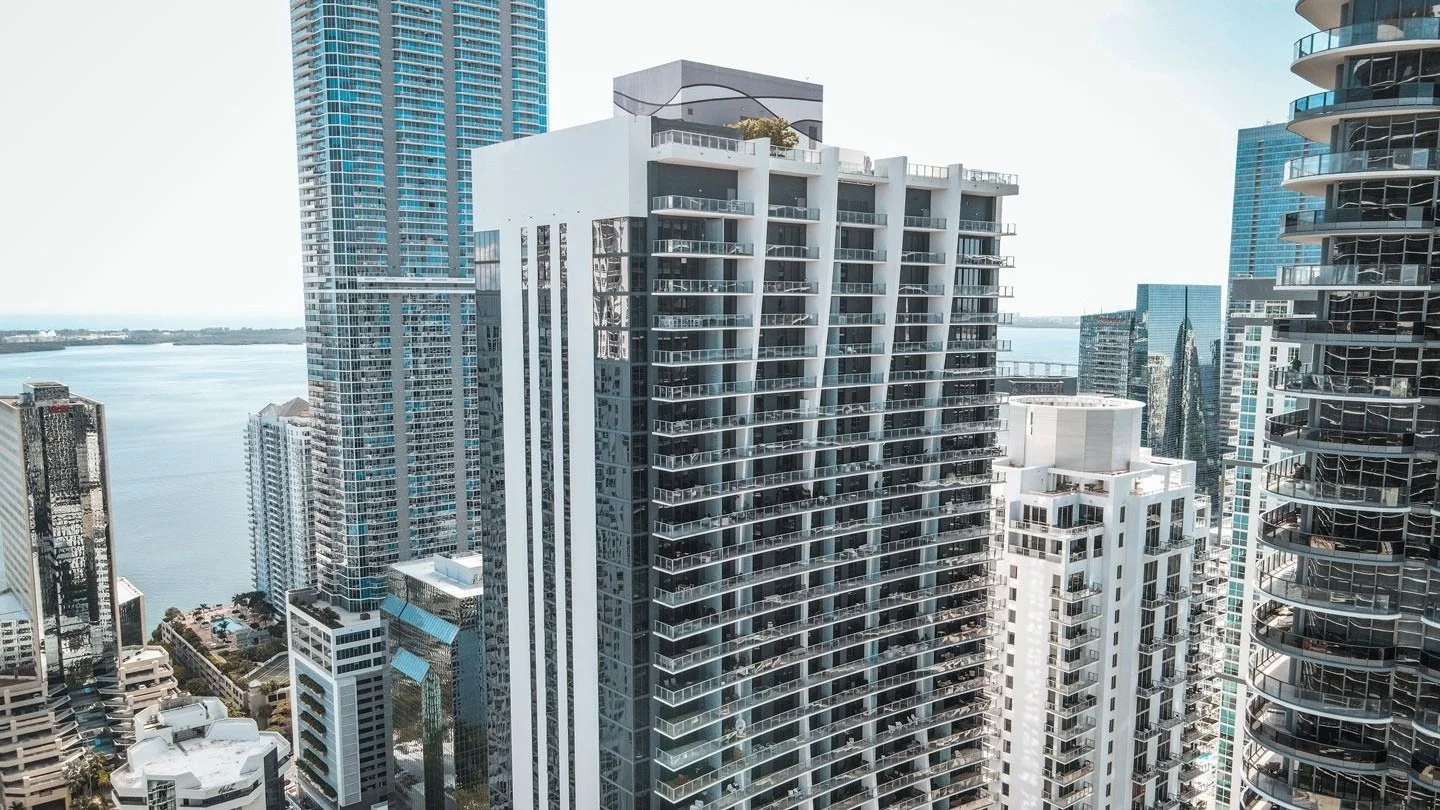
Quick answer: This is a 50-floor tower of small residences with a six-month minimum lease. Those two facts pull against each other. Studios from about 633 square feet are the units buyers most often purchase expecting flexibility, and here there is none: no monthly letting, no seasonal tenant, one lease a year at best. Add dues assessed on area at roughly 0.93 dollars per square foot on a studio, and the arithmetic is the whole decision.
A six-month floor in a building of small units
Across the buildings covered on this site, a six-month minimum is common. What is less common is finding it on stock this small.
| Building | Minimum lease | Typical unit |
|---|---|---|
| 1010 Brickell | six months | studios and one-beds from 633 sq ft |
| Echo Brickell | six months | large residences |
| Quantum on the Bay | six months | mixed |
| SLS Brickell | 30 days | mixed |
| Brickell Flatiron | see declaration | mixed |
A 633 square foot studio is the archetypal flexible-letting purchase: small ticket, urban location, easy to furnish. Buyers reach for exactly this product intending monthly or seasonal letting, and at this address that intention fails at the declaration.
What remains is an annual tenancy to a single occupant, competing against a deep and price-sensitive Brickell studio market. That is a coherent long-hold position at a modest entry price. It is not a yield story, and it offers no route to the higher rates a 30-day rule would unlock.
Confirm the clause in the recorded declaration with all amendments before assuming any part of this.
The dues arithmetic on a small unit
Dues here are assessed on floor area, and a studio sits near 588 dollars a month.
| Residence | Approximate area | Monthly dues at that rate | Annual |
|---|---|---|---|
| Studio | 633 sq ft | about 588 USD | about 7,050 USD |
| One bedroom | 900 sq ft | about 840 USD | about 10,100 USD |
| Two bedroom | 1,300 sq ft | about 1,210 USD | about 14,500 USD |
| Three bedroom | 2,170 sq ft | about 2,020 USD | about 24,200 USD |
Those are illustrative extensions of the studio rate, not quoted figures: get the actual schedule from the association for the specific unit.
The point is the ratio rather than the absolute number. At roughly 0.93 dollars per square foot, a studio carries dues that are high relative to its rent, because the amenity programme, the staff and the master insurance divide by residence and by area rather than by how much of the building you use. Small units in amenity-rich towers always carry this penalty, and it is the line that most often turns a plausible yield into a thin one.
Rebuild the figure before comparing with any other building: ask what the dues include, and add back the services another building bills separately. See 1428 Brickell and Brickell Heights for the neighbouring comparison.
What 387 residences means
| Effect | Consequence |
|---|---|
| Fixed costs divide across 387 owners | dues per foot sit above a very large tower’s |
| Standing supply is real but not vast | some pricing discipline, no pricing power |
| An assessment divides 387 ways | smaller per owner than a boutique, larger than a 700-unit tower |
| Comparable set is workable | enough trades to price a studio properly |
This is a mid-density building, and the practical consequence is that comparables exist. Ask for every trade in the building over the last 24 months by unit type rather than the closest three, and for achieved rents by unit type over a full year. In a building of near-identical studios, that data is genuinely predictive.
Who rents a Brickell studio for a year
The six-month floor decides the tenant, so it is worth naming who that is. Annual studio tenancies in Brickell go overwhelmingly to single professionals working in the financial and legal offices within walking distance, and to people relocating who take a small unit for a first year.
That pool is deep, which is the good news: a correctly priced studio here does not sit empty for long. It is also highly price-aware and highly comparable, because the tenant is choosing between dozens of near-identical units within a few blocks. There is no scarcity to price against.
Three consequences for an owner. Rent is set by the building and the block, not by your finishes. Turnover is annual and predictable, so budget one void period and one make-good every year. And the parking space matters more than the view to this tenant, so establish whether the unit conveys one before assuming it does.
A 2017 building, so the reserve study is the document
A 2017 completion places the first milestone inspection near 2042 under the 25-year coastal trigger, repeating every 10 years, comfortably outside a normal hold.
What is live:
| Document | What it answers |
|---|---|
| Structural integrity reserve study | expected component costs, applies regardless of age |
| Reserve funding percentage | how much is already collected |
| 3 years of dues split into reserves and insurance | whether the board funds or defers |
| Assessment history and board minutes, 24 months | what has been levied, is pending or discussed |
Coastal Miami master policies have repriced every year since 2022 and sit inside the dues. On a building whose owners are heavily weighted toward small units, a large premium increase lands hard on the people least able to absorb it, which is worth knowing about the board you are joining. See the Florida property insurance guide.
Financing
Two project-level tests apply. Reserve funding, on every questionnaire since 2021. And investor concentration, which in a building dominated by studios and one-bedrooms is usually the number under pressure, because small units attract landlords.
Obtain a written project eligibility determination before offering. Where a project is non-warrantable the conventional thirty-year loan is unavailable building-wide, leaving cash, portfolio lending or a DSCR loan underwritten on rent at a larger deposit. Overseas buyers work through foreign national mortgage programmes. For the wider market see the Brickell area page.
The annual carry, built properly
For a let studio, the dues are one of five lines:
- Association dues, near 588 dollars a month on a studio.
- Miami-Dade property tax on the actual assessed value, without homestead.
- An owner’s HO-6 policy covering the interior and liability.
- Management, where used.
- Vacancy between annual tenancies.
Build all five before deciding what the unit yields. A rent figure set against dues alone will overstate the return by a wide margin, and on a small unit the fixed lines are a larger share of rent than most buyers expect.
Verification checklist before you wire
- Confirm the six-month minimum in the recorded declaration with amendments.
- Get the actual dues schedule for the specific unit, not a building average.
- Request 3 years of dues history split into reserve contribution and insurance premium.
- Get the structural integrity reserve study and the current funding percentage.
- Ask about assessments levied, pending or discussed in the last 24 months.
- Ask for every trade in the building over 24 months, by unit type.
- Ask for achieved rents by unit type over a full year, not asking rates.
- Obtain a written lender project eligibility determination addressing investor concentration.
- Build the annual carry from all five lines before judging the yield.
Which buyer this building suits
It suits a long-hold owner or an owner-occupier who wants a well-located Brickell address at a modest entry price, will let annually if at all, and has priced the dues against the unit’s actual rent rather than against its purchase price.
It suits a flexible-letting buyer poorly, and that is worth saying plainly because the product looks like it should serve them. A small furnished unit in a walkable urban core is exactly what a 30-day letting model wants, and this declaration does not allow it. Buyers wanting that should look at the 30-day buildings in this series instead.
Frequently Asked Questions
Six months. That is the strict tier and it rules out monthly and seasonal letting entirely, which matters more here than at most buildings because a large share of the stock is studios and one-bedrooms, the sizes whose owners most often assume flexibility.
Fifty floors and 548 feet at 1010 Brickell Avenue, with about 387 residences from studios to three bedrooms, ranging roughly 633 to 2,170 interior square feet. Completed in 2017, developed by Key International with architecture by Sieger Suarez.
Dues are assessed on floor area, and a studio sits near 588 dollars a month. On a 633 square foot studio that is close to 0.93 dollars per square foot, which is a heavy figure for a small unit and reflects an amenity programme spread across only 387 owners. Confirm the current schedule and 3 years of history from the association.
A 2017 completion places the first milestone inspection near 2042 under the 25-year coastal trigger, repeating every 10 years, so it falls outside a normal hold. The live document is the structural integrity reserve study and the funding percentage it produces.
It is an annual-tenancy asset, not a flexible one. With a six-month floor the only model available is a long tenancy, and the tenant pool for a 633 square foot studio in Brickell is deep but price-sensitive. Underwrite from achieved rents inside the building rather than from asking rates.
Amenity space is staffed, cooled, insured and maintained out of the dues, and 1010 Brickell carries an unusually broad programme for a building of 387 residences. That ratio, rather than the finish level of any single unit, is what sets the dues per square foot you will pay every month.
Get the dues schedule and achieved rents at 1010 Brickell
Tell us which unit type you are considering. We will come back with the actual dues for that unit, 3 years of history split into reserves and insurance, the reserve funding percentage, every trade in the building over 24 months by unit type, and achieved rents rather than asking rates.