Quick answer: Ninety-six owners. That is the number this purchase turns on, not the architecture. The building was completed in 1982, so its milestone inspection deadline has passed and a report exists. A finding that costs a 500-unit tower a modest sum per owner costs this one several times more, because the arithmetic divides by 96. Get the report and the funding percentage before you look at anything else.
Ninety-six is the whole story
Every building covered on this site divides its costs across its owners. Here the denominator is unusually small, and on a 1982 building that has already been inspected it is the dominant fact.
| Building | Completed | Residences | A 2,000,000 USD remedy costs each owner |
|---|---|---|---|
| Atlantis on Brickell | 1982 | about 96 | about 20,800 USD |
| Tower 41 | 1972 | about 420 | about 4,800 USD |
| 50 Biscayne | 2007 | about 523 | about 3,800 USD |
| Marina Blue | 2007 | about 516 | about 3,900 USD |
That illustration uses one round figure across four buildings to isolate the effect of scale; the actual cost at any of them depends on what its own engineer found. The point is the ratio. The same finding is four to five times more expensive per owner here.
That is not a reason to avoid small buildings. Small associations are frequently better run, better maintained and easier to hold to account than a 500-owner tower where nobody attends a meeting. It is a reason that the reserve funding percentage matters more here than anywhere else on this site, because there is no crowd to spread a surprise across.
The report exists, so read it
A 1982 completion puts this building past the 25-year coastal trigger by decades. Buildings already past the threshold when the statute took effect had until 31 December 2024 to complete the initial inspection, and the repeat interval is 10 years.
| Document | What it tells you |
|---|---|
| Completed phase one milestone inspection report | what the engineer found |
| Phase two findings, if one was required | how serious it was |
| Board resolution on those findings | the plan, the timing, the cost |
| Structural integrity reserve study | the wider component schedule |
| Reserve funding percentage | whether the remedy is paid for |
| Assessments levied, pending or discussed in 24 months | what is already in motion, with minutes |
With 96 owners, that last line is where a purchase is won or lost. An assessment already discussed at board level and not yet levied is a cost you inherit, and at this denominator it is a large one.
Architecture is a resale asset, not a maintenance fund
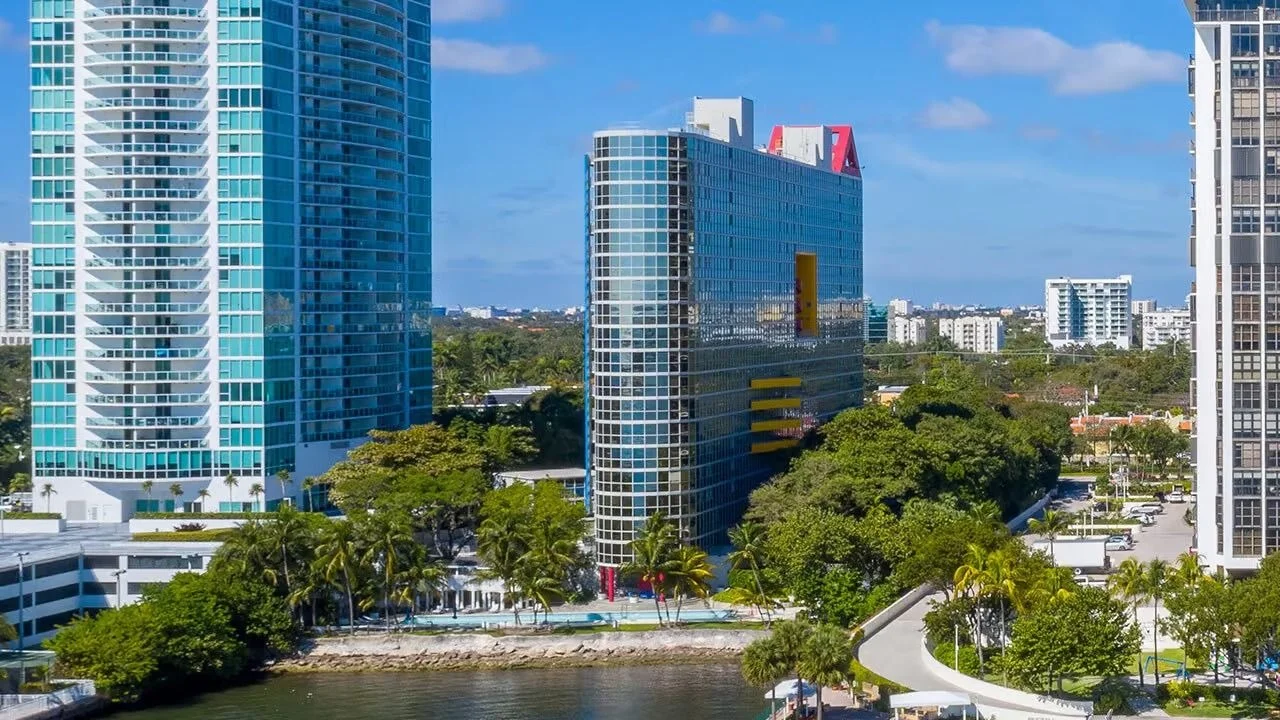
The building is a genuine landmark. Arquitectonica’s five-storey open court, cut clean through the facade with a red spiral staircase and a palm tree, made it one of the most recognised silhouettes in Miami and it has stayed that way for four decades.
That is worth something real at resale. Buyers seek this building by name, which shortens marketing and widens the pool that finds it. Very few 1982 condominiums have that.
It is worth nothing at all toward a roof, a riser or a waterproofing remedy, and a distinctive facade with a large cut-out is a more complex envelope to maintain than a plain one. Ask specifically what the reserve study allocates to the exterior envelope and the court structure, because that is where this building’s architecture becomes a line item.
What a 1982 building has already used up
Forty-four years in, essentially every original system is beyond its first cycle. Ask what has been replaced and when, with permits:
- Roof and waterproofing.
- Plumbing risers, which on stock of this era drive claims and assessments.
- Electrical distribution.
- Lifts, a substantial line even on 20 storeys.
- Glazing, sealants and the court structure, given the exposed elevation.
A building that has completed its inspection, funded the finding and replaced its risers is a defensible purchase at any age. One that has done none of it, with 96 owners to carry the bill, is a different proposition at the same asking price.
Coastal master policies have repriced every year since 2022 and sit inside the dues. With only 96 owners, a given premium rise moves each owner’s dues considerably more than at a large tower. Ask for the master premium as a separate figure for each of the last three years. See the Florida property insurance guide.
The pet rule works in a landlord’s favour here
Reported rules permit one pet per residence for owners and tenants alike, with a weight limit near 20 pounds.
That is worth flagging because this site has documented the opposite arrangement twice, at Neo Vertika and Courvoisier Courts, where tenants are excluded entirely. A tenant-inclusive pet policy keeps a large share of the rental market in play, which shows up as more enquiries, shorter voids and firmer achieved rent.
The weight limit still filters, and one pet per residence is a real cap. Confirm the current rule in the recorded declaration and association rules, since pet policies are amended more often than letting clauses. See the HOA and association restrictions checklist.
Read the letting rule from the document
The letting terms are not reliably reported by listings for a building of this age. Read the recorded declaration with all amendments and establish:
- The minimum lease term.
- Any annual cap on lettings.
- Any waiting period after purchase before letting is permitted at all.
That third item is common in older Brickell associations and is the one that most often surprises an investor. With two and three bedroom residences only, the tenant here is a household rather than a single occupant, so underwrite from achieved rents by unit type inside the building rather than from Brickell studio averages.
Financing a 1982 building
Reserve funding is the test under real pressure, and on a small association with a completed inspection a lender will want to see both the finding and how it is funded. Investor concentration is the second, and at 96 residences a handful of let units moves the percentage sharply.
Obtain a written project eligibility determination before offering. Where a project is non-warrantable the conventional thirty-year loan is unavailable building-wide, leaving cash, portfolio lending or a DSCR loan underwritten on rent. Overseas buyers work through foreign national mortgage programmes. For the surrounding market see Santa Maria and the Brickell area page.
Verification checklist before you wire
- Get the completed milestone inspection report and any phase two findings.
- Get the board resolution, with dates and amounts.
- Get the structural integrity reserve study and the current funding percentage.
- Ask about assessments levied, pending or discussed in 24 months, with minutes.
- Ask what the reserve study allocates to the exterior envelope and the court structure.
- Get the permit history for roof, risers, electrical, lifts and glazing.
- Request 3 years of master insurance premium as a separate figure.
- Read the letting term, annual cap and any waiting period from the declaration.
- Confirm the pet rule for tenants in the declaration and association rules.
- Obtain a written lender project eligibility determination.
Which buyer this building suits
It suits an owner-occupier who wants something genuinely singular on Brickell Avenue, values a small, quiet, well-governed association, and is prepared to underwrite a completed inspection with documents. A landmark building with 96 owners and a funded reserve is a rare and defensible thing to own.
It suits a buyer who wants to skip the reserve conversation least of all. Ninety-six owners is a small denominator and a 1982 envelope is a real maintenance obligation, so the funding percentage here carries more weight than at any large tower on this site. Ask for it first, and let the architecture be the reason you buy rather than the reason you stop reading.
Frequently Asked Questions
About 96, in a 20-storey building of 223 feet at 2025 Brickell Avenue, in two and three bedroom layouts. That is the smallest owner count of any building covered on this site, and it is the fact that governs the purchase: every shared cost and every assessment divides across 96 owners rather than several hundred.
It has passed. Construction ran from 1980 to 1982, so the building crossed the 25-year coastal trigger long ago, and buildings already past the threshold had until 31 December 2024 to complete the initial inspection, repeating every 10 years. Ask for the completed report rather than a date.
Yes. Reported rules permit one pet per residence for owners and renters alike, with a weight limit near 20 pounds. That is more permissive than several buildings covered on this site where tenants are excluded entirely, and it widens the pool of tenants available for a letting.
The letting terms must be read from the recorded declaration with amendments rather than taken from a listing. Establish the minimum lease term, any annual cap, and any waiting period after purchase before underwriting rent, because older Brickell associations commonly impose all three.
It was designed by Arquitectonica and completed in 1982, and its five-storey open palm court cut through the middle of the facade, with a red spiral staircase and a palm tree, made it one of the most recognisable buildings on the Miami skyline. Architectural standing helps resale demand and does not pay for a roof.
For assessment exposure, yes. A remedy costing a fixed sum divides across 96 owners here against 420 or 520 at the large towers covered elsewhere on this site, so the per-owner figure is several times higher. Against that, small buildings are quieter, easier to govern and often better maintained. The reserve funding percentage tells you which case you are in.
Get the inspection report and funding percentage at Atlantis
Tell us which residence you are considering. We will come back with the completed milestone report and any phase two findings, the board resolution and assessment history, the reserve study with what it allocates to the envelope and court, the permit history, and the recorded letting and pet clauses.