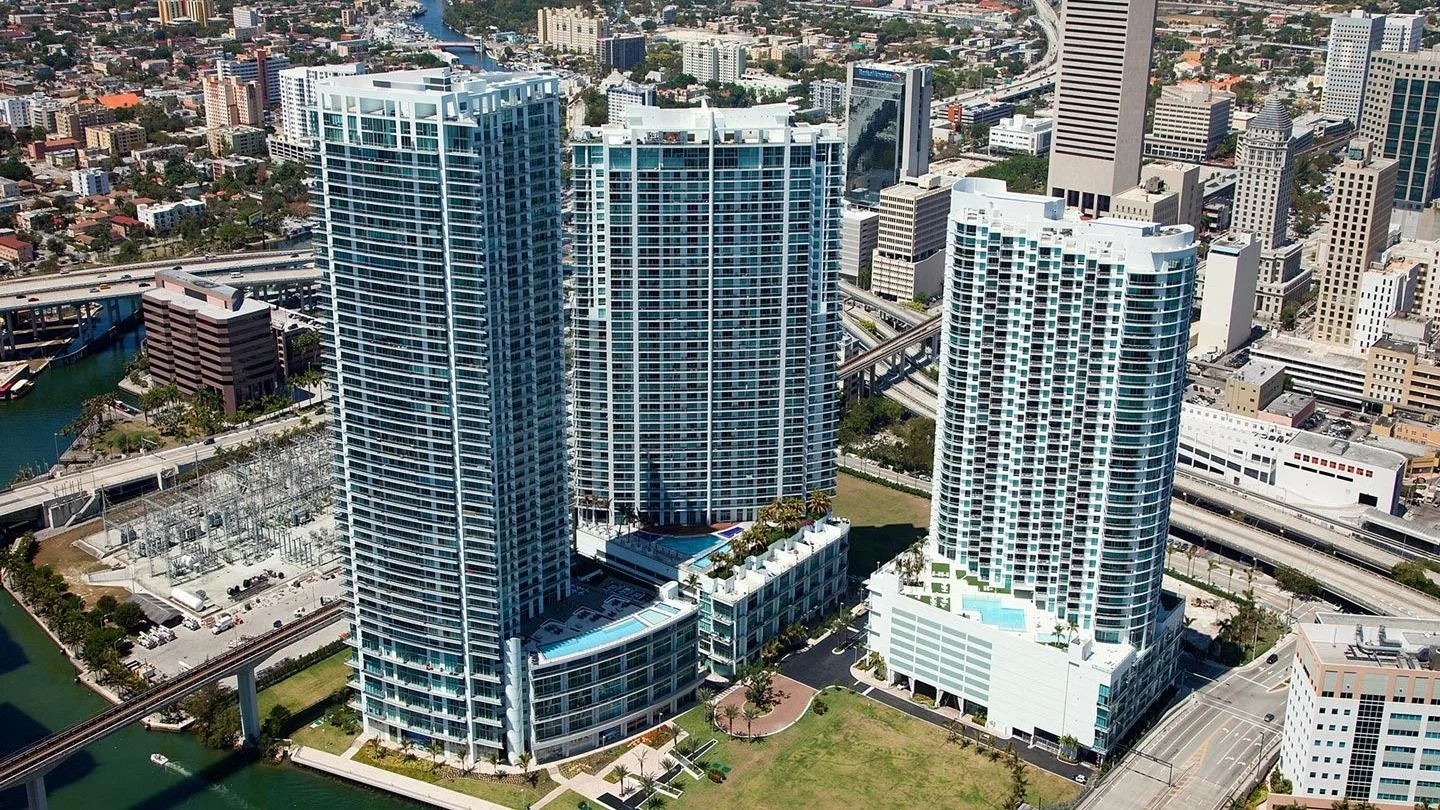
Quick answer: Waterfront is treated as one category and priced as one. A river is not a bay, and the differences run through flood cover, insurance, the character of the frontage and what gets built on the opposite bank.
The published record on this building is unusually inconsistent, which is itself the first thing a buyer should resolve.
The tower in outline
| Detail | |
|---|---|
| Address | 92 SW 3rd Street, Downtown Miami |
| Frontage | North bank of the Miami River |
| Completed | between 2008 and 2010, depending on source |
| Storeys | between 52 and 56, depending on source |
| Residences | around 527 to 530 |
| Structural review due | about 2033 to 2035 |
We do not resolve those ranges here because we cannot verify them from any source we would be willing to cite. The declaration and the certificate of occupancy settle all three, and the completion date in particular determines the inspection deadline.
Flood is a separate question from wind
Florida buyers learn to ask about hurricane cover and frequently stop there. On any waterway site the flood question is distinct, differently underwritten and differently priced.
| Windstorm | Flood | |
|---|---|---|
| What drives it | Construction, opening protection, roof, exposure | Elevation, flood zone, proximity to the water source |
| Who writes it | Property insurers, or the state-backed insurer | The federal programme, or private flood insurers |
| What the association carries | Master policy | A separate master flood policy, if one exists |
| What the owner carries | Contents and interior | Separate flood cover, often required by a lender |
The specific questions on a river site are: what flood zone the parcel sits in, what the base flood elevation is relative to the building’s lowest occupied and mechanical levels, whether the association carries master flood cover and to what limit, and what a lender will require of an individual buyer.
Ask them separately from the windstorm questions, because they are answered by different documents. Our property insurance costs guide covers the wider market, and our Hillsborough flood insurance update shows how the flood side has moved for Florida owners generally.
The Miami River is a working waterway
This is the part that is visible on a viewing and rarely thought through.
The river carries commercial vessel traffic. Sections of its banks are in marine industrial and commercial use: shipping terminals, boatyards, and the operations that go with them. Bridges along its length open for vessels, which affects road traffic on a schedule nobody controls.
| Consequence | What it means for an owner |
|---|---|
| Vessel and yard activity | Noise and movement at hours a residential street does not have |
| Bridge openings | Journey times that vary with marine traffic |
| Industrial land use nearby | Different neighbours from a bay or beach address |
| Redevelopment pressure on the banks | The view and the surroundings change over a holding period |
None of that is a reason to avoid the address. It is the reason the frontage costs less than bay frontage, and a buyer who wants water and skyline at a downtown price is making a rational trade. The mistake is making it without knowing, then discovering the working river after closing.
The last row cuts both ways and deserves attention. River banks in Miami have been under sustained redevelopment pressure, and what stands opposite a unit today may not stand there in ten years. That can improve an outlook or remove it. Establish what is permitted on the opposite bank before you buy a view.
Why the inconsistent record matters more than it looks
It is worth pausing on the fact that four basic attributes of this building (its completion year, its height, its unit count and even the street type in its address) appear differently across published sources.
That is not unusual in Miami condominium listings, and it is more consequential here than in most cases because one of those attributes sets a statutory deadline. A 2008 completion and a 2010 completion produce inspection deadlines two years apart, and two years is the difference between a question that falls inside a five-year hold and one that does not.
The resolution is simple and it is not something a buyer should delegate to a listing:
| Question | Where the answer actually lives |
|---|---|
| Completion date | The certificate of occupancy |
| Residence count | The declaration of condominium |
| Storey count | The declaration, or the approved plans |
| What is a common element | The declaration |
Anyone selling a unit should be able to produce the declaration without difficulty; it is the document that created their ownership. An agent who cannot say which of the published figures is correct has not read it, which tells you something about the rest of what they are telling you.
Dividing the costs
| Capital spend of | Per residence, across about 530 |
|---|---|
| A $1m programme | $1,900 each |
| A $3m programme | $5,700 each |
| A $5m programme | $9,400 each |
Illustrative amounts divided by the higher published residence count.
A base above five hundred is among the widest in this collection and it is a genuine advantage: capital work divides efficiently and the building produces enough transactions each year for pricing to be observable. Set against that is the internal competition that every large tower carries at letting time, which we set out in our Aria on the Bay review.
The building also carries the financial history of its cohort. Whether it completed in 2008 or 2010, it was delivered into or immediately after the worst residential market in decades, which shaped its early budgets and possibly its ownership. Both are readable: the budget sequence by the method in our Infinity at Brickell review, and the ownership by the records search in our Marquis Miami review.
The document list
- The certificate of occupancy date, which settles the inspection deadline.
- The flood zone, base flood elevation, and the association’s master flood cover and limit.
- The windstorm declarations page, deductible and allocation clause.
- The last five to eight annual budgets, and the reserve funding percentage.
- A county records check on ownership concentration.
- What is permitted or under construction on the opposite bank.
The first two are specific to this building and this frontage. The remainder is the standard file for a late-cycle tower, and none of it substitutes for settling the completion date, because that one answer moves the deadline everything else is measured against.
What works and what does not
Advantages. Water and skyline outlook at a downtown price rather than a bayfront one. A large owner base that divides capital costs efficiently. Post-2005-code construction with a structural review still years away. And genuine transaction depth, which makes both pricing and exit legible.
Disadvantages. Flood is a separate and material question on a river site. The working waterway brings noise, marine activity and bridge openings. Redevelopment on the banks can change the outlook in either direction. And the published record on this building is inconsistent enough that a buyer must verify its basic facts rather than rely on listings.
Where to walk away
- A completion date, storey count or unit count quoted from a listing without the declaration behind it.
- No flood zone or base flood elevation offered.
- No master flood cover, or cover whose limit nobody can state.
- Flat dues across the years when Florida insurance repriced.
- A view sold without reference to what is permitted opposite.
Our reading: a large, well-located building whose two genuine questions are both about water and neither is the one buyers usually ask. Settle the flood position and the completion date first; everything after that is ordinary due diligence on a late-cycle tower.
For a large Edgewater tower and its letting economics, see our Opera Tower review. For how to check who owns a late-cycle building, see our Marquis Miami review.
Frequently Asked Questions
At 92 SW 3rd Street in Downtown Miami, on the north bank of the Miami River. Published sources give completion dates between 2008 and 2010, storey counts between 52 and 56, and around 527 to 530 residences.
Flood exposure, first. A river has a defined channel, upstream drainage and structures that control it, so its flood behaviour differs from open bay frontage. Insurance follows the flood zone, not the view.
The Miami River is a working waterway with marine industrial and commercial use along parts of its length, and bridges that open for vessel traffic. Both affect the day-to-day experience and the pattern of development on the banks.
Not necessarily. Working-river frontage is cheaper than bay frontage for reasons that are visible and stable, and the water and skyline outlook is real. It is a different product that needs pricing as one.
Between about 2033 and 2035, depending on which published completion date is correct. That has to be settled from the certificate of occupancy.
Sources: address and river frontage from Downtown Miami condominium market records for Mint at Riverfront. Published completion dates range from 2008 to 2010, storey counts from 52 to 56, and residence counts from about 527 to 530; all three ranges are reported rather than a single figure asserted, and the inspection window follows from the date range. The description of the Miami River as a working waterway with marine industrial use and opening bridges is general public knowledge of the river rather than a survey of this site’s immediate surroundings.
Settle the flood position first
Send a unit at Mint or any Miami River building. We establish the flood zone, the master cover and the completion date before you offer.