Quick answer: Park Shore Naples delivers 1.5-3.8% net yield depending on seasonal versus annual lease strategy. Entry from approximately $550,000 for a one-bedroom bayfront condo. Peak snowbird rents from November through April can lift effective yield above flat LTR underwriting.
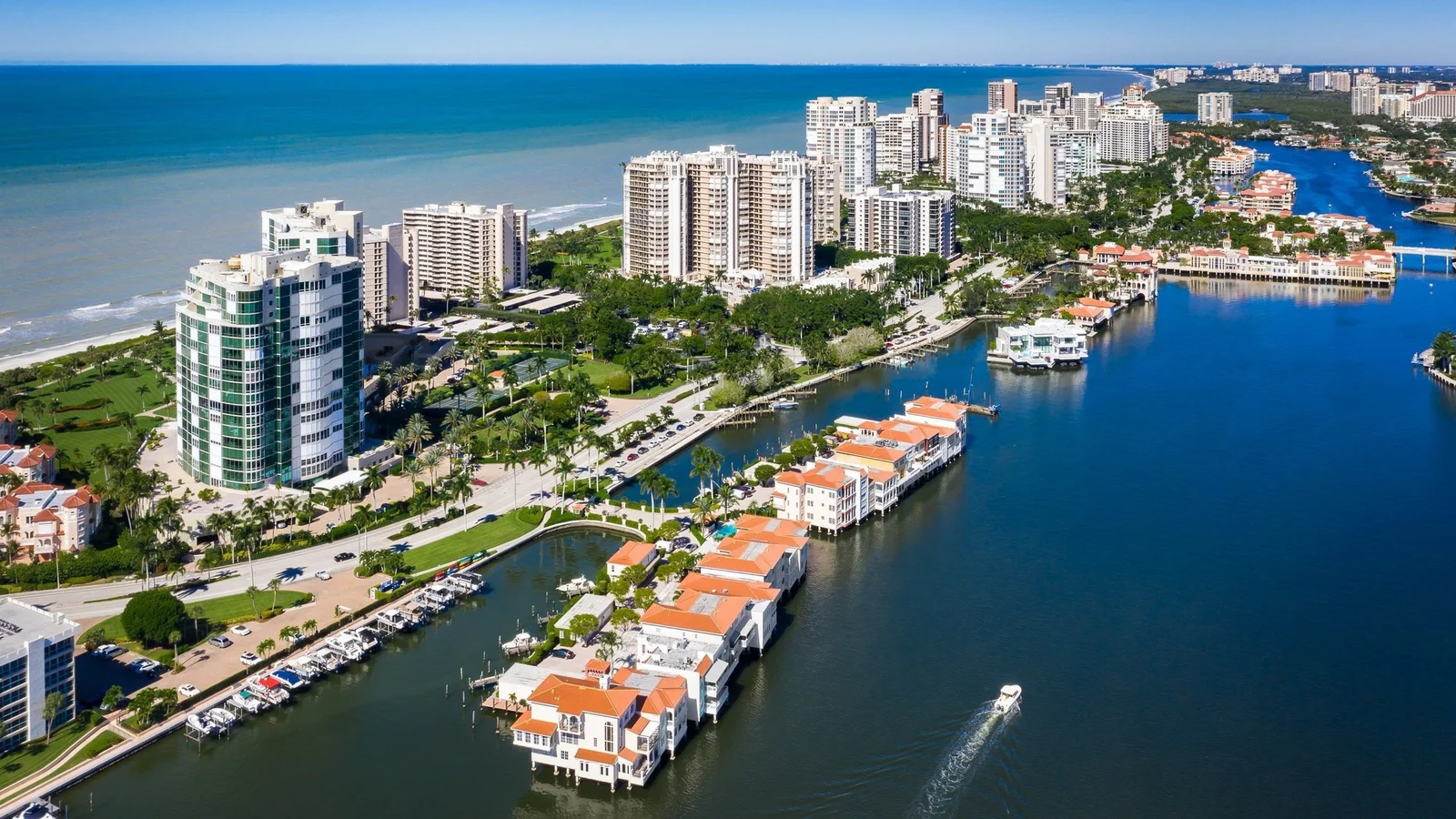
Park Shore occupies the most desirable bayfront corridor in Naples, a strip of luxury high-rise and mid-rise condominiums between the Venetian Bay and the Gulf of Mexico, walking distance to the Naples Pier, Third Street South, and Fifth Avenue South dining. For seasonal luxury investors, Park Shore represents Collier County’s answer to Miami Beach’s South of Fifth: trophy addresses, snowbird demand, and a rental calendar that peaks when Midwest and Northeast winter drives Gulf Coast occupancy above 85%.
Unlike Tampa Bay’s long-term rental cash-flow machines or Miami’s international finance-tenant profile, Park Shore generates income from a seasonal calendar, November through April snowbird occupancy at furnished rates that can triple off-season monthly equivalents. Investors who underwrite only annual long-term rent on a $725,000 bayfront condo will underestimate what the same unit earns when leased furnished from January to March at $12,000-$15,000 per month.
This review models net yields across seasonal and annual scenarios, explains HOA rental rules, and assesses insurance and flood costs that define Southwest Florida luxury coastal economics.
For broader Naples context, see our Naples area investment guide. For yield comparison, read the Florida rental yield guide.
Investment Review building stock and park shore boundaries
Park Shore investment inventory concentrates in bayfront and beach-access towers along Gulf Shore Boulevard and Park Shore Drive.
| Building tier | Typical era | One-bedroom entry | Two-bedroom entry | Seasonal appeal |
|---|---|---|---|---|
| Ultra-luxury bayfront high-rise | 1990-2010 | $650,000-$950,000 | $850,000-$1.4M | Highest peak rents |
| Mid-rise bay view | 2000-2018 | $550,000-$750,000 | $700,000-$1.0M | Strong seasonal |
| Beach-access boutique | 2010-2024 | $500,000-$680,000 | $650,000-$900,000 | Good seasonal |
| Venetian Bay inland | 1995-2010 | $450,000-$600,000 | $580,000-$780,000 | Moderate seasonal |
Investment recommendation: Mid-rise bay-view two-bedroom units in 2000-2018 vintage deliver the best seasonal-yield-to-entry-price balance. Ultra-luxury high-rises command peak rents but compress net yield through higher HOA and insurance. Inland Venetian Bay units offer lower entry but lack the beach-access premium that drives snowbird pricing.
Investment resale prices in Q2 2026
Park Shore resale prices reflect Collier County’s luxury tier positioning.
| Unit type | Size range (sq ft) | Price range (Q2 2026) | Price per sq ft |
|---|---|---|---|
| 1 bedroom | 900-1,200 | $550,000-$780,000 | $580-$680 |
| 2 bedroom | 1,400-2,000 | $725,000-$1,200,000 | $550-$650 |
| 2 bed + den | 1,800-2,400 | $950,000-$1,500,000 | $560-$640 |
| 3 bedroom / penthouse | 2,500-4,000 | $1,400,000-$3,500,000 | $600-$900 |
Park Shore trades at a 10-20% premium over North Naples and Vanderbilt Beach, justified by bayfront access, walkability to Fifth Avenue, and established snowbird demand.
Investment Review net rental yield model: seasonal vs annual
The following model uses a representative two-bedroom bayfront condo at $725,000 purchase price (1,650 sq ft, 8th floor, bay view).
Scenario A: Long-Term Annual Lease
| Cost line | Conservative | Base case | Optimistic |
|---|---|---|---|
| Monthly rent (annual LTR) | $4,200 | $4,600 | $5,000 |
| Annual gross rent | $50,400 | $55,200 | $60,000 |
| Vacancy (8% / 5% / 3%) | −$4,032 | −$2,760 | −$1,800 |
| Effective gross income | $46,368 | $52,440 | $58,200 |
| Property management (12% / 10% / 8%) | −$5,564 | −$5,244 | −$4,656 |
| Property tax (non-homestead ~0.9%) | −$6,525 | −$6,525 | −$6,525 |
| Insurance (wind + flood) | −$7,500 | −$6,800 | −$6,000 |
| HOA fees ($900/mo avg) | −$10,800 | −$10,800 | −$10,800 |
| Furnishing reserve (seasonal prep) | −$2,000 | −$1,500 | −$1,000 |
| Capex reserve (3%) | −$1,391 | −$1,573 | −$1,746 |
| **Net Operating Income | $12,588 | $19,998 | $27,473 |
| **Net yield on $725,000 | 1.7% | 2.8% | 3.8% |
Scenario B: Seasonal Furnished Calendar (Conservative Model)
| Month | Occupancy | Monthly rate | Revenue |
|---|---|---|---|
| Jan-Mar (peak) | 90% | $13,500 avg | $36,450 |
| Nov-Dec, Apr (shoulder) | 70% | $8,000 avg | $16,800 |
| May-Oct (off-season) | 50% LTR @$4,500 | $13,500 | $13,500 |
| **Annual gross | $66,750 |
| Cost line | Seasonal base case |
|---|---|
| Effective gross income | $66,750 |
| Property management (15% seasonal) | −$10,013 |
| Property tax | −$6,525 |
| Insurance (wind + flood) | −$6,800 |
| HOA fees ($900/mo) | −$10,800 |
| Utilities (owner-paid seasonal) | −$4,800 |
| Turnover / cleaning | −$3,600 |
| Furnishing amortization | −$5,000 |
| Capex reserve (2%) | −$1,335 |
| **Net Operating Income | $17,877 |
| **Net yield on $725,000 | 2.5% |
Seasonal strategy lifts net yield approximately 0.3-0.8 points above pure LTR when peak months are weighted honestly with off-season discounting.
Park Shore furnishing standards for seasonal income: Snowbird tenants at the $9,000-$18,000/month price point expect hotel-quality furnishing, premium linens, fully equipped kitchens with wine storage, high-speed fiber internet, smart-home climate control, and professional photography for marketing. Under-furnished units compete on price; properly furnished units compete on availability. Budget $50,000-$80,000 initial furnishing for a two-bedroom bayfront seasonal rental targeting the top quartile of Park Shore pricing.
Collier County seasonal management: Professional seasonal management in Naples typically charges 15-20% of gross rent plus coordination fees for turnover, cleaning, and utility management. Off-season utility costs (electric cooling, water, internet) run $600-$900/month when the owner carries utilities, common in furnished seasonal leases. Include these in net yield models; they are the line item that most often separates 3% net from 1.5% net on seasonal pro formas.
Tax considerations for seasonal landlords: Collier County tourist development tax (5% on stays under six months) applies to furnished seasonal rentals. Florida sales tax may apply depending on lease structure and property type, consult a Florida CPA before launching seasonal operations. Annual LTR tenants do not trigger TDT obligations.
Park Shore vs Old Naples pricing: Old Naples (south of 14th Avenue South) commands 10-20% price premium over Park Shore on equivalent square footage due to walkability to Third Street South and Naples Pier foot traffic. Park Shore offers bay views and beach access at slightly lower entry, the trade-off is fewer walkable dining options within two blocks. Investors choosing between the two submarkets should compare rent-per-dollar on identical bedroom counts rather than assuming Old Naples always outperforms.
Exit liquidity note: Park Shore and Pelican Bay dominate Collier County luxury resale transactions, combined they represent approximately 35-40% of Naples condo sales above $600,000 according to Florida Estate market tracking. This liquidity depth supports faster marketing periods on exit compared to North Naples or Bonita Springs, where buyer pools are thinner above $800,000.
Hurricane preparedness for seasonal landlords: Collier County enters hurricane season June 1 through November 30. Seasonal tenants expect functional hurricane shutters, evacuation instructions, and property management contact information. Budget $2,000-$5,000 for electric or manual shutter systems if the unit lacks them, insurance discounts of 5-15% on wind premiums often offset shutter installation cost within 3-4 years.
HOA rental restrictions and seasonal lease rules for Investment Review
Park Shore luxury condominiums regulate rentals to protect resident quality and align with seasonal market norms.
Typical Park Shore rental rules:
- Minimum lease term: 30 days to 6 months depending on building
- Seasonal furnished leases (3-6 months): permitted in most towers, this is the core strategy
- Short-term rental (under 30 days): prohibited in approximately 85% of buildings
- Platform rental (Airbnb, VRBO): prohibited for nightly stays; some buildings allow 30+ day platform bookings
- Lease approval: board or management review; $500-$1,000 application fee
- Collier County tourist development tax: 5% on stays under six months
- Move-in fee: $500-$1,500 in luxury towers
Seasonal lease structure:
The viable Park Shore strategy is furnished seasonal lease: 3-6 month terms November through April at premium rates, with off-season LTR or owner use May through October. This complies with most HOA minimum-stay rules while capturing snowbird pricing.
For STR regulations statewide, see our Florida STR regulations guide.
Investment Review insurance, HOA reserves, and flood risk profile
Park Shore’s Gulf Coast bayfront exposure makes insurance the dominant operating cost, not structural inspections that dominate Miami condo due diligence.
Insurance cost profile (representative two-bedroom, 8th floor, bayfront):
| Insurance component | Estimated annual cost | Trend |
|---|---|---|
| Master policy allocation (wind) | ~$3,500-$5,500/yr | +8-12% since 2022 |
| HO-6 (unit interior) | $1,500-$2,500/yr | +5-8% per year |
| Flood (Zone AE/V, bayfront) | $1,500-$3,500/yr | Rising |
| Loss assessment coverage | $250-$500/yr | Recommended |
| **Total estimated | $6,750-$12,000/yr |
HOA reserve considerations:
| Building era | Reserve risk | Investor note |
|---|---|---|
| Pre-1990 | High | Concrete restoration, window replacement |
| 1990-2010 | Moderate | Roof, waterproofing, amenity refresh |
| 2011+ | Low-Moderate | Standard coastal reserves |
Flood zone guidance:
Park Shore bayfront towers sit in FEMA Zone AE or VE depending on elevation and construction date. Mandatory flood insurance applies. Upper-floor units in the same building may qualify for reduced premiums, verify elevation certificate before offer.
For insurance modeling, see our Florida property insurance investment costs 2026 guide.
Advantages of investing
- Premier Naples bayfront address with established snowbird demand
- Peak seasonal rents $9,000-$18,000/month for two-bedroom bayfront units
- Walkability to Fifth Avenue South and Third Street South dining
- Collier County luxury buyer liquidity on exit
- Seasonal calendar allows owner use during off-season months
- Professional tenant and snowbird demographics, low damage risk
- No Florida state income tax on rental income
- Gulf access and Naples Pier proximity for tenant appeal
- Lower density than Miami Beach, scarcity supports pricing
Main risks at Investment
- Insurance $6,800-$12,000/year compresses net yield below 3% in most scenarios
- STR prohibition blocks nightly Airbnb income
- Off-season May-October requires LTR tenant or accepts vacancy
- High HOA fees $600-$1,200/month in luxury towers
- Furnishing capex $40,000-$80,000 for seasonal-standard units
- Non-homestead property tax on high assessed values
- Hurricane evacuation and storm season tenant retention
- Collier County tourist development tax on seasonal stays under six months
- Ultra-luxury tier above $1M functions as appreciation-first, not yield-first
Buyer profile: who should consider for Investment Review
This submarket works for:
Seasonal luxury investors who model the snowbird calendar. Affluent buyers seeking Gulf Coast exposure with furnished income November-April. Wealth-preservation investors accepting 2-3% net for Naples address liquidity. Snowbird landlords with professional management relationships in Collier County.
This submarket does not work for:
Maximum cash-flow investors, Tampa Bay and Jacksonville beat Park Shore on net yield. Nightly STR operators, HOA rules block it. Budget-conscious buyers, entry starts at $550,000+ with high operating costs. Investors who project peak-season rent across twelve months.
What does a five-year hold look like at Investment
Projection for a $725,000 two-bedroom, seasonal base-case with 2.5% appreciation:
| Year | Gross rent (seasonal) | NOI (net) | Cumulative cash | Estimated value |
|---|---|---|---|---|
| 2026 | $66,750 | $17,877 | $17,877 | $743,125 |
| 2027 | $68,753 | $17,600 | $35,477 | $760,703 |
| 2028 | $70,816 | $17,400 | $52,877 | $778,721 |
| 2029 | $72,940 | $17,550 | $70,427 | $797,190 |
| 2030 | $75,128 | $17,700 | $88,127 | $816,120 |
Five-year total return: approximately $88,127 cumulative NOI + $91,120 unrealized appreciation = $179,247 gross total return, or approximately 24.7% cumulative (4.5% annualized).
How does Park Shore vs Pelican Bay vs Vanderbilt Beach?
| Metric | Park Shore | Pelican Bay | Vanderbilt Beach |
|---|---|---|---|
| Entry price (2BR) | $725,000-$1.2M | $600,000-$1.0M | $450,000-$900,000 |
| Peak seasonal rent | $9K-$18K/mo | $10K-$22K/mo | $7K-$15K/mo |
| HOA/mo (2BR) | $600-$1,200 | $700-$1,400 | $500-$900 |
| Insurance (2BR est.) | $6,800-$12,000/yr | $5,500-$10,000/yr | $4,500-$8,500/yr |
| Net yield (seasonal) | 1.5-3.8% | 1.8-4.0% | 2.0-4.5% |
| Beach access | Direct bay/Gulf | Private beach club | Direct beach |
Park Shore balances bayfront prestige with slightly lower entry than Pelican Bay ultra-luxury tier.
Due diligence priorities for for Investment Review
- Obtain written wind and flood insurance quotes before offer: budget upper range
- Confirm HOA rental minimum stay and seasonal lease approval process
- Review reserve study and special assessment history
- Model seasonal calendar with off-season vacancy honestly
- Budget furnishing capex for seasonal-standard presentation
- Verify Collier County tourist development tax obligations
- Confirm FEMA flood zone and elevation certificate
- Compare HOA fee trajectory over 3 years
- Walk Fifth Avenue and Gulf Shore Boulevard for tenant appeal
- Model non-homestead property tax at purchase price
For complete due diligence, see our Florida due diligence guide.
Florida Estate’s final assessment of Investment
Park Shore Naples is a seasonal luxury address, a submarket where snowbird calendar income, bayfront scarcity, and Collier County buyer liquidity justify entry prices that compress flat LTR net yield below 3%. Investors who furnish professionally, manage the November-April window, and accept off-season LTR or vacancy can lift effective returns toward 2.5-3.5% net while holding a Gulf Coast trophy asset.
The right buyer models seasons, not spreadsheets averaged across twelve identical months.
What market context and commercial intake should Investment investors verify
See the Naples area overview for Collier County supply and snowbird demand.
Compare nearby submarkets:
- Pelican Bay Naples building review
- Vanderbilt Beach Naples building review
- Florida rental yield guide
Closing verification checklist
Before you wire earnest money on any Florida condo, run this sequence with your Florida-licensed attorney and broker. Request the recorded declaration and all amendments, then confirm rental minimum stay length, annual rental caps, and any right-of-first-refusal language that could delay your tenant placement. Pull the current budget, reserve study, and two years of board minutes. For Miami-Dade towers three stories or taller, obtain the milestone inspection report and SIRS funding summary even when Phase 1 is years away.
Model net yield with your actual insurance quote, not a brochure estimate. Non-homestead property tax resets on sale in Florida, so use your contract price in the pro forma. If you plan furnished leases, add furniture depreciation and turnover cleaning to every scenario. Compare at least two comparable buildings in the same submarket so you understand whether you are paying a brand premium or a location premium.
Florida Estate publishes independent research; closing remains your attorney’s job. Use our due diligence guide as a worksheet, then request a filtered shortlist when you are ready to tour.
Florida Estate’s insider tip
Insider tip: model the peak months conservatively. Bayfront two-bedrooms earn $9,000-$18,000 a month from January through March, but with $6,800-$12,000 a year of wind and flood insurance, the seasonal strategy only delivers 2.5-3.5% net if you do not count on the top of that range.
Frequently Asked Questions
Net yields range from 1.5% on pure LTR to 3.8% optimistic. Seasonal furnished strategy typically delivers 2.5-3.5% net when peak months are modeled conservatively.
Two-bedroom bayfront units command $9,000-$18,000 per month January through March when furnished to seasonal standards.
Nightly STR is prohibited in most towers. Furnished seasonal leases of 3-6 months are the viable strategy.
Park Shore offers direct bayfront access. Pelican Bay offers master-planned amenities and private beach club with stricter HOA rental rules.
Budget $6,800-$12,000 per year for bayfront two-bedroom units including wind and flood coverage.
Get Park Shore Naples Investment Analysis
Seasonal yield projection, tower comparison, and availability for your budget.