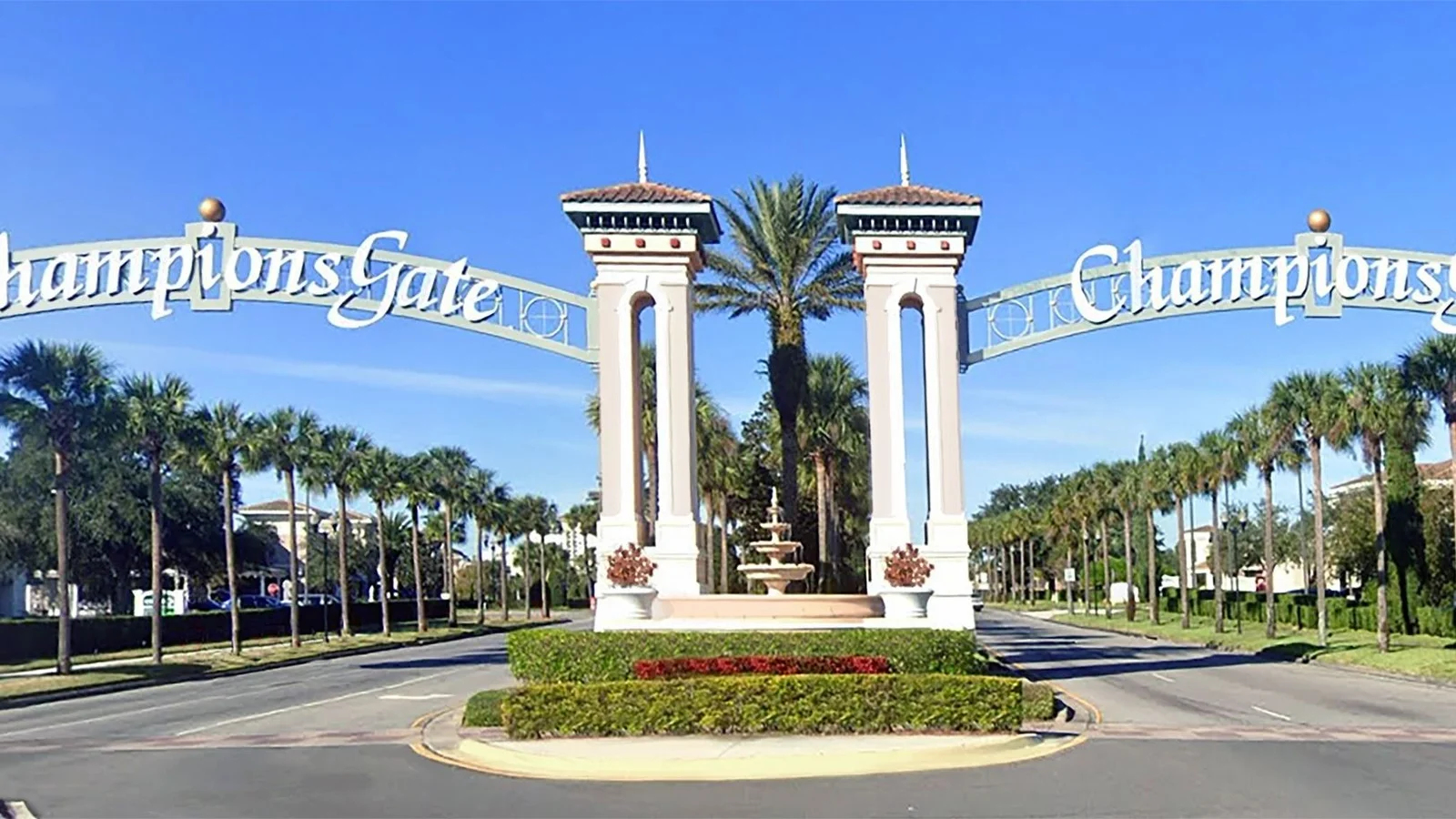
Quick answer: ChampionsGate is not in one county. The Osceola, Polk line runs through the community, and the short-term rental tax stack on one side is 1.5 percentage points higher than on the other. Almost nobody checks which side a specific house is on before making an offer.
This page has been rewritten from an earlier version that stated a “13% Tourist Development Tax”. That was wrong twice: the tourist development tax is 6% in Osceola and 5% in Polk, and the figures near 13% are the combined stack of three separate taxes remitted to two different authorities. The correction matters because someone acting on the old figure would have remitted the wrong amount to the wrong place.
The community, in outline
| Type | Unincorporated master-planned resort community |
| Location | Near Davenport, south-west of the Orlando attractions corridor |
| Counties | Osceola and Polk, with the line running through the community |
| Known arrangement | At least one project spans the line, with phase one in Polk and phase two in Osceola, under an inter-county registration agreement |
| Product | Resort homes and townhomes, golf, resort amenity |
| Osceola tax stack on short-term lets | 13.5% combined |
| Polk tax stack on short-term lets | 12% combined |
That last pair of rows is the reason this page exists.
The tax stack, set out properly
Florida short-term rental taxation is three separate charges that buyers routinely collapse into one number and one payee. Separating them is the first thing to get right.
| Component | Osceola | Polk | Remitted to |
|---|---|---|---|
| State sales and use tax | 6% | 6% | Florida Department of Revenue |
| County discretionary sales surtax | 1.5% | 1% | Florida Department of Revenue, with the state tax |
| County tourist development tax | 6% | 5% | The county tax collector |
| Combined | 13.5% | 12% | Two authorities |
Three things follow from that table and each of them costs money if it is got wrong.
First, the tourist development tax is a county tax collected by the county, and the state components go to the Department of Revenue. They are separate registrations and separate filings.
Second, the difference between the two counties is 1.5 percentage points of gross rental revenue, every year, forever. On any given booking that is small. Compounded across a holding period on a property let year-round, it is not.
Third, the tourist development tax reaches rentals of six months or less, which is a wider net than the 30-day threshold that triggers the state licensing requirement. A compliant monthly lease can still owe county tax.
Our Osceola County short-term rental guide covers the county-level position in full, and our Florida short-term rental regulations guide the statewide framework.
What 1.5 points actually does to a return
The instinct is to treat a small percentage difference as noise. Work it through and it is not.
The tax is charged on gross rental revenue, before management fees, before the mortgage, before maintenance. It comes off the top. A net return, by contrast, is a small residual of that same gross figure after every cost is deducted.
So a difference expressed as 1.5% of gross is a much larger percentage of net. If a property’s costs consume most of its gross revenue (and on a managed Florida short-term rental with management fees, taxes, insurance, utilities, pool and lawn care and association dues, they generally consume a great deal of it) then 1.5 points of gross can be several points of whatever is left.
We do not publish a net yield figure for this community, and the reason is set out below. What we will say is that anyone modelling a return here should model it twice, once at 13.5% and once at 12%, and see for themselves how much of the difference survives to the bottom line. Our gross versus net yield guide sets out the full deduction chain.
Establishing which county a parcel is in
This is a five-minute exercise and it is conclusive.
- Use the property appraiser’s record, not the listing, the agent or the community’s marketing. Each county’s property appraiser publishes parcel records searchable by address, and the parcel appears in the records of the county it is in.
- Check the parcel identification number. County parcel numbering is county-specific, so the number itself identifies the county.
- Do not rely on the postal address. Postal addresses in this area frequently read “Davenport” or “ChampionsGate” regardless of which county the land is in, because postal geography and county geography are different systems.
- Do not rely on a neighbouring property. The line runs through the community; the house across the street may be in the other county.
The inter-county registration arrangement reported for at least one project spanning the line is a reminder that administrative arrangements and tax liability are not necessarily determined by the same thing. Where a parcel’s position is genuinely near the line, confirm the tax position with both county tax collectors rather than inferring it.
The licensing chain, in order
Short-term letting in Florida is a sequence of permissions, and missing any one of them is a compliance problem regardless of the others.
| Step | What it is | Who grants it |
|---|---|---|
| 1 | Confirm the community’s covenants permit short-term letting | The homeowners association |
| 2 | Confirm zoning permits it for that parcel | The county |
| 3 | DBPR vacation rental licence | Florida Department of Business and Professional Regulation |
| 4 | County tourist development tax account | The county tax collector |
| 5 | Florida Department of Revenue sales tax registration | The state |
| 6 | Any local registration or business tax receipt | The county |
The licensing threshold is the one people misread. A DBPR vacation rental licence is required where a dwelling is let for periods of less than 30 days more than three times in a calendar year. Letting twice a year for a fortnight each does not trigger it; letting weekly does.
Step 1 is first for a reason. County permission is irrelevant if the covenants prohibit the use, and covenants are private contracts that no licence overrides.
Why this page carries no yield figure
The version of this page we replaced stated a net yield range, an occupancy range and nightly rate ranges. None of it was sourced. We removed all of it and we are not replacing it with our own estimates, for three reasons.
The inputs vary more than the output. Two houses in the same community, of the same size, can produce very different results depending on whether they have a pool, a game room, how they are furnished, which platform they are on, how they are priced and who manages them. A single range for a community averages across variation that dominates the answer.
Nobody publishes the denominator. Occupancy and rate data for individual vacation communities is not published by any authority. Figures circulating online are management companies’ own portfolios, which are a selected sample presented by an interested party.
A specific-looking number is worse than no number. A range quoted to one decimal place reads as researched. Presented without a source it is a guess wearing a lab coat, and a buyer who models on it has borrowed someone else’s confidence.
What we will do is set out the deduction chain accurately, so the arithmetic is yours to run with your own inputs.
The deduction chain, honestly
Every item below comes off gross rental revenue. The order matters because some are charged on gross and some on what remains.
| Deduction | Charged on | Notes |
|---|---|---|
| State sales tax and county surtax | Gross | 7.5% in Osceola, 7% in Polk |
| County tourist development tax | Gross | 6% in Osceola, 5% in Polk |
| Platform or booking fees | Gross | Varies by channel |
| Management fee | Gross, typically | The largest single deduction on a managed property |
| Cleaning, where not passed to guests | Per stay | Frequency scales with turnover, not with revenue |
| Property insurance | Fixed annual | Short-term use affects the policy required |
| Association dues | Fixed annual | Set by the community, not by your revenue |
| Utilities | Largely fixed | Higher on short-term use than long-term |
| Pool and lawn maintenance | Fixed annual | Standard on resort homes |
| Repairs and replacement | Variable | Turnover-driven wear is higher than residential |
| Property tax | Fixed annual | An investment property does not receive homestead treatment |
The pattern worth noticing is how many of those are fixed rather than proportional. Fixed costs mean a soft season hurts disproportionately, because the costs do not fall with the revenue.
What the covenants control, and why they come first
County zoning decides whether a use is permitted on the land. The community’s own recorded covenants decide whether it is permitted to you. Where the two disagree, the stricter one governs your property, and it is almost always the covenants.
That produces a set of questions that no licence, no county registration and no tax account answers:
- Is short-term letting permitted at all, and is the permission in the recorded declaration or merely in current practice? A practice can be changed by a board; a recorded provision needs an amendment.
- Is there a minimum stay? Some communities impose one above the statutory threshold, which changes the business entirely.
- Is there a cap on the number of homes that may be let, or on lettings per year per home?
- Is guest registration required, and does the association charge for it?
- What are the parking, noise and occupancy limits, and how are they enforced? Occupancy caps in particular determine what a large house can actually earn.
- What is the fining regime, and what does the association’s record show about how it is applied?
The occupancy cap deserves a line of its own. A short-term rental’s revenue is closely tied to how many guests it sleeps, because parties book by group size rather than by square footage. A covenant limiting occupancy below what the house physically accommodates directly limits revenue, and it is invisible in any listing.
Establish all six before making an offer. Every one is answerable from documents the association will provide on request, and the answers are more consequential than anything in the sales material.
The amendment risk nobody prices
Covenants are not fixed. They are amended by the membership under whatever procedure the declaration sets, and in vacation communities the membership is a mix of investors who let and owners who do not.
Those two groups want different things. Owners who live in a community generally prefer fewer short-term guests, less turnover and quieter streets. Owners who let want the opposite. Where the balance shifts (and it shifts as a community matures and more homes pass into owner-occupation) the rules can move.
This is not speculative. Restrictions on short-term letting in Florida communities have tightened in many places over the past decade, driven by exactly that dynamic. A buyer underwriting a twenty-year hold on the current rules is underwriting a rule set that the current membership can change.
Two things partially protect against it. Some communities were purpose-built for vacation letting and their entire economic identity depends on it, which makes a prohibition improbable. And where a state statute preempts local regulation, that preemption constrains local government rather than private covenants, so it offers no protection here at all.
Check the amendment procedure, the current owner-occupier share if the association will state it, and the minutes for any discussion of restricting rentals. A community already debating it is telling you where it is heading.
Pros and cons
Advantages. A purpose-built resort community in the strongest short-term rental corridor in Florida, with the amenity and location that supports guest demand. Substantial transaction depth, so pricing is observable rather than inferred. Established management infrastructure. And a genuine, checkable tax advantage on the Polk side for anyone who identifies it and buys accordingly.
Disadvantages. The county split means the tax position must be verified parcel by parcel rather than assumed for the community. Fixed costs dominate the expense base, which makes a soft season expensive. Association covenants govern short-term use independently of the county, and can change. And the corridor’s supply of comparable resort homes is large, which limits pricing power in any individual house.
Red flags
- Any listing or agent quoting a “13% tourist development tax”. The tourist development tax is 6% in Osceola and 5% in Polk.
- A county stated from the postal address rather than from the property appraiser’s parcel record.
- A yield or occupancy figure offered with no source behind it.
- Covenants not produced, or produced as a summary.
- A management proposal quoting a fee without stating what it is charged on.
- Any assurance that a DBPR licence overrides the community’s own rules. It does not.
Our reading: ChampionsGate is a serious short-term rental market and the single most useful thing a buyer can do here is unglamorous. Pull the parcel record, establish the county, read the covenants, and run the arithmetic twice at the two tax rates. For a neighbouring community entirely on the Polk side, see our Solterra Resort review; for one entirely in Osceola with a different structural question, see our Reunion Resort review.
Frequently Asked Questions
Both. ChampionsGate is an unincorporated master-planned community that straddles the Osceola and Polk county line. Parts of it, including phases of some neighbourhoods, sit on the Polk side, and an inter-county agreement has covered registration arrangements for at least one project spanning the line.
Because the tax stack differs. Osceola County short-term accommodation carries a combined 13.5%: 6% state sales tax, 1.5% county discretionary surtax and 6% county tourist development tax. Polk County carries a combined 12%: 6% state, 1% surtax and 5% tourist development tax.
No, and this is a common error. The tourist development tax is 6% in Osceola and 5% in Polk. The figures near 13% are the combined stack including state sales tax and the county surtax, and they are remitted to different authorities.
Yes. A Florida DBPR vacation rental licence is required where a dwelling is let for periods of less than 30 days more than three times in a calendar year, alongside county tax registration and whatever the community's own covenants require.
The county the specific parcel is in, from the property appraiser's record rather than from a listing, because that determines the tax stack and which county's registration applies.
Sources: the community’s straddling of the Osceola and Polk county line, and the reported inter-county arrangement covering a project with phases in each county, from contemporaneous local reporting and county geographic records. Tax rates are from the Florida Department of Revenue’s local option transient rental tax schedule and discretionary sales surtax schedule, together with the Osceola and Polk county tax collectors, verified 28 August 2026. Licensing thresholds are set by Florida Statutes Chapter 509 and DBPR vacation rental licensing. No occupancy, nightly rate or yield figures are asserted for this community; the previous version of this page stated such figures without a source and they have been removed.
Check the parcel, not the postcode
Send a ChampionsGate address. We pull the property appraiser record, confirm the county and set out the tax stack that actually applies.