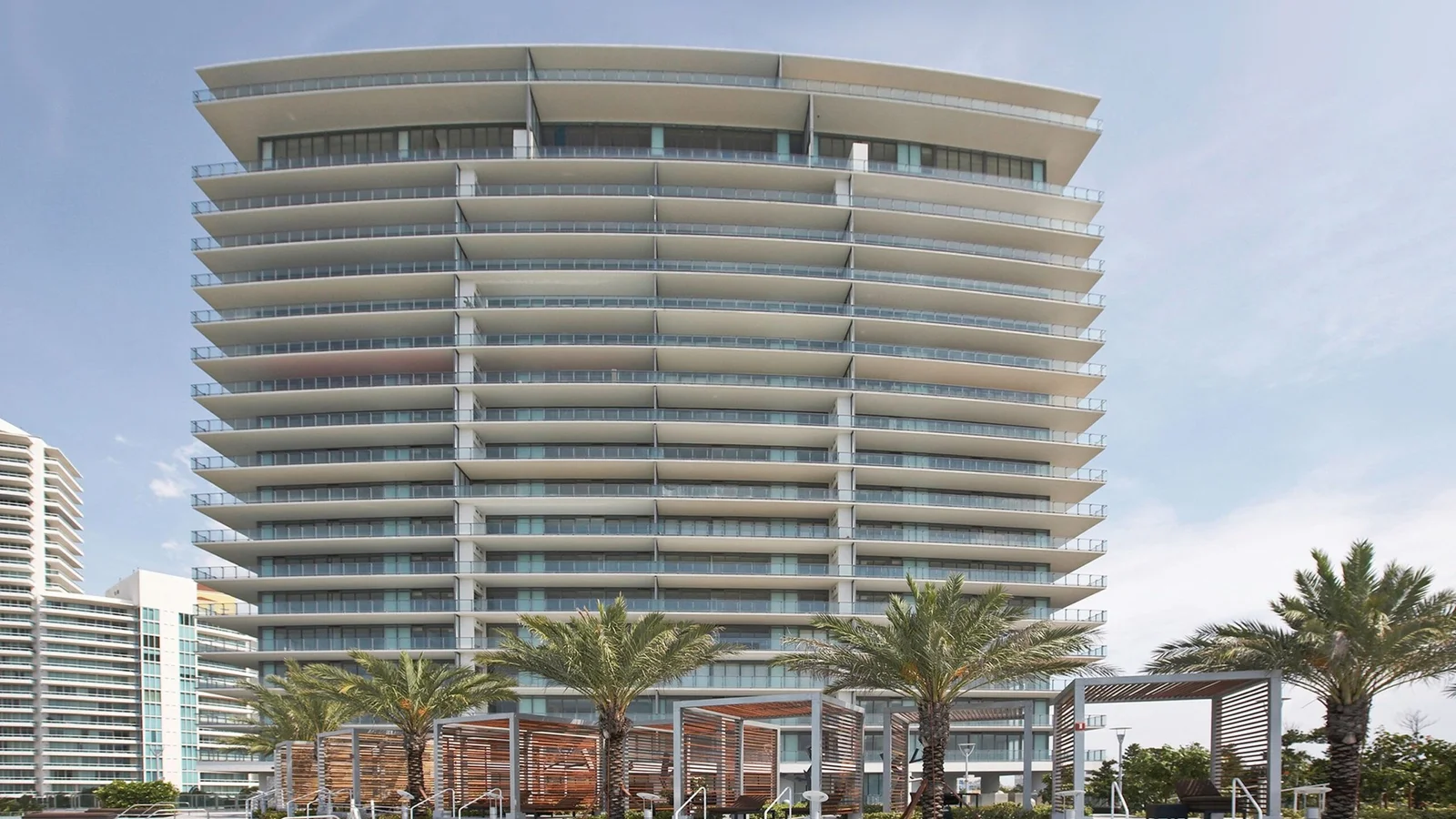
Quick answer: At 67 residences this is not a condominium in the sense most buyers mean. It is a partnership with a deed structure, and the single most informative number attached to it is one almost nobody asks for: how many owners are behind on their dues.
Every condominium has a delinquency rate. In most buildings it is a line in the financials that nobody reads because it does not change anything. Here it changes everything.
Address, age and size
| Figure | |
|---|---|
| Address | 800 South Pointe Drive, Miami Beach |
| Built | 2007 or 2008, depending on source |
| Storeys | about 22 |
| Units | 67 |
| Architect | Sieger Suarez Architectural Partnership |
| 25-year structural trigger | about 2032 or 2033 |
Sixty-seven residences over roughly 22 storeys is about three per floor, with flow-through plans running from around 3,100 to over 4,100 interior square feet. The building sits at the southern tip of Miami Beach, in the South of Fifth district, on the waterfront side.
The arithmetic that makes this building different
Divide anything by 67 and it becomes personal.
| A capital project of | Costs each of 67 owners |
|---|---|
| $1,000,000 | roughly $14,900 |
| $3,000,000 | roughly $44,800 |
| $5,000,000 | roughly $74,600 |
The costs on the left are illustrative; only the division by 67 is a fact.
Those numbers are not alarming for owners at this price level, and the point of showing them is not to alarm. The point is the second-order effect, which is where the real exposure sits.
If a single owner stops paying, the association still has to meet its obligations. The shortfall is made up by the owners who are paying, either through a higher assessment or by drawing down reserves. In a 500-unit building that shortfall is two-tenths of one per cent. Here it is one and a half per cent, and two or three delinquent owners at once is a material budget event with no cushion behind it.
What to actually ask for
The delinquency question resolves into four documents, and none of them is difficult to obtain.
- The association’s financial statements, which will show receivables and any allowance for doubtful accounts. A growing receivables balance on a 67-unit building is not a rounding error.
- The estoppel letter for the unit you are buying, covered in our estoppel letter guide. It tells you about your unit, not the building, which is why it is only one of the four.
- Board minutes for three years, where any collection action, lien or foreclosure will be recorded.
- The current budget’s bad-debt provision, if one exists. A board that provides for it has thought about it.
A building with zero delinquencies and a solvent, engaged owner base is one of the safest structures in Florida condominium ownership, precisely because the group is small enough to know and manage itself. The same size that concentrates the risk also makes it visible, which is not true of a large association where problems can accumulate anonymously.
Where the money actually goes when someone stops paying
Florida gives associations real collection powers, and understanding the sequence explains why the delinquency figure is a timing problem rather than a permanent loss.
An association can lien a unit for unpaid assessments and ultimately foreclose on that lien. In most cases the debt is recovered, either when the owner catches up, when the unit sells, or through the foreclosure itself. The building is rarely left permanently short.
What it is left with is a gap in the meantime, and the meantime is measured in quarters rather than weeks:
| Stage | What the association does | What the other owners experience |
|---|---|---|
| Missed payments accumulate | Notices, then a claim of lien | Nothing visible yet |
| Lien recorded | Collection costs begin | Receivables rise in the financials |
| Foreclosure or sale | Debt recovered, often less costs | Cash returns, months or years later |
There is a further complication where a mortgage lender forecloses first. In that situation Florida law limits what a first mortgagee taking title has to pay the association for the previous owner’s unpaid assessments, which means part of the arrears may simply never be collected.
For a large association that entire sequence is invisible. For a 67-unit building it is a real cash-flow event, and if it coincides with a capital project the association is funding it twice over: once for the work and once for the missing share. That coincidence is unlikely, and it is exactly the scenario the financial statements let you rule out before you buy.
The other side of a small association
It is worth resisting the reflex that small equals fragile, because on most measures a 67-unit building outperforms a large one.
| Characteristic | 67-unit building | 500-unit building |
|---|---|---|
| Speed of decision | Weeks | Quarters or years |
| Board’s knowledge of the building | Usually detailed | Usually delegated |
| Ability to fund work quickly | High, if owners are solvent | Slow, regardless of solvency |
| Effect of one non-paying owner | Material | Immaterial |
| Anonymity of a developing problem | Very low | High |
Three of those five favour the small building. The concentration risk is real and it is one variable among several, which is the case for reading the financials rather than for avoiding the category.
How the apportionment is determined is set out in the special assessments guide.
Structure and insurance
A completion in 2007 or 2008 places the building under the Florida Building Code as strengthened after the 2004 and 2005 seasons, which is a favourable position for its age. That puts the inspection deadline in 2032 or 2033: outside a typical hold period, and well inside the reserve funding horizon.
The waterfront location at the southern tip of Miami Beach carries the exposure that implies. Ask for the master policy declarations page, its hurricane deductible, and the clause allocating that deductible among owners. On a 67-unit building the deductible allocation is not an abstraction: a named-storm deductible divided by 67 lands in a way it does not elsewhere. Our Florida property insurance costs guide sets out what has moved in the wider market.
What to ask for, and in what order
- The association’s financial statements for three years, with the receivables position.
- The reserve study and the funding percentage the budget meets against it.
- Board minutes for three years, including any collection or lien activity.
- The master policy declarations page, its hurricane deductible, and the allocation clause.
- The estoppel letter for the unit.
- The last five annual budgets in sequence.
The first item is the one this page exists to argue for. On most buildings it is a formality. On this one it is the analysis.
Pros and cons
Advantages. One of the strongest locations in Miami Beach, in a district with permanently constrained supply. Post-2005-code construction with a milestone outside a normal hold. Very large residences at roughly three per floor. And a small, capable association that can decide and act at a speed no large building can match.
Disadvantages. Sixty-seven owners is the most concentrated denominator in this collection, and one delinquent owner is a visible budget event. The waterfront position drives both insurance and envelope maintenance. Large-format ultra-prime has a narrow buyer pool, so exit depends on finding the right buyer. And there is no cushion: what the owners do not fund, nobody funds.
Red flags
- Financial statements that are not produced, or produced without the receivables detail.
- A rising receivables balance across consecutive years.
- Minutes recording collection action against more than one owner.
- No bad-debt provision in the budget on a building this size.
- A reserve study with generic intervals that ignore the oceanfront exposure.
Our reading: an excellent building whose analysis is unusually simple and unusually neglected. Read the financial statements before the floor plan. If the owner base is current and the reserves are funded, the small association is an advantage rather than a risk, and the concentration works entirely in your favour.
For the same concentration problem attached to bespoke machinery, see our Porsche Design Tower review. For the architectural version, see our Jade Signature review.
Frequently Asked Questions
67, at 800 South Pointe Drive in the South of Fifth district of Miami Beach. The tower runs to roughly 22 storeys, so around three residences per floor.
Because each residence is roughly one and a half per cent of the budget. In a 500-unit building a single non-paying owner is absorbed without anyone noticing. In a 67-unit building it is a visible hole that the other owners fill.
Sieger Suarez Architectural Partnership. Published completion dates give 2007 and 2008 depending on the source, which puts the coastal milestone around 2032 or 2033.
Not inherently. Small associations decide faster and are usually better informed about their own building. The exposure is concentration, and it is manageable when the owner base is solvent and current.
The association's financial statements and the estoppel letter, and the board minutes will usually record any collection action. Ask for all three.
Sources: address, unit count, architect and residence sizes from Miami Beach condominium market records for Apogee South Beach. Published completion dates differ between 2007 and 2008 and both are given rather than one asserted. Because the completion year is itself disputed, the milestone is given as a window rather than a date, calculated from the statutory trigger. The per-owner column is a hypothetical cost divided by 67.
Ask for the financials, not the floor plan
Send a unit at Apogee or any small Miami Beach association. We read the receivables position and the reserve funding before you offer.