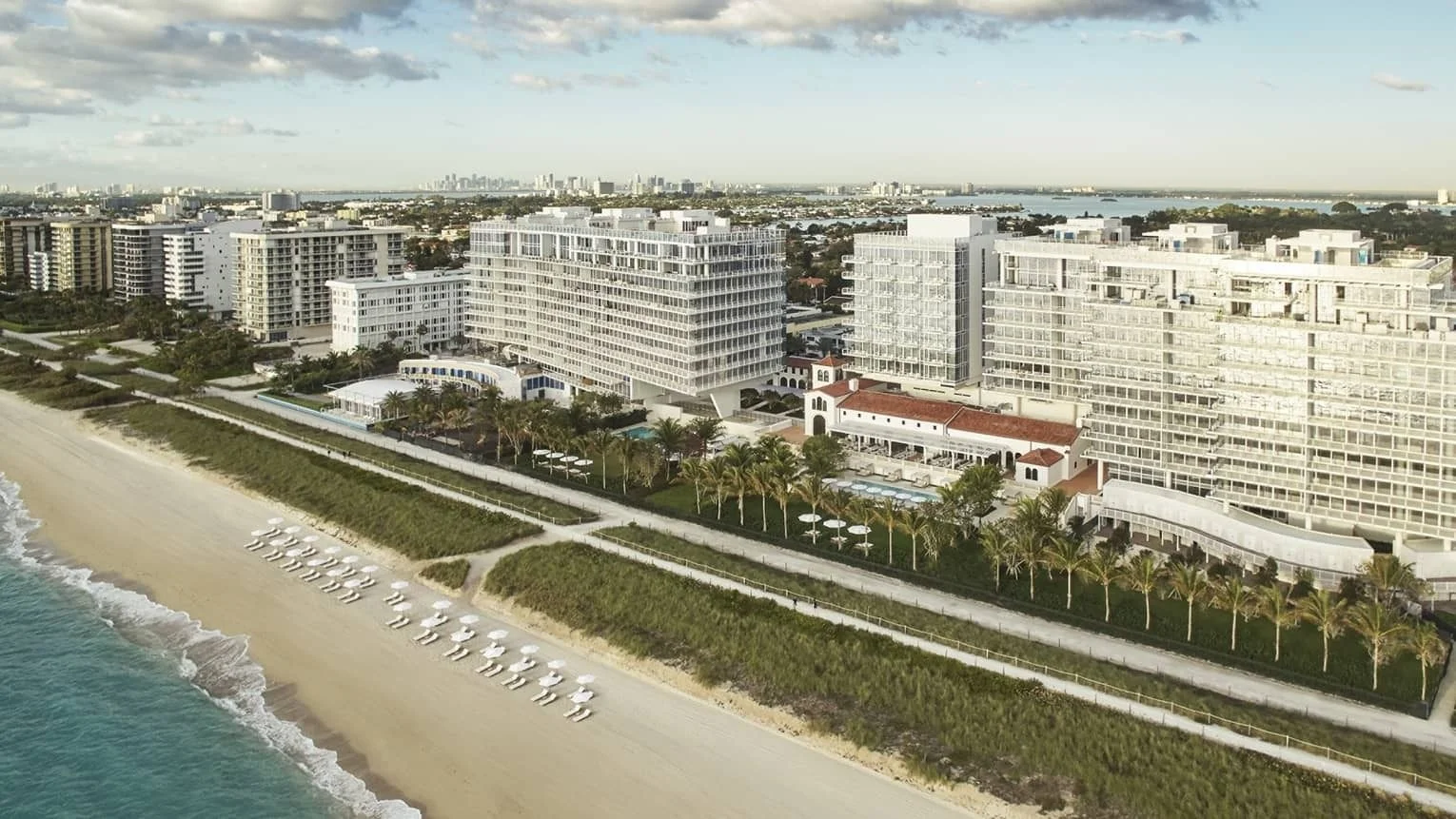
Quick answer: Two structures of very different ages sit under one address here, and only one of them behaves like ordinary condominium construction. The 1930s building is the reason the project exists and it is also a conservation obligation, which is a different category of expense from maintenance.
Buyers read the historic building as character. It is character, and it is also a line in a budget that no comparable modern tower carries.
The site in outline
| Location | Collins Avenue, Surfside |
| New construction completed | 2017 |
| Residential towers | Two, twelve storeys each |
| Historic component | The original Surf Club building, 1930s |
| Architect | Richard Meier |
| Residences | Roughly 150 by most published counts, including hotel-branded residences |
| Milestone, new towers, 25-year coastal trigger | about 2042 |
Counts vary between sources because the site mixes private residences with hotel-branded ones, and different publishers draw the line differently. Nothing below depends on the exact figure.
Conservation is not maintenance
The distinction sounds pedantic and it is worth several hundred thousand dollars over a holding period.
Ordinary building maintenance optimises for cost and durability. If a component fails, you replace it with the best available equivalent, tender the work to several contractors, and choose. Work on a protected historic structure optimises for fidelity first:
| Ordinary maintenance | Conservation work |
|---|---|
| Replace with the best modern equivalent | Match the original material and method where required |
| Any competent contractor can bid | A narrower pool of qualified specialists |
| Board decides and proceeds | Changes may require approval from a preservation authority |
| Cost driven by market pricing | Cost driven by scarcity of skill and material |
| Timetable set by the association | Timetable includes an approval process |
None of that is exotic. It is how every listed building in the world is looked after, and it is entirely normal to own a share in one. What is not normal is to own a share in one without knowing it, which is the position a buyer occupies if the reserve study treats the whole site as a single 2017 asset.
What to check on the older structure
Four questions settle the position, and the association should be able to answer all of them from documents it already holds.
- What protection applies? Local historic designation, a preservation easement, a covenant, or none. Each imposes different obligations, and the answer determines everything downstream.
- Is the historic structure inside the condominium’s common elements? If it is, owners fund it. If it belongs to the hotel or another interest, they may not, and the shared-cost agreement will say how much they do.
- Where does it sit on the inspection regime? A structure of that age has its own position under the state’s milestone framework, and it is not the towers’ 2042. Our SB 4-D safety guide sets out how the framework applies by building.
- Does the reserve study price it separately? A single blended line for the whole site is a sign the study has been done generically.
The second question is the one with the largest number attached, and it is a documentary answer rather than a matter of opinion.
Why the older building is also the asset
Everything above reads as cost, and the balance of the argument sits on the other side of the ledger, so it belongs here rather than buried in a list.
Scarcity in ultra-prime real estate is usually manufactured. A developer limits a tower to a small number of residences, specifies expensive finishes and calls the result rare. It is rare in the sense that any deliberately limited thing is rare, and the next developer along the beach can do the same thing next year.
A 1930s oceanfront clubhouse cannot be produced again at any price. Neither can the entitlement to build alongside it, on a beach where new oceanfront sites do not exist. That is scarcity of a different kind, and it is the reason a project like this holds value through cycles that reprice ordinary luxury stock.
The two facts are the same fact seen from opposite sides. The structure that costs more to keep is the structure that makes the address non-reproducible, and a buyer who treats the conservation obligation as a defect has misread what they are being sold. The correct response is not to avoid the cost but to establish its size, which the documents will tell you.
Where that reasoning fails is if the cost is unquantified. An obligation you have measured is a line in a budget. The same obligation unmeasured is an open-ended claim on your capital, and the difference between the two is a reserve study that has actually looked at the building.
The oceanfront and Surfside context
The site is first-row on the Atlantic in Surfside, which carries the full coastal exposure: chloride attack on exposed metal and sealant, maximum windstorm rating, and an envelope maintenance cycle shorter than any inland equivalent. On the 2017 towers that is manageable and expected, and we set out the general case in our Jade Signature review.
On the historic structure it compounds with everything above. Salt air acts on original fabric exactly as it acts on new fabric, and the response is constrained by what the protection permits.
Ask for the master policy declarations page, the hurricane deductible, and how that deductible is allocated. Then ask whether the historic structure is insured on the same policy and at what basis of valuation, reinstatement of a protected structure is not the same figure as replacement of an equivalent modern one.
Dividing the costs
| A capital project of | Costs each of roughly 150 owners |
|---|---|
| $1,000,000 | roughly $6,700 |
| $3,000,000 | roughly $20,000 |
| $5,000,000 | roughly $33,300 |
Those are divisions of illustrative sums by the residence count, not prices anyone has quoted.
A base of roughly 150 is small for a site carrying this much specialist obligation, and the two facts compound in the same direction. The offset is the same one that applies across ultra-prime: owners here are generally able to fund what the site needs, and a small association can move quickly once it agrees. The apportionment mechanics are covered in our special assessments guide.
What to obtain before offering
- The reserve study, with the historic structure priced as its own line.
- Whatever designation, easement or covenant governs that structure.
- The cost-sharing agreement between the residential association and any hotel or commercial interest on the site.
- The master policy, its hurricane deductible, the allocation clause and the valuation basis for the historic building.
- Board minutes for three years, including any preservation approvals sought.
- The association’s financial statements for three years.
The first three are specific to this site. If an agent cannot produce the third, they do not know how the project is funded, and neither do you.
What works and what does not
Advantages. A genuinely irreplaceable asset: the combination of a 1930s landmark, a Richard Meier design and an oceanfront Surfside site cannot be recreated. New construction to post-2010 code with a distant milestone on the residential towers. Very low density. And an owner base with both the means and the motive to maintain the site to standard.
Disadvantages. The historic component is a conservation obligation rather than an ordinary maintenance item, and it is permanent. Roughly 150 owners carry it. The oceanfront position drives insurance and envelope cost. And a shared site with commercial interests means the cost-sharing agreement, not the declaration alone, determines what you fund.
Where to walk away
- A reserve study that treats the site as one 2017 asset.
- No clear answer on what protection applies to the historic structure.
- A cost-sharing agreement with hotel or commercial interests that cannot be produced.
- Insurance on the historic building at a modern replacement basis.
- Minutes that record no preservation approvals at all across three years.
Our reading: an exceptional site whose defining feature is also its most specialised expense. Owning a share in a protected building is a perfectly reasonable thing to do; doing it without having read what protection applies is not.
For a site where the surrounding assets rather than the building itself carry the dependency, see our Faena House review. For one where two structures of different ages sit under one name, see our Continuum review.
Frequently Asked Questions
A Surfside oceanfront development completed in 2017 on Collins Avenue, designed by Richard Meier, in which two twelve-storey residential towers were built around and alongside the original Surf Club building of the 1930s.
Because work on a protected historic structure is conservation rather than maintenance. Materials must often be matched rather than replaced, approvals are required for changes, and the contractors qualified to do the work are fewer and dearer.
Published counts differ. The figures most often cited are around 150 residences in total, including a set of hotel-branded residences alongside the private ones.
For the 2017 towers, roughly 2042 on the 25-year coastal trigger. The historic component is a separate structure of a different age and its inspection position must be established on its own terms.
The reserve study, and specifically whether it prices the historic structure separately from the new towers. If it does not, the study has not engaged with the site.
Sources: location, completion year, tower configuration, architect and the incorporation of the original Surf Club building from Surfside condominium market records. Residence counts differ between published sources and are therefore given as an approximate figure. The 2042 date applies to the 2017 construction and is calculated from the statutory coastal trigger. Conservation cost observations are general to protected structures rather than an assessment of this association’s budget.
Find out what protects the old building
Send a unit at the Surf Club or any Surfside oceanfront property. We establish what governs the historic structure and who funds it before you offer.