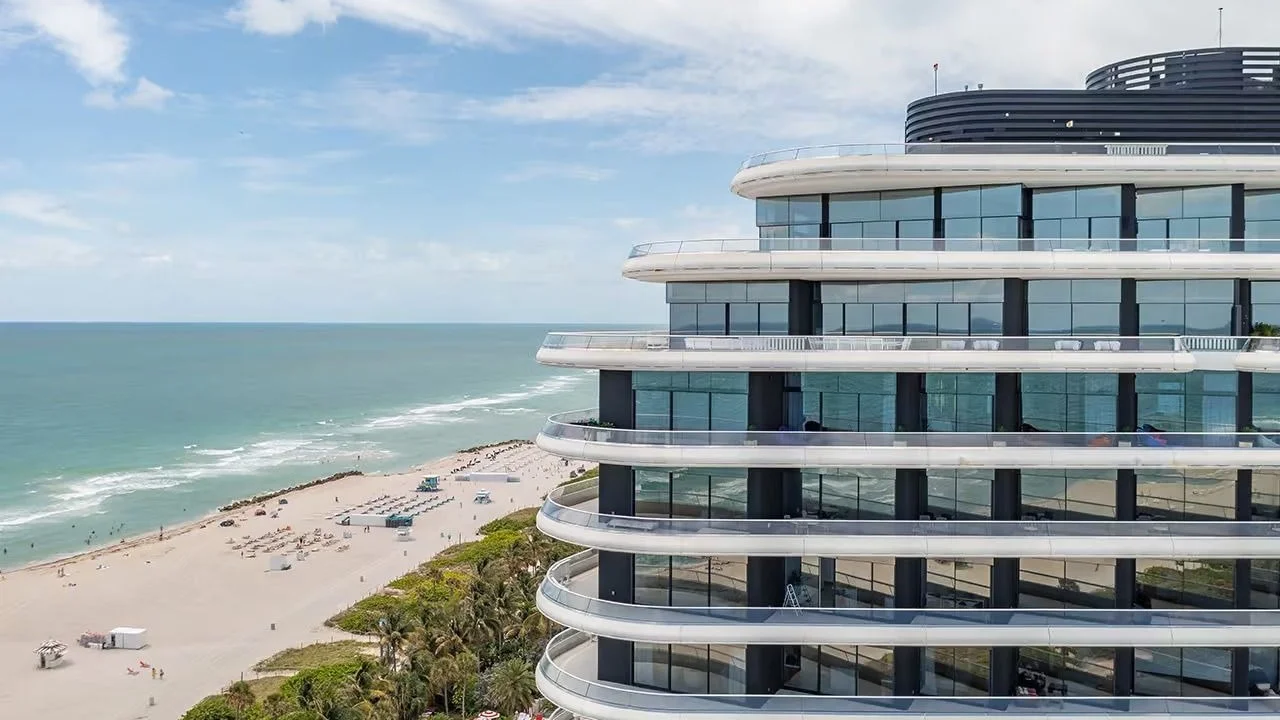
Quick answer: The building is excellent and it is not the product. The product is a stretch of Mid-Beach that one developer conceived, built and programmed as a cultural district, and a buyer here acquires 47 residences’ worth of exposure to assets they neither own nor control.
That dependency is not a defect and it is not disclosed anywhere in a listing. It is simply the structure of the investment, and it deserves to be named.
The residence itself
| Figure | |
|---|---|
| Address | 3315 Collins Avenue, Miami Beach |
| Built | 2015 |
| Storeys | 18 |
| Units | 47 |
| Architect | Foster and Partners |
| Developer | Alan Faena |
| Milestone year, coastal rule | about 2040 |
Forty-seven residences over 18 storeys, with wrapping terraces integral to the design rather than applied to it. Low-rise by Collins Avenue standards and very low density by any standard.
What the district actually is
Along the same stretch of Collins Avenue the developer assembled and built a set of connected assets: a hotel, a building for arts and events programming, a retail bazaar, and further accommodation. The residences were conceived as one component of that whole rather than as a standalone tower with a good address.
This is why the district matters commercially rather than culturally:
| What the district supplies | Who owns and funds it |
|---|---|
| The restaurant, hotel and service infrastructure | The district’s owners, not the condominium |
| Cultural programming that makes the address distinctive | The district’s owners |
| The visual and physical coherence of the streetscape | The district’s owners |
| The residences themselves | The condominium association |
A conventional oceanfront building draws its value from the beach, the structure and the neighbourhood at large, thousands of independent decisions that no single party can reverse. Here a meaningful share of the value comes from a small number of adjacent buildings under concentrated ownership.
The question that follows from that
If the district’s operator changes strategy, sells the assets, reduces the programming or repositions the hotel, the condominium has no vote and no remedy. Its residences remain exactly as good as they were; their context does not.
The reverse case is equally real and rather more likely. A committed operator maintaining an internationally recognised precinct sustains a premium that no individual building could generate alone, and does so at no cost to the association.
So the diligence is different from the usual list, and it is about counterparties rather than components:
- Who currently owns and operates the principal district assets, and has that changed since 2015?
- Are there recorded agreements (easements, covenants, shared-use or reciprocal access) that bind the district to the condominium in any enforceable way?
- Does the association pay anything toward district amenities, or receive any right to them, and is that documented?
- What has happened to the programming’s intensity over the last three years?
The second question is the important one. A right recorded against title survives a change of ownership. An arrangement based on goodwill does not, and buyers routinely assume they have the first when they have the second.
How to price a dependency you cannot control
The instinct on discovering an exposure like this is to demand a discount for it. That is usually the wrong move, because the exposure is already in the price on both sides.
A more useful approach is to separate the two components of what you are buying and value them independently.
| Component | What it is worth | How durable |
|---|---|---|
| The residence itself | An oceanfront Foster and Partners home on Collins Avenue | Permanent, subject to maintenance |
| The district context | Programming, service infrastructure, precinct identity | Contractual at best, discretionary at worst |
Ask what the residence would be worth if the surrounding assets were simply well-run conventional hotels with no cultural programme. That number is your floor, and it is not a low one: the building, the beach and the architecture do not depend on anyone’s strategy. The distance between that floor and the asking price is what you are paying for the district, and it is the part that has a counterparty attached.
Whether that spread is reasonable is a judgement rather than a calculation, and it is a judgement most buyers never consciously make because the two components are never separated. Making it explicitly is the whole recommendation of this page.
There is a version of this that argues in the building’s favour. A precinct assembled at this cost, with assets of this quality, is expensive to dismantle and its owners have every commercial reason to keep it functioning. Concentrated ownership cuts both ways: one party can withdraw, and one party can also invest without needing anyone’s agreement. Diffuse neighbourhoods cannot do the second thing at all.
The 47-unit denominator
| A capital project of | Costs each of 47 owners |
|---|---|
| A $1m programme | $21,300 each |
| A $3m programme | $63,800 each |
| A $5m programme | $106,400 each |
Illustrative amounts divided by 47. No work at this building has been priced.
Forty-seven is the smallest owner base in this collection, and the concentration argument that applies to any small association applies here in its strongest form. We set it out in full, including the effect of a single non-paying owner, in our Apogee review.
What partly offsets it is the same thing that creates the dependency. A residence here is bought by people who wanted this specific proposition, which correlates with the ability to fund the building when it needs funding. The apportionment mechanics sit in the special assessments guide.
Structure, insurance and the rental question
A 2015 completion means post-2010 code construction and a milestone around 2040. Structure is genuinely not the near-term issue, and the near-term issue is the same one that applies to any new oceanfront building: whether the reserve study prices envelope maintenance for a Collins Avenue site rather than a generic one. We set that argument out in our Jade Signature review.
On the rental side, the district cuts both ways. It supports achievable rent at the very top of the Mid-Beach market and it narrows the pool of tenants to those buying the same proposition the owners bought. Long vacancies at high rents are a different business from short vacancies at moderate ones, and the difference is invisible in a gross yield figure. Modelling that properly is the subject of our rental yield guide.
The paperwork that decides it
- Any recorded easements, covenants or reciprocal agreements between the condominium and the district’s assets.
- Current ownership of the principal district assets.
- The reserve study, with envelope intervals appropriate to an oceanfront site.
- The association’s financial statements for three years, with the receivables position.
- The hurricane deductible on the master policy, and the clause that allocates it.
- Minutes from the last three board years.
The first item is what makes this building different from any other on this site. Everything else is the standard oceanfront file.
Strengths and weaknesses
Advantages. A genuinely distinctive proposition with an internationally recognised name and an architect to match, in a stretch of Mid-Beach that no competitor can replicate. Post-2010 construction with a distant milestone. Extremely low density and large, well-designed residences. And a district that, while it operates as intended, supports a premium the building could not generate on its own.
Disadvantages. A material share of the value rests on assets the association neither owns, funds nor controls. Forty-seven owners is the most concentrated base here. Oceanfront exposure drives insurance and envelope maintenance. And the buyer pool is narrow by design, which lengthens exit rather than lowering price.
What should stop you
- No recorded agreement of any kind between the condominium and the district.
- A seller who describes district amenities as though they were association amenities.
- Ownership of the principal district assets that cannot be established.
- A reserve study with generic component intervals on an oceanfront site.
- Financial statements withheld on a 47-unit association.
Our reading: an outstanding building attached to a proposition that behaves more like an equity position in a neighbourhood than like a conventional condominium purchase. That is a legitimate thing to own. It is worth knowing that you own it.
For the concentration argument in isolation, see our Apogee review. For a beachfront project where the complication is two towers rather than a district, see our Continuum review.
Frequently Asked Questions
An 18-storey oceanfront condominium of 47 residences at 3315 Collins Avenue, Mid-Beach, completed in 2015 to a Foster and Partners design for the developer Alan Faena.
A group of adjacent assets on the same stretch of Collins Avenue, including a hotel, an arts and events building, a retail bazaar and other accommodation, developed as a single cultural precinct alongside the condominium.
Because a substantial part of what the address is worth comes from buildings the condominium does not own, does not fund and cannot vote on. The residences depend on the district; the district does not depend on the residences.
The dependency itself is common. Its scale here is not. Most condominiums sit in neighbourhoods with many owners, so no single party's decisions reshape the context. Here the surrounding context was created and is largely held by one interest.
Around 2040, working forward 25 years from a 2015 completion under the coastal rule. Structure is not the near-term question here.
Sources: address, build year, storey count, unit count, architect and developer from Miami Beach condominium market records for Faena House. The composition of the surrounding district is drawn from public descriptions of the development; current ownership of those assets is not asserted here and should be established from the county records at the time of purchase. The 2040 date is calculated from the coastal trigger, not published. Per-owner figures divide an illustrative sum by 47 residences.
Find out what is recorded, not what is implied
Send a unit at Faena House or any Mid-Beach oceanfront building. We check what rights the condominium actually holds against its surroundings before you offer.