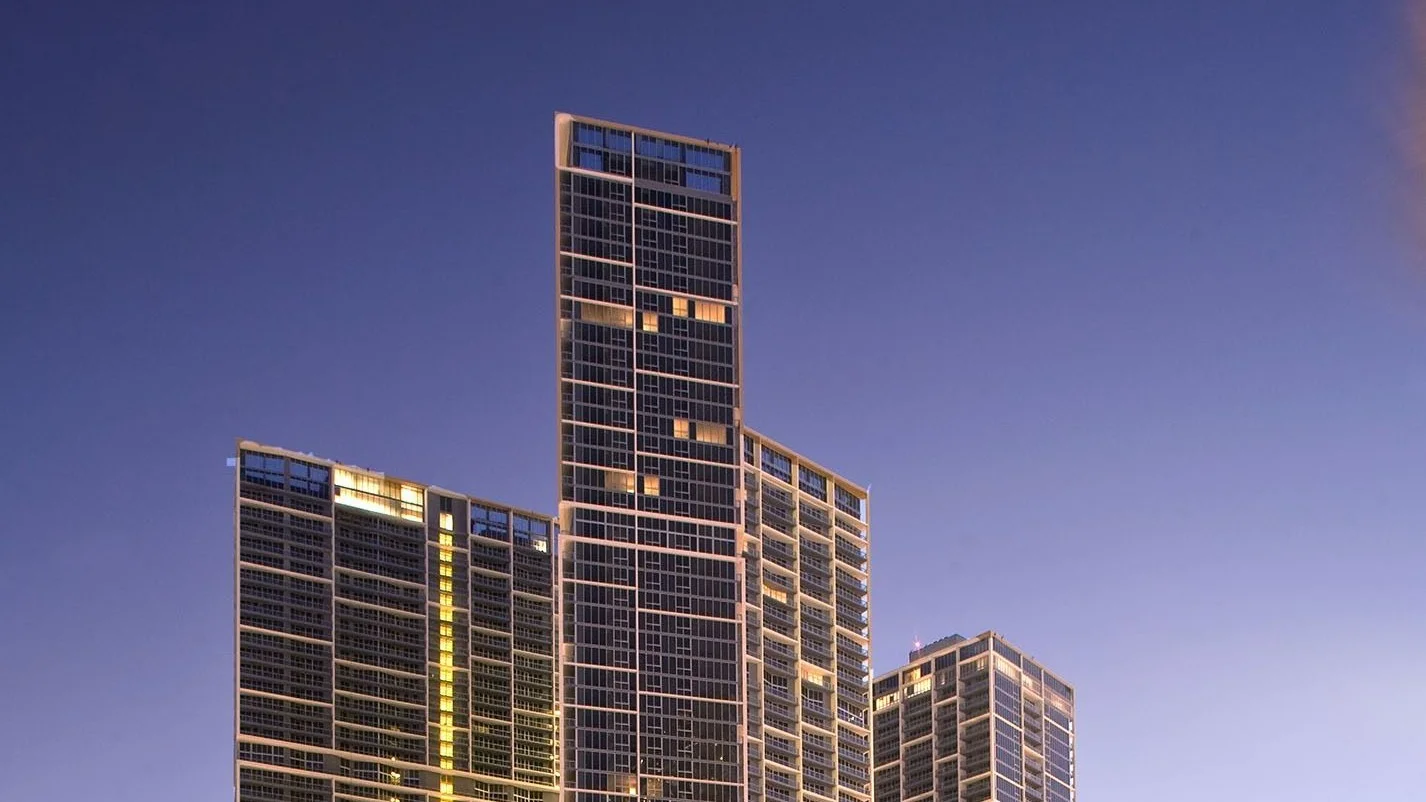
Quick answer: Most Miami condominium analysis treats a building as a location with a price attached. At Icon Brickell the decisive variable is neither: it is that 1,718 units share the structure. Every cost this building incurs divides by a very large number, and every decision it makes has to pass through a very large group. That cuts both ways, and it is the thing to understand before you look at a floor plan.
This page previously described Icon Brickell as a twin-tower development. It is three towers, and the third contains a hotel. Both facts change the analysis, which is why they are the first thing here rather than a footnote.
What the building actually is
| Component | Storeys | Units |
|---|---|---|
| Tower 1 | 57 | 713 |
| Tower 2 | 57 | 561 |
| Tower 3, W Miami | 50 | 444 condo, plus 148 hotel rooms |
| Total residential | 1,718 |
Completed in 2008. Developer: The Related Group. Architecture: Arquitectonica. Interiors: Philippe Starck.
Those last two names are not decoration. A building with a signature architect and a named interior designer carries a design premium at resale, and it also carries a maintenance obligation: distinctive common areas cost more to keep looking distinctive than plain ones do, and that cost sits in the monthly dues forever.
Why 1,718 owners is the whole analysis
Condominium economics are division. A cost arrives at the building and is split among the owners. The size of the denominator therefore decides how any given event feels to you.
Consider the same repair in two buildings:
| Repair cost | Split across 171 units | Split across 1,718 units |
|---|---|---|
| $2 million | about $11,700 each | about $1,160 each |
| $5 million | about $29,200 each | about $2,900 each |
| $10 million | about $58,400 each | about $5,800 each |
Those figures are arithmetic on the unit counts, not quotes for any actual work. What they show is the structural advantage of scale: an assessment that would be painful in a boutique oceanfront building is an inconvenience here.
The trade is governance. Seventeen hundred owners produce slower decisions, harder quorums, more contested board elections and more difficulty agreeing to spend money before it becomes urgent. Large associations frequently defer, and deferral is how a manageable repair becomes a special assessment.
So the honest summary is not “large is safer”. It is that a large association converts a small number of large shocks into a larger number of small ones, provided it actually decides things. Whether this one decides things is a question the minutes answer and the brochure does not.
The hotel in Tower 3 is a separate question
Tower 3 operates as the W Miami and holds 148 hotel rooms alongside its 444 condominium units. Mixed-use changes three things for an owner in that tower.
Shared expenses have to be allocated between residential and commercial interests, and the allocation formula lives in the declaration rather than in market practice. Read it. A formula written when the building opened may not reflect how the two uses actually consume services now.
Insurance is more complex, because a hotel operation is a different risk from a residence and the master policy has to cover both.
And governance acquires a second party with its own interests. A commercial owner in a mixed-use condominium is often a substantial voting block with priorities that differ from those of a residential owner planning to hold for a decade.
None of that is a reason to avoid Tower 3. It is a reason to price it as a different asset from Towers 1 and 2, which many listings do not.
Choosing between the three towers
Listings treat Icon Brickell as one address. For a buyer it is three buildings with different characteristics, and the choice between them is a real decision rather than a matter of view preference.
| Tower 1 | Tower 2 | Tower 3 (W Miami) | |
|---|---|---|---|
| Storeys | 57 | 57 | 50 |
| Residential units | 713 | 561 | 444 |
| Hotel rooms | none | none | 148 |
| Mixed use | no | no | yes |
Unit density. Tower 1 carries 713 units, roughly a quarter more than Tower 2 at the same height. That means more units per floor, which usually means smaller average floor plans, more neighbours sharing each lift bank, and more competing listings when you sell. Tower 2’s lower count at the same height is a genuine difference in daily experience and in resale competition.
The mixed-use question. Tower 3 is the one to think hardest about. Hotel operation brings activity, service infrastructure and a commercial co-owner. Some buyers value the hotel adjacency and the services that come with it. Others find that a building with a lobby full of arriving guests is not what they wanted from a residence. Neither view is wrong, but the two produce different resale pools, and a Tower 3 unit sells to a narrower group than an equivalent unit in Tower 2.
What this means practically. When you compare two units at “Icon Brickell”, establish which tower each sits in before comparing anything else. Price per square foot across towers is not a like-for-like comparison, and a discount in one tower may be the market pricing a structural difference rather than an opportunity.
Ask the listing agent for the tower, the floor, the line and the exposure. Those four facts explain most of the price variation within this development, and only the first is usually volunteered.
The milestone clock, and how to compute it yourself
Florida requires a milestone structural inspection at 30 years from the certificate of occupancy, or 25 years where the building sits within three miles of the coastline. Icon Brickell sits on Brickell Bay, comfortably inside that three-mile band.
A 2008 completion therefore points to a milestone around 2033.
Two cautions on that number. The clock runs from the certificate of occupancy rather than from the year a building is described as “completed”, and those can differ by months. And a building may have inspected early, voluntarily or on the association’s own schedule, in which case the useful question is what the engineer found rather than when the deadline falls.
The practical value of computing it is that it tells you which side of the cycle you are buying on. A building that has inspected, funded and completed its work is a known quantity. A building five years out from its first milestone is carrying an unquantified liability, and the price rarely reflects that difference. The mechanism is set out in our SB 4-D assessment wave update.
What the amenity programme costs to run
Icon Brickell was built with amenity space at a scale that was unusual in 2008 and remains substantial: extensive pool decks, spa and fitness facilities, and common areas designed as a destination rather than as a lobby.
Three cost consequences follow, and all of them are permanent.
Staffing is the largest line in most large-association budgets, and a building with resort-style facilities staffs like a resort. Utilities on large water features and conditioned common space are significant and rise with rates. And a Starck-designed common area has a refurbishment cycle: finishes date, and replacing them to the original standard costs more than replacing them to an ordinary one.
Spread across 1,718 units these numbers divide well. That is the scale advantage again. What an investor should still do is read the actual budget rather than assume the division makes the total irrelevant.
What a 2008 build does to the insurance line
Construction date is the single strongest input into a Florida windstorm quote, and 2008 places this building on the favourable side of the most important line.
Florida tightened its building code substantially after the 1992 and 2004 to 2005 storm seasons, and structures permitted under the later standards perform measurably better on impact resistance, opening protection and roof attachment. Carriers price that, and they price it building by building rather than by neighbourhood.
For an owner here the practical consequences are two.
The master policy premium, which arrives through your dues rather than through a bill in your name, benefits from the construction standard. That is money you never see and never pay separately, and it is a real advantage over otherwise comparable 1980s and 1990s stock in the same submarket.
Your own HO-6 policy, covering the interior and your contents, is a separate contract you arrange yourself. It is priced partly on the building and partly on what you have done inside the unit, and a renovated interior insured at its original value is under-covered in a way that only becomes visible after a loss.
Ask the association for the master policy declarations page and its deductible. A high building deductible transfers exposure to unit owners through assessments after an event, and it is not visible in the monthly figure.
What to verify on rental income
Any Brickell listing will quote a yield. The inputs to check, in the order they matter:
- The current minimum lease term in the recorded rules, not in the listing. Boards amend rental restrictions, and an amendment can remove a rental model overnight.
- How many leases per year a unit is permitted, which is a separate restriction from the minimum term and is frequently overlooked.
- Whether the association requires tenant approval, and how long approval takes. A four-week approval window is four weeks of vacancy on every turnover.
- Current monthly dues, and what they include.
- The reserve funding level against the structural reserve study.
Our Florida rental yield guide sets out how to turn those into a net figure, and the estoppel letter is the document that reveals the unit-level position rather than the building-level story.
Pros and cons for an investor
Advantages. The largest denominator in Brickell, which materially softens the per-owner impact of any capital event. A 2008 building constructed to a post-2000 code standard, which insures better than older stock. Genuine architectural provenance that supports resale. Deep rental demand in the strongest submarket in Miami. And a wide range of unit types and price points across three towers, which means real liquidity: something in this building trades most months.
Disadvantages. Governance at this scale is slow, and slow associations defer. The amenity programme is expensive to run and cannot be reduced without a vote of a very large group. Tower 3’s mixed-use structure adds complexity that not every buyer wants. Competition at resale is internal as well as external: when you sell, other units in the same building are your comparables, and there are seventeen hundred of them.
Red flags to check before you offer
- A listing describing the development as two towers, which suggests the seller’s material is out of date or careless. Ours was, until this update.
- Yield quoted on a rental model the current rules do not permit.
- Dues quoted without the reserve contribution identified separately.
- No engineer’s report available, on a building approaching its milestone window.
- Board minutes showing repeated deferral of recommended capital work, which is the clearest advance warning of an assessment that exists.
Our reading: ask for two years of board minutes before you ask for anything else. In a 1,718-unit association the minutes are where you see whether the size of the group is producing decisions or preventing them, and that single question determines whether the scale advantage described above is real or theoretical.
Who this building suits
Suits. An investor who wants Brickell exposure with the assessment risk spread as thinly as it can be spread anywhere in the neighbourhood, and who will do the governance diligence rather than relying on the denominator alone.
Suits differently. A buyer who values liquidity above all. With this many units, an exit is nearly always available at some price, which is not true of boutique buildings.
Does not suit. An owner who wants influence over how their building is run, or one who needs certainty about rental rules over a long hold. Both are harder here than in a small association.
For the mirror image of this analysis, a 171-unit oceanfront building where every cost divides by a small number, see our Auberge Beach Residences review. For a building already inside its milestone window, see our Akoya review.
Frequently Asked Questions
Three towers and 1,718 units. Tower 1 is 57 storeys with 713 units, Tower 2 is 57 storeys with 561, and Tower 3, the W Miami tower, is 50 storeys with 444 condo units alongside 148 hotel rooms.
Completed in 2008 by The Related Group, designed by Arquitectonica with interiors by Philippe Starck.
On the 25-year trigger that applies within three miles of the coastline, a 2008 certificate of occupancy points to roughly 2033. Confirm the actual certificate date, because the clock runs from it rather than from the completion year.
It affects shared costs, insurance and governance in that tower. A mixed-use structure divides expenses between residential and commercial interests, and how it divides them is set out in the declaration.
Costs divide across more owners, which softens any single assessment. Decisions also take longer and reserve shortfalls are proportionally larger in absolute terms. Scale changes the shape of the risk rather than removing it.
Rental minimums are set by the association's own documents and can be amended by the board. Any figure quoted in a listing should be checked against the current recorded rules before you underwrite the income.
Sources: tower configuration, storey and unit counts, completion year, developer, architect and interior designer from Miami condominium market records for Icon Brickell. Milestone timing is computed from the statutory 25-year coastal trigger and requires the certificate of occupancy date to confirm. Assessment division figures are arithmetic on unit counts, not quotations. Verified 27 August 2026.
Read the minutes before you read the listing
Send a unit at Icon Brickell or any large Brickell association. We pull the rental rules, reserve position and recent board minutes and tell you what the yield actually survives.