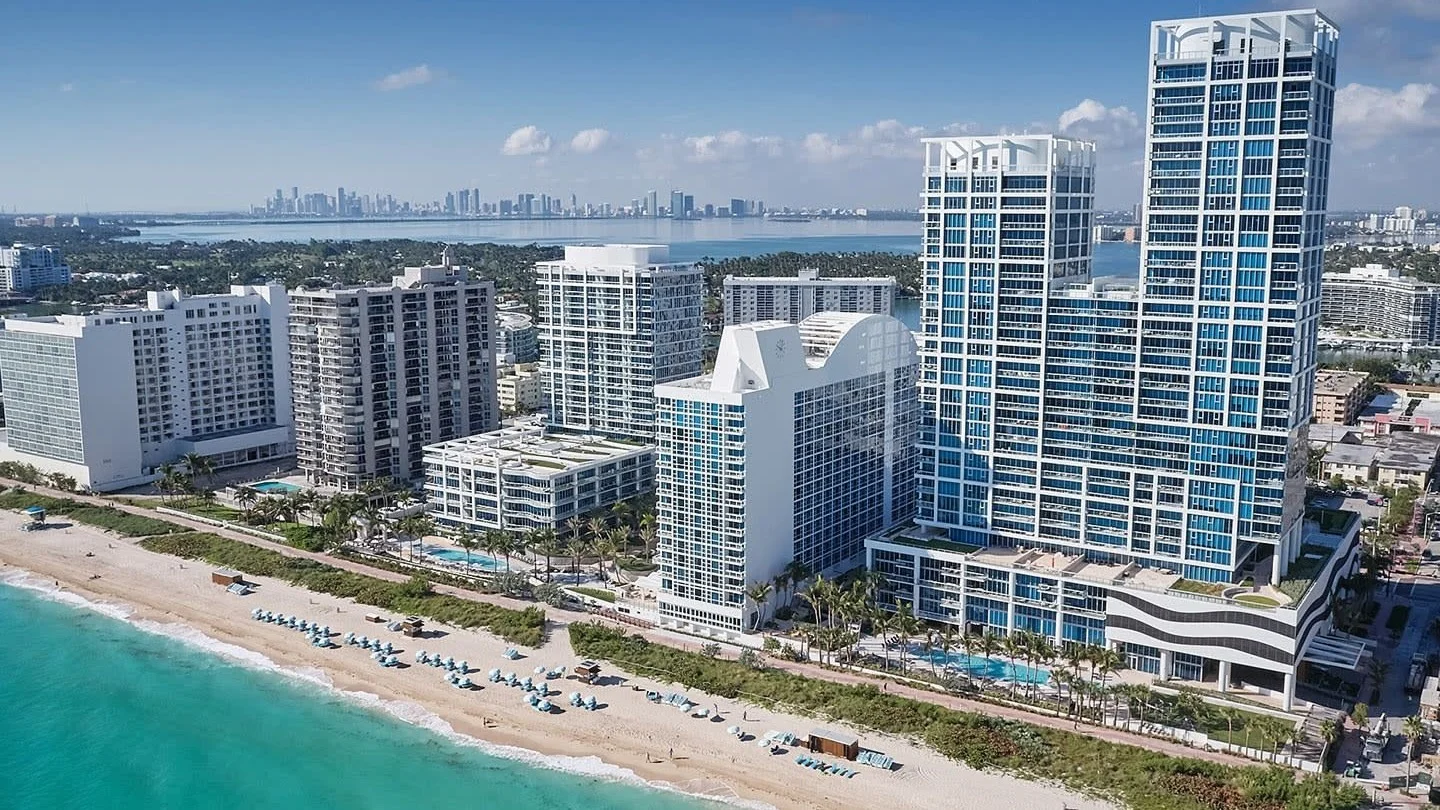
Quick answer: Comparing this building’s dues against a conventional Mid-Beach tower is a category error. Owners here fund a working wellness resort, and the useful question is not whether the dues are high but whether the operation they pay for is one you will actually use.
Amenity-heavy buildings are usually analysed as though the amenities were free and the dues were the problem. They are the same thing seen twice.
The site in outline
| Location | Collins Avenue, Miami Beach |
| Completed | 2008 |
| Towers | Three |
| South Tower | about 141 residences |
| North Tower | about 199 residences |
| Central Tower | condominium-hotel, hotel floors below, residences above |
| Total residences | about 459 |
| Architect and interiors | Arquitectonica, Rockwell Group |
| 25-year structural trigger | about 2033 |
What a resort operation costs to run
A conventional condominium’s operating budget covers security, cleaning, landscaping, insurance, management, plant and reserves. It is a building being kept.
A resort operation adds a business on top of it. Treatment rooms staffed by practitioners, a fitness and programming schedule with instructors, multiple pools with attendants, food and beverage, and a service standard that has to be maintained continuously rather than achieved once. Each of those is payroll.
That produces a specific and predictable financial shape:
| Characteristic | A plain residential tower | A resort-operation building |
|---|---|---|
| Dues per square foot | Lower | Materially higher |
| Proportion of budget that is payroll | Small | Large |
| Sensitivity to wage inflation | Low | High |
| Ability to cut cost in a downturn | Limited but real | Constrained by service standard |
| What the owner receives for it | Maintenance | Maintenance plus a service business |
None of those rows is a criticism. A buyer who uses the spa several times a week is receiving something for the money that a lower-dues building does not offer at any price. A buyer who wants a beach and a lock-up-and-leave apartment is paying for a business they will not use, and would be better served elsewhere on the same stretch of Collins Avenue.
The honest framing is that dues here are partly a service subscription, and the question is whether you want the subscription.
The brand is a contract, not a feature
This property offers unusually direct evidence for a point that is usually theoretical.
For years it operated under the Canyon Ranch name, and it no longer does. The real estate did not move; a commercial arrangement ended. Anyone who bought partly for the brand on the door discovered that the brand was a term, and the term expired.
That generalises to every branded residence in Florida, and it produces three questions worth asking here:
- What is the current operating arrangement, who is the operator, and what is its term?
- What obligations does the association carry to that operator, and what happens if it ends?
- Has the change of brand affected dues, occupancy or resale pricing, and does the board’s own record say so?
The third question is answerable from documents. Board minutes and successive budgets across a rebranding period show exactly what changed and what it cost, which is a more reliable guide than anyone’s opinion about the current brand.
For how the wider documentary set governs what you can and cannot do with the unit, see our HOA restrictions guide.
The Central Tower is a different asset
Two of the three towers are residential. The third is a condominium-hotel, which means residences sit above floors operating as hotel accommodation.
A buyer in that tower is in a different position from one in the North or South. Shared lifts and lobbies carry commercial traffic, plant runs to a commercial duty cycle, and cost allocation between the hotel operation and the residences is a documentary matter rather than an obvious one. A buyer in the residential towers is exposed to the shared site elements but not to the tower-level ones.
Establish which tower you are buying in first, then read the declaration for how costs divide between the three. That question comes before the price.
Dividing the costs
| A project costing | Across the North Tower’s ~199 | Across the South Tower’s ~141 | Across all ~459 |
|---|---|---|---|
| $1,000,000 | roughly $5,000 | about $7,100 | about $2,200 |
| $3,000,000 | roughly $15,100 | about $21,300 | about $6,500 |
Illustrative sums divided by residence counts. Which column applies to you depends on whether the work is tower-specific or site-wide, which the declaration settles.
Read across a row rather than down a column. The spread between the tower figures and the site figure is the value of the answer to the allocation question, and it is large.
South Tower buyers should note their position specifically. At roughly 141 residences it carries the smallest base on the site, so any work classified as tower-specific rather than site-wide lands hardest there. That is worth establishing before agreeing a price, because the declaration’s classification of a given component is not negotiable afterwards. Our due diligence guide covers the wider document set.
Structure, insurance and the rental question
A 2008 completion means post-2005-code construction and a coastal milestone around 2033. The near-term issue is funding rather than findings, in common with the rest of that cohort.
On insurance, ask for the master policy declarations page, the hurricane deductible and its allocation clause, plus the last wind mitigation report. On a resort site, also ask how the amenity structures and pool decks are insured, since they are a larger share of the insured value here than in a plain tower.
On rental, the resort operation cuts in an investor’s favour more than in most buildings: it supports achievable rent and shortens vacancy, because the amenity is a genuine draw. Against that, the dues that fund it come out of the same figure. Gross yield is an especially poor guide here, and our gross versus net yield guide sets out the arithmetic that matters.
What to ask for, and in what order
- The declaration, and how costs allocate between the three towers and the hotel operation.
- The current operating or management arrangement for the wellness operation, and its term.
- The last five annual budgets, with the payroll share of operating cost identified.
- Board minutes across the rebranding period and for the last three years.
- The reserve study, including amenity structures, and the funding percentage.
- The master policy, its hurricane deductible and the allocation clause.
The third item is the one that tells you whether the dues are stable. A budget that is mostly payroll moves with wages, and wages have moved.
Strengths and weaknesses
Advantages. A genuine resort operation on an oceanfront Mid-Beach site, which is a real product rather than a marketing claim and supports both rental demand and resale to the right buyer. Post-2005-code construction with a milestone still years out. A large site base across roughly 459 residences for site-wide costs. And an operating history long enough, including a change of brand, to judge the building on evidence.
Disadvantages. Dues carry a service business and are therefore structurally higher and more wage-sensitive than a plain tower’s. The brand is a contract with a term, as this property has already demonstrated. Three towers with a hotel component makes cost allocation a documentary question. And a buyer who will not use the amenities is paying for them regardless.
What should stop you
- Dues compared directly against a conventional Mid-Beach tower’s.
- No visibility into the payroll share of the operating budget.
- An operating agreement for the wellness business whose term nobody can state.
- A reserve study that omits amenity structures and pool decks.
- Comparable sales drawn across all three towers without distinguishing them.
Our reading: an unusually honest building, in the sense that what you pay for is visible and continuously delivered rather than promised at purchase. The analysis is simply whether you want it. If you do, read the budget’s payroll share and the operator’s term; if you do not, the same beach is available two blocks away for less.
For a site where four ownership classes share the cost, see our St Regis Bal Harbour review. For one where the amenity context sits outside the association entirely, see our Faena House review.
Frequently Asked Questions
A three-tower oceanfront property on Collins Avenue in Miami Beach, completed in 2008 with around 459 residences. The South Tower holds about 141 condominiums, the North Tower about 199, and the Central Tower is a condominium-hotel with hotel accommodation on the lower floors and privately owned residences above.
Because a spa, health centre, multiple pools and a programme of classes is a commercial operation, and its running cost sits in the owners' dues. That is a product choice rather than a defect, but it means dues here are not comparable with those of a plain residential tower.
Yes. The property operated for years under the Canyon Ranch name before being rebranded. That is useful evidence: the wellness brand attached to a building is a commercial arrangement with a term, not a permanent feature of the real estate.
Arquitectonica, with interiors by the Rockwell Group.
Not until roughly 2033, since the coastal clock runs 25 years from a 2008 certificate.
Sources: location, completion year, tower configuration, residence counts, architect and interior designer from Miami Beach condominium market records for the Carillon, together with the property’s publicly reported operation under the Canyon Ranch name before its rebranding. Residence counts are approximate and differ slightly between sources. We derived 2033 from the trigger; the certificate of occupancy would confirm it. Cost columns divide illustrative sums by the counts shown.
Ask what share of the budget is payroll
Send a unit at the Carillon or any Florida resort-operation building. We separate the maintenance cost from the service cost before you offer.