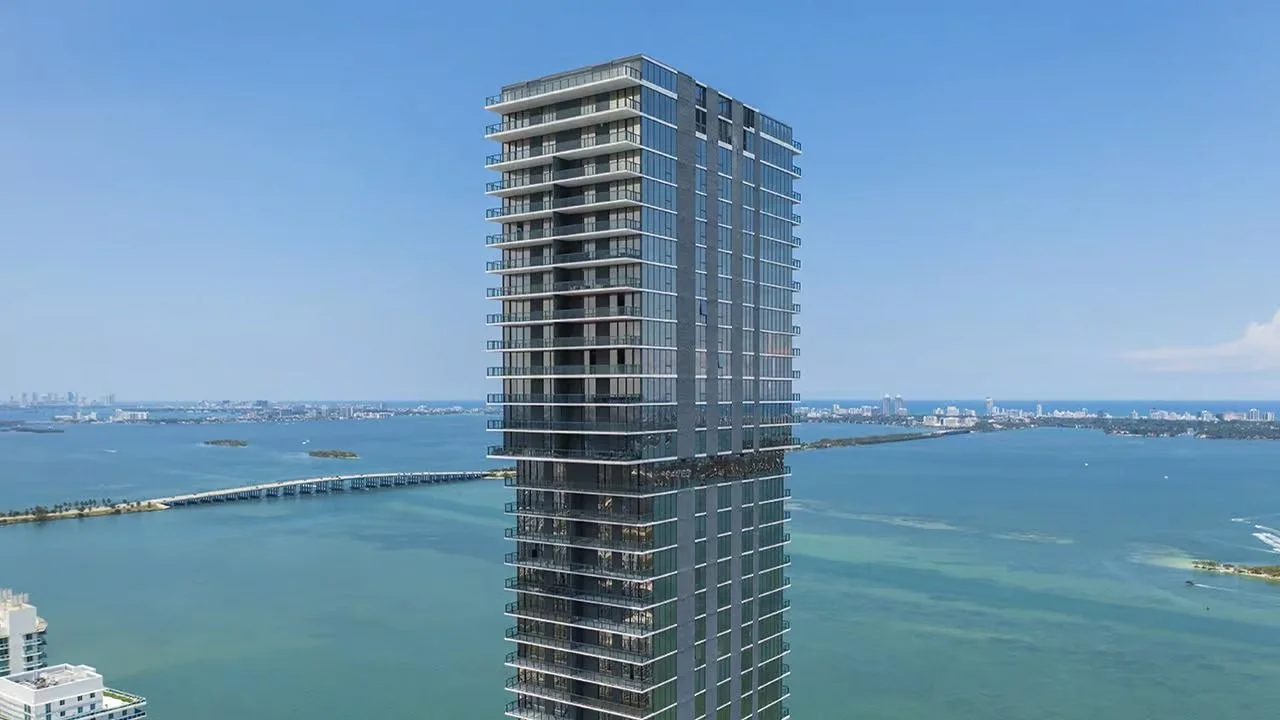
Quick answer: The most consequential fact about this building is in the floor plans rather than the finishes. There is no small stock here at all, which means there is almost no short-horizon investor money, which means the association behaves in a way that a mixed-mix tower’s does not.
Unit mix is treated as a marketing attribute. It is closer to a constitutional one.
The tower in outline
| Location | Edgewater, Miami, bayfront |
| Completed | 2021 |
| Storeys | 57 |
| Residences | roughly 95 to 100, depending on source |
| Configurations | three, four and five bedrooms |
| Interior sizes | about 2,660 to 3,995 square feet |
| Architect and interiors | Arquitectonica; Jean-Louis Deniot |
| Developer | Two Roads Development |
| Coastal inspection due | about 2046 |
Street addresses appear in published sources as both 700 and 788 NE 23rd Street. Roughly one and a half to two residences per floor.
How unit mix determines the owner base
Buyers self-select by what they can buy. A building’s mix therefore decides, before anyone moves in, roughly what kind of owners it will have.
| Unit mix | Who buys | How the association tends to behave |
|---|---|---|
| Heavy in studios and one-bedrooms | Investors, first-time buyers, short holders | Cost-sensitive, high turnover, resists spending |
| Balanced across sizes | Mixed, competing priorities | Slow, negotiated, prone to deferral |
| Exclusively large residences | Occupiers and long-term holders | Fewer competing interests, more willing to fund |
The third row is this building. That has four consequences a buyer can rely on more than they can rely on any projection.
- Internal rental competition is minimal. The problem that dominates a 647-unit tower, where a landlord’s substitutes are on the same lift bank, does not arise at this scale or in this mix. We set that case out in our Aria on the Bay review.
- Spending decisions carry. Owners who live in a building, or intend to hold it for a decade, generally vote to maintain it. Deferral is the behaviour of owners planning to be gone before the bill arrives.
- Turnover is lower. Fewer transactions, fewer distressed sales, and a resale market that moves in steps rather than continuously.
- Delinquency is less likely and more consequential. A base of roughly a hundred means each owner is around one per cent of the budget, so solvency matters, and the ownership profile makes it less likely to be an issue.
The concentration this creates
| Spend of | Per residence, across about 95 |
|---|---|
| A $1m programme | $10,500 each |
| A $3m programme | $31,600 each |
| A $5m programme | $52,600 each |
Illustrative sums divided by the lower published residence count, which is the conservative reading.
Ninety-five to a hundred owners under a 57-storey tower is a genuinely concentrated position, and the arithmetic above is the price of everything in the previous section. Facade access, lift modernisation and plant renewal on a building of this height are not proportional to its unit count.
The mitigation is the ownership profile itself: this is a base that can fund what it decides to fund, and that decides faster than a large one. Concentration is a solvency question first, and on this mix it is a favourable answer. The apportionment rules are covered in our special assessments guide, and the financial statements are what confirm the position, using the method in our Apogee review.
What the mix costs you at resale
The alignment described above is real and it is not free. The same feature that produces a stable owner base narrows the market you will eventually sell into.
A one-bedroom in a large Miami tower has a buyer pool numbering in the thousands: investors, first-time purchasers, second-home buyers, relocations. A four-bedroom apartment of nearly four thousand square feet at this price has a pool numbering in the dozens at any given moment, and those buyers are also considering houses, which is an entirely different comparison set.
That produces the pattern common to all large-format prime residential:
| Metric | Small-unit tower | Large-format tower |
|---|---|---|
| Buyers active at any moment | Many | Few |
| Price sensitivity to a soft quarter | High | Lower |
| Time on market | Short | Long |
| Effect of needing to sell quickly | Modest discount | Substantial discount |
The practical instruction follows from the last row rather than the third. Time on market is only a problem if you have a deadline. An owner with no financing pressure and no fixed exit date experiences a narrow buyer pool as price resilience; an owner who must transact by a certain date experiences the same fact as a discount. The building does not change between those two cases. The purchase structure does, and it is the one variable entirely within a buyer’s control.
Against this, large-format stock in Edgewater is genuinely scarce, and most of what the district is still building is not competing for the same buyer. Scarcity within a category is the thing that holds price when the district’s headline inventory numbers look alarming.
Structure, insurance and the new-build question
A 2021 completion is the strongest structural position available: the current code edition, engineered opening protection, and a coastal milestone around 2046 that sits beyond any realistic hold.
Bayfront exposure is a lower windstorm category than the beach, and worth confirming from the master policy declarations page along with the deductible and its allocation clause.
The live question at this age is the one every recent tower raises, and it is worth asking with more force here because of the denominator. Does the reserve study reach beyond the statutory structural list to the mechanical plant, the lifts, the envelope sealant and the amenity fit-out? On a 57-storey building shared by a hundred owners, a lift modernisation that has not been provided for is a large individual number. The general argument sits in our Brickell Heights review.
The document list
- The reserve study, and specifically what it covers beyond the statutory components.
- The funding schedule against it, with the years the major items land.
- Three years of financial statements, read for what the receivables line is doing.
- The last four annual budgets, to see how operating cost has moved since handover.
- Whatever the documents say about letting: minimum term, approval, any cap.
- The declarations page, the deductible, and who bears it after a named storm.
The first two matter more here than in a larger building, because there is no wide base to absorb an unfunded item. On a hundred-owner tower, a component nobody provided for becomes a five-figure letter rather than a line adjustment.
What works and what does not
Advantages. A unit mix that all but eliminates internal rental competition and produces an owner base inclined to maintain the building. New construction with the best code position available and a milestone beyond any normal hold. Bayfront rather than oceanfront exposure. And large, well-designed residences of a size that Edgewater’s newer inventory largely does not offer.
Disadvantages. Around a hundred owners carry a 57-storey tower, so every capital cost is concentrated. The buyer pool for three- to five-bedroom apartments at this price is narrow, which lengthens exit. Entry pricing already reflects the specification. And Edgewater continues to add supply, even if little of it competes directly on unit size.
Where to walk away
- A reserve study confined to the statutory structural list on a tower of this height.
- No funding schedule showing when lifts and plant land.
- Receivables not disclosed on an association this small.
- Dues unchanged since handover.
- Comparables drawn from Edgewater’s smaller-unit stock, which is not the same market.
Our reading: an unusually well-aligned building, where the mix produces an owner base whose interests match a long-term buyer’s. The cost of that alignment is concentration, and the way to price it is to read the reserve schedule for what it has provided for rather than what it has covered.
For the opposite mix and the problems it creates, see our Aria on the Bay review. For a neighbouring bayfront tower with a brand question instead, see our Missoni Baia review.
Frequently Asked Questions
A 57-storey bayfront tower in Edgewater completed in 2021 by Two Roads Development, designed by Arquitectonica with interiors by Jean-Louis Deniot. It holds roughly 95 to 100 residences, all of them three bedrooms or larger, from about 2,660 to 3,995 interior square feet.
Because unit mix determines who owns the building. A tower with no studios or one-bedrooms attracts almost no short-horizon investor purchases, so the owner base skews towards occupiers and long-term holders, and associations of that kind behave differently on spending and on maintenance.
It makes it a different one. Fewer competing rentals inside the building and a more stable association, against a narrower resale pool and a much higher entry price.
Around 95 to 100, depending on the source. That is a small base for a 57-storey tower, and every capital cost divides accordingly.
Not until roughly 2046, since the coastal clock runs 25 years from a 2021 certificate.
Sources: completion year, storey count, residence configurations, interior sizes, architect, interior designer and developer from Edgewater condominium market records for Elysee Miami. Published sources give both 95 and 100 residences and both 700 and 788 NE 23rd Street; both are reported rather than one asserted, and the cost table uses the lower count. 2046 follows from applying the 25-year coastal rule to the completion year. The relationship between unit mix and owner behaviour is a general observation about condominium governance, not a finding about this association.
Read the schedule, not just the study
Send a unit at Elysee or any small-association Miami tower. We check what the reserve schedule has provided for before you offer.