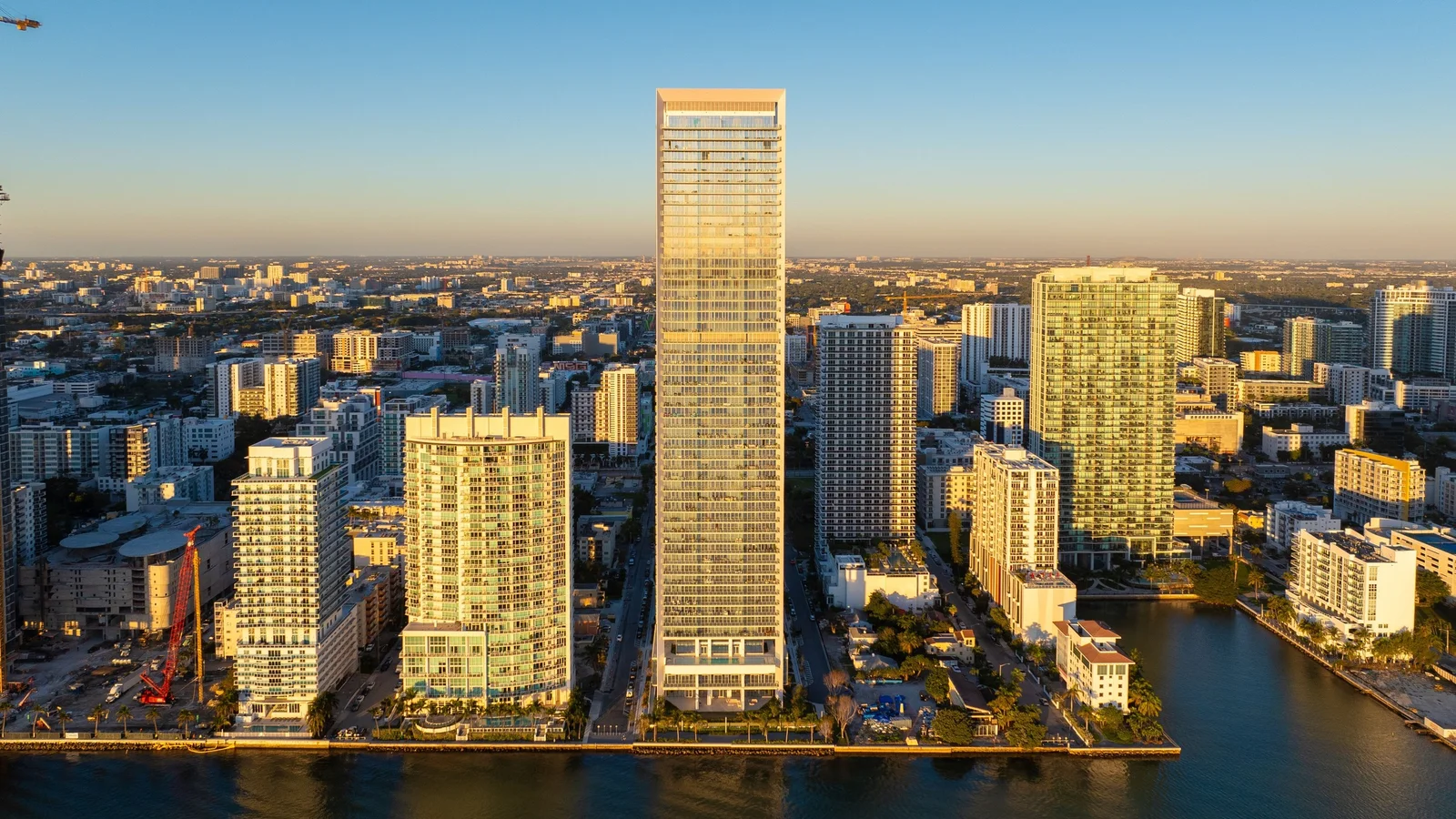
Quick answer: Branded residences are usually discussed as one category. They are at least two. A hotel brand brings an operator, a payroll and a service standard you fund every month. A fashion house brings a design and a name. This building is the second kind, and the difference runs through the whole investment case.
The distinction is not academic. It determines what your dues buy, what happens if the arrangement lapses, and how the name behaves at resale.
The tower in outline
| Address | 700 NE 26th Terrace, Edgewater |
| Completed | 2021 |
| Storeys | 57 |
| Residences | 249 |
| Bay frontage | around 200 linear feet |
| Architecture | Asymptote Architecture with Revuelta |
| Interiors | Paris Forino |
| Developer | OKO Group, in partnership with Missoni |
| Inspection deadline under the coastal trigger | about 2046 |
Amenity accommodation occupies several floors in the lower part of the tower rather than being distributed, which is a configuration that concentrates both the benefit and the maintenance.
Two kinds of brand, two kinds of cost
Set the models side by side and the differences are structural rather than a matter of degree.
| Hotel-operator brand | Design or fashion-house brand | |
|---|---|---|
| What the brand supplies | Staff, standards, service delivery | Design direction, materials, identity, a name |
| Where it appears in the budget | Continuously, as payroll and standard-driven capital | Almost entirely at construction, once |
| Effect on monthly dues | Substantial and wage-sensitive | Limited, close to a conventional tower’s |
| What happens if it ends | Service level and standards change | The building looks the same; the name may go |
| What a buyer is really buying | An ongoing service relationship | A designed object with a label |
Neither column is superior. An owner who wants concierge-level service every day is buying the left column and should expect its cost, as we set out in our Carillon review. An owner who wants a well-designed apartment without funding a service business is buying the right column, and that is this building.
What the right column asks of a buyer is a different question: not what the brand costs, but how long the name is contracted for and what happens after.
Questions to put about the naming arrangement
These are documentary and the association will either be able to answer them or reveal that nobody has asked.
- Is there a licensing or naming agreement, and does it have a stated term?
- Does the association hold any obligation under it, financially or otherwise?
- What happens to the name, signage and marketing rights on expiry?
- Is there any continuing design-control provision that constrains what the association may alter?
The last one has practical consequences. A design-control clause can require that replacement materials match an original specification, which is the mechanism by which a design brand quietly becomes an operating cost after all. It is worth knowing whether one exists before you need to replace anything.
There is also a resale dimension that is easy to state and hard to price. A hotel brand’s value at resale is partly the service the next buyer will receive, which continues to exist. A design brand’s value is the design, which is built and permanent, plus the name, which may not be. If the name goes, what remains is an Asymptote-designed bayfront tower with high-specification interiors, which is not a bad thing to be left holding. Buyers who treat the label as the whole of the premium are the ones exposed.
Our HOA restrictions guide covers the wider set of documents that govern what an owner can and cannot do.
Edgewater’s own variable
The building’s location matters here in a way that is separate from the brand.
Edgewater has absorbed a very large volume of new bayfront construction over the past decade, and more is in progress. That is different from a supply-constrained beach address: this is a district where the competing product is not only existing towers but towers not yet finished.
For a buyer that produces a specific discipline. Establish what is under construction and permitted within a few blocks, and on what timetable. In a district still adding inventory, the relevant comparison for resale in five years is not today’s stock but today’s stock plus whatever completes in between.
The offsetting point is that Edgewater’s bay frontage is finite even where its density is not. A tower with genuine water frontage competes with a smaller set of buildings than the district’s total pipeline suggests, and that distinction is the one worth verifying block by block rather than assuming.
Dividing the costs
| A project costing | Costs each of 249 owners |
|---|---|
| $1,000,000 | roughly $4,000 |
| $3,000,000 | roughly $12,000 |
| $5,000,000 | roughly $20,100 |
Illustrative sums divided by the residence count, not quoted work.
Two hundred and forty-nine is a healthy base, and combined with a 2021 completion it puts this building in the most comfortable structural position in this collection: a distant milestone, a modern code, and enough owners that capital work divides without drama.
The live question at this age is the one that applies to all new towers: whether the reserve study reaches the non-structural components, or stops at the statutory list. We set that argument out in our Brickell Heights review and it applies here without modification.
Insurance and the rental question
Post-2020 construction on a bayfront rather than oceanfront site is close to the best insurance position available in Florida: the strongest code edition, engineered opening protection, and a lower exposure category than the beach. Ask for the master policy declarations page, the deductible and its allocation clause, and note that a new building’s advantage here is real but smaller in absolute terms than buyers expect, because the whole market repriced.
On rental, a design-brand building behaves closer to a conventional luxury tower than a hotel-brand one does. There is no service package to advertise and no operator programme to fill vacancies, so achieved rent rests on the apartment, the view and the district. That makes the arithmetic more predictable and the upside more ordinary. Our gross versus net yield guide covers how to model it without flattering the result.
What to obtain before offering
- The naming or licensing agreement’s term, and any design-control provisions.
- The reserve study, checked for whether it reaches beyond the statutory component list.
- The last four annual budgets, to see how operating cost has moved since handover.
- The leasing rules, minimum term and approval process.
- The master policy declarations page, deductible and allocation clause.
- A list of permitted and under-construction projects within a few blocks.
The first and last items are the two specific to this building. The rest is the standard file for a recent tower.
The case for and against
Advantages. Bay frontage in a district where frontage is finite even though density is not. Post-2020 construction with the best available code position and a milestone two decades out. A 249-unit base. And a brand relationship that adds design without adding payroll, which keeps dues closer to a conventional tower’s than a hotel-branded building’s.
Disadvantages. The name is a licence with a term rather than a permanent attribute, and design-control provisions can constrain future work. Edgewater continues to add competing inventory. There is no operator service package, which is a disadvantage for buyers who wanted one. And amenity accommodation concentrated on a few floors concentrates its maintenance too.
Warning signs
- A naming agreement whose term nobody can state.
- Design-control provisions discovered after closing rather than before.
- A reserve study limited to the statutory structural list.
- Dues unchanged since handover on a building with a substantial amenity programme.
- No enquiry made into what is permitted or under construction nearby.
Our reading: a well-designed bayfront tower in the strongest structural position on this site, whose brand question is narrower and cheaper than the hotel-branded alternatives. Establish the licence term, read the reserve study for what it omits, and check the pipeline down the street.
For the operator-brand version of the same decision, see our Carillon review. For a mixed-ownership branded resort, see our St Regis Bal Harbour review.
Frequently Asked Questions
A 57-storey bayfront tower of 249 residences at 700 NE 26th Terrace in Edgewater, completed in 2021. OKO Group developed it with the Italian fashion house Missoni; Asymptote Architecture and Revuelta designed the building, with interiors by Paris Forino.
A hotel brand usually comes with an operator running services the owners fund continuously. A fashion-house association is typically a design and licensing arrangement: it shapes how the building looks and what it is called, without operating anything.
Cheaper to run and thinner on service. There is no operator payroll inside your dues, and equally no operator delivering a service standard. Which you prefer is a genuine choice rather than a quality ranking.
The design stays, because it is built. The name may not. That is a question to put to the association, since the term of any naming arrangement is a document rather than a matter of opinion.
The 25-year rule applies within three miles of the coast, so a 2021 building comes due around 2046.
Sources: address, completion year, storey count, residence count, bay frontage, architects, interior designer and developer from Edgewater condominium market records for Missoni Baia. The distinction between operator brands and design or licensing brands is a general description of how such arrangements are usually structured; the specific terms governing this building are documents to request rather than facts asserted here. The trigger arithmetic gives 2046; nothing here is taken from a filing.
Ask how long the name is contracted for
Send a unit at Missoni Baia or any branded Miami tower. We separate what the brand supplies from what it costs before you offer.