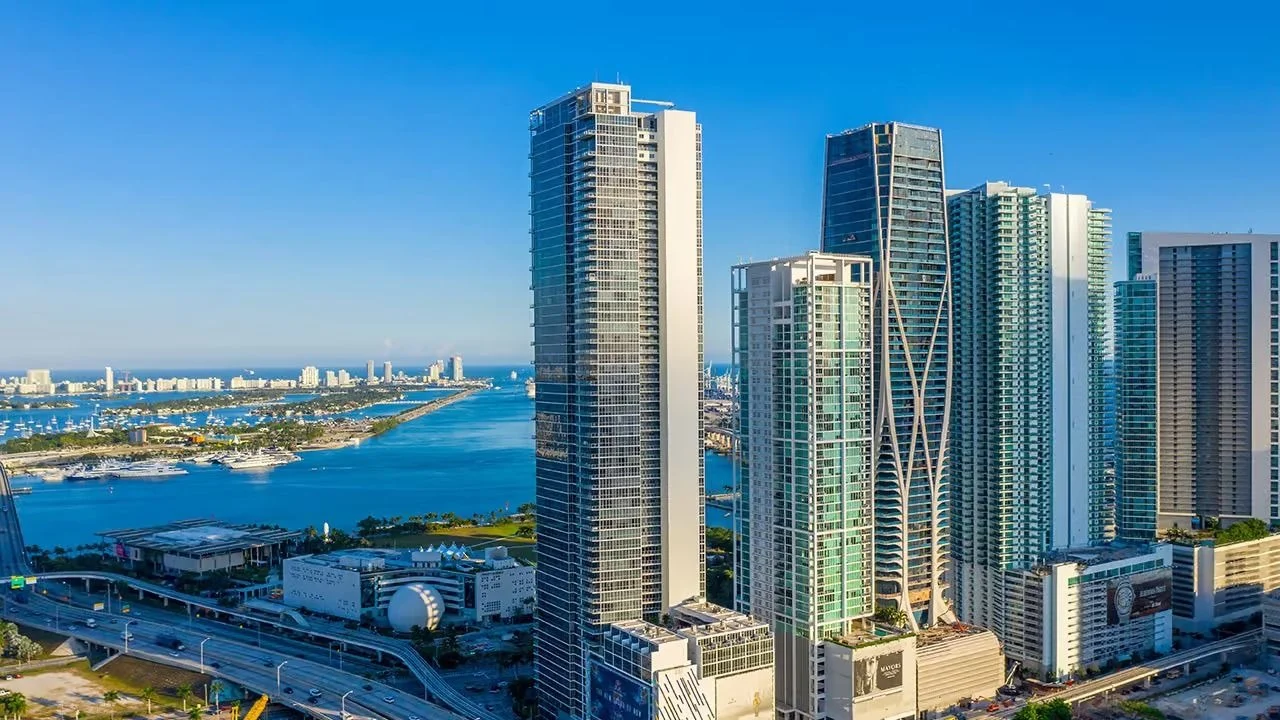
Quick answer: Buildings finished in 2009 rarely sold out to end users, because there were no end users. What happened to the unsold stock determined who owns the building today, and that is a public record rather than a matter of speculation.
This is the least glamorous check in condominium due diligence and one of the most informative, because it tells you who you will be sharing decisions with for as long as you own.
The tower in outline
| Detail | |
|---|---|
| Address | 1100 Biscayne Boulevard, Downtown Miami |
| Completed | 2009 |
| Height | about 702 feet |
| Storeys | 67 |
| Residences | around 292 |
| Hotel component | about 129 rooms |
| Architect | Arquitectonica |
| Inspection deadline under the coastal trigger | about 2034 |
Published sources give both 292 residences and a higher combined figure that includes hotel accommodation. Roughly four to five residences per floor, which is a low density for a tower of this height and reflects the large flow-through plans.
What happened to towers finished in 2009
Construction on a building of this size begins years before it ends. This one broke ground in a market that assumed absorption and completed in one that had none.
The sequence that followed was common across the cohort and it has a durable consequence:
| Stage | What developers did | What it left behind |
|---|---|---|
| Completion into no demand | Held inventory, carried costs | Developer-controlled board, dues subsidised or deferred |
| Carrying costs mounting | Sold blocks of units at large discounts | New owners holding many units each |
| Bulk buyers taking possession | Let the units rather than occupying | An owner base weighted to landlords |
| Gradual retail resale | Units released individually over years | A long tail of originally bulk-held stock |
Not every 2009 tower followed that path and some sold through conventionally. The point is that it is answerable, and answering it changes what you know about the building. Fifteen years on, the pattern is not visible from a listing, a floor plan or a viewing. It is visible only in the ownership records, which is why almost nobody looks.
How to check ownership concentration
Florida property records are public and searchable by parcel. For a condominium that means every unit’s owner is visible.
- Pull the owner of record for each unit, or a representative sample across floors and unit types.
- Look for the same corporate name, or variations of one, appearing repeatedly.
- Note the acquisition dates. A cluster of purchases in the same month a decade ago is the signature of a bulk transaction.
- Compare the number of units held by the largest owner against the total, and against the threshold at which the declaration gives that holder any special right.
A building where the largest owner holds two or three units is an ordinary condominium. One where a single entity holds thirty is a building with a partner you did not choose, and there is nothing improper about that as long as you know before you buy.
Our guide to due diligence on Florida property covers the general record search; this application of it is specific to the cohort.
Why concentration cuts both ways
The instinct is to treat a large holder as a negative. It genuinely depends on which kind of holder it is.
| A concentrated owner who is | Effect on the building |
|---|---|
| A long-term institutional landlord | Reliable dues, pressure to maintain the asset, stable votes |
| A patient private investor | Similar, with less predictability |
| A holder waiting for a price to exit | Resists capital spending; may list many units at once |
| Delinquent or distressed | A single point of failure for a large share of the budget |
The first two are frequently better neighbours than a fragmented base of short-horizon owners, because their interest in the building’s condition matches yours. The third and fourth are the risks, and they are distinguishable: the acquisition dates, any liens on record, and the association’s receivables position between them tell you which you are looking at.
The rules governing what any owner may do with their units sit in the documents, and our HOA restrictions guide covers what to look for.
Dividing the costs
| Capital spend of | Per residence, across about 292 |
|---|---|
| $1 million | about $3,400 |
| $3 million | about $10,300 |
| $5 million | about $17,100 |
Illustrative sums divided by the residential count. Where a cost is shared with the hotel component, the effective denominator differs, which the declaration settles.
That last sentence carries more weight here than the table does. A 67-storey tower’s expensive items (facade access, lift modernisation, high-zone pumping plant) scale with height rather than with unit count, and this building has a great deal of height and a moderate number of residences. Establish which of those costs the hotel component shares before assuming the column above applies.
Structure, insurance and 2034
A 2009 completion means construction under the code as strengthened after the 2004 and 2005 seasons, and a coastal inspection deadline around 2034. The near-term question is funding rather than findings.
The building’s budget history matters as much as its ownership history, and for the same reason: developer control during a collapsed market produced operating assumptions nobody would write today. Read the budget sequence rather than the current dues figure, using the method set out in our Infinity at Brickell review.
For insurance, request the declarations page, the deductible and its allocation clause, plus the last wind mitigation report, and ask specifically how cover and deductibles are apportioned between the residential and hotel components.
Your first requests
- A county records search on unit ownership, looking for concentration.
- The declaration, including how costs divide between residences and the hotel.
- The last five to eight annual budgets in sequence.
- The reserve study and the funding percentage the budget meets.
- The association’s receivables position from its financial statements.
- The master policy declarations page, deductible and allocation clause.
The first item costs nothing but time and answers a question no seller will volunteer.
One practical note on doing it. You do not need to search all 292 units to reach a usable conclusion. Twenty or thirty across different floors and unit types will show a concentration pattern if one exists, because bulk holdings are rarely confined to a single line of the building. If the sample turns up nothing repeated, the base is fragmented and the question is closed. If it turns up the same name three or four times, widen the search before going further.
The case for and against
Advantages. A prominent Biscayne Boulevard position in a district that has developed substantially since the building was completed. Post-2005-code construction with an inspection deadline still years away. Flow-through layouts and large floorplates. And nearly two decades of operating history to read, which newer competitors cannot offer.
Disadvantages. A 2009 delivery means the owner base may have been shaped by bulk disposal rather than retail sale. Height-driven costs divide by a moderate residential count. The hotel component makes cost allocation a documentary question. And the building carries the cohort’s budget history, including any years in which reserves were waived.
Warning signs
- A seller who cannot say whether bulk sales occurred.
- Repeated corporate names across many units with liens on record.
- Cost allocation between residences and hotel that nobody can explain.
- Flat dues across the years when Florida insurance repriced.
- No reserve funding percentage the board is willing to state.
Our reading: a strong building in a district that improved around it, with two questions attached that both have documentary answers. Run the ownership search first. It is the cheapest hour in the whole process and it tells you what kind of association you are joining.
For a newer tower in the same district and an entirely different cost question, see our Paramount review. For how to read a late-cycle budget history, see our Infinity at Brickell review.
Frequently Asked Questions
A 67-storey tower of roughly 702 feet at 1100 Biscayne Boulevard in Downtown Miami, completed in 2009 to an Arquitectonica design. It holds around 292 condominium residences alongside a hotel of about 129 rooms.
Because a tower finished in 2009 was delivered into the worst residential market in living memory. Unsold inventory in that period was frequently disposed of in bulk at large discounts, and the buyers of those blocks became a substantial part of the owner base.
Ownership is a matter of public record. County property records show the owner of each unit, and repeated corporate names across many units indicate concentration. It is a search rather than an enquiry.
Because a holder of many units controls a proportionate share of the vote, has a different time horizon from an occupier, and can list many units at once when it decides to exit.
Around 2034, working forward 25 years from a 2009 completion under the coastal rule.
Sources: address, completion year, height, storey count, residence and hotel room counts and architect from Downtown Miami condominium market records for Marquis Miami. Published counts differ on whether hotel accommodation is included in the total and both readings are noted. The trigger arithmetic gives 2034; nothing here is taken from a filing. The bulk-sale pattern described is the general history of towers completed into that market, not an assertion about this building, which the records search above is what would establish.
Run the ownership search first
Send a unit at Marquis or any Miami tower completed between 2008 and 2010. We check the county records for ownership concentration before you offer.