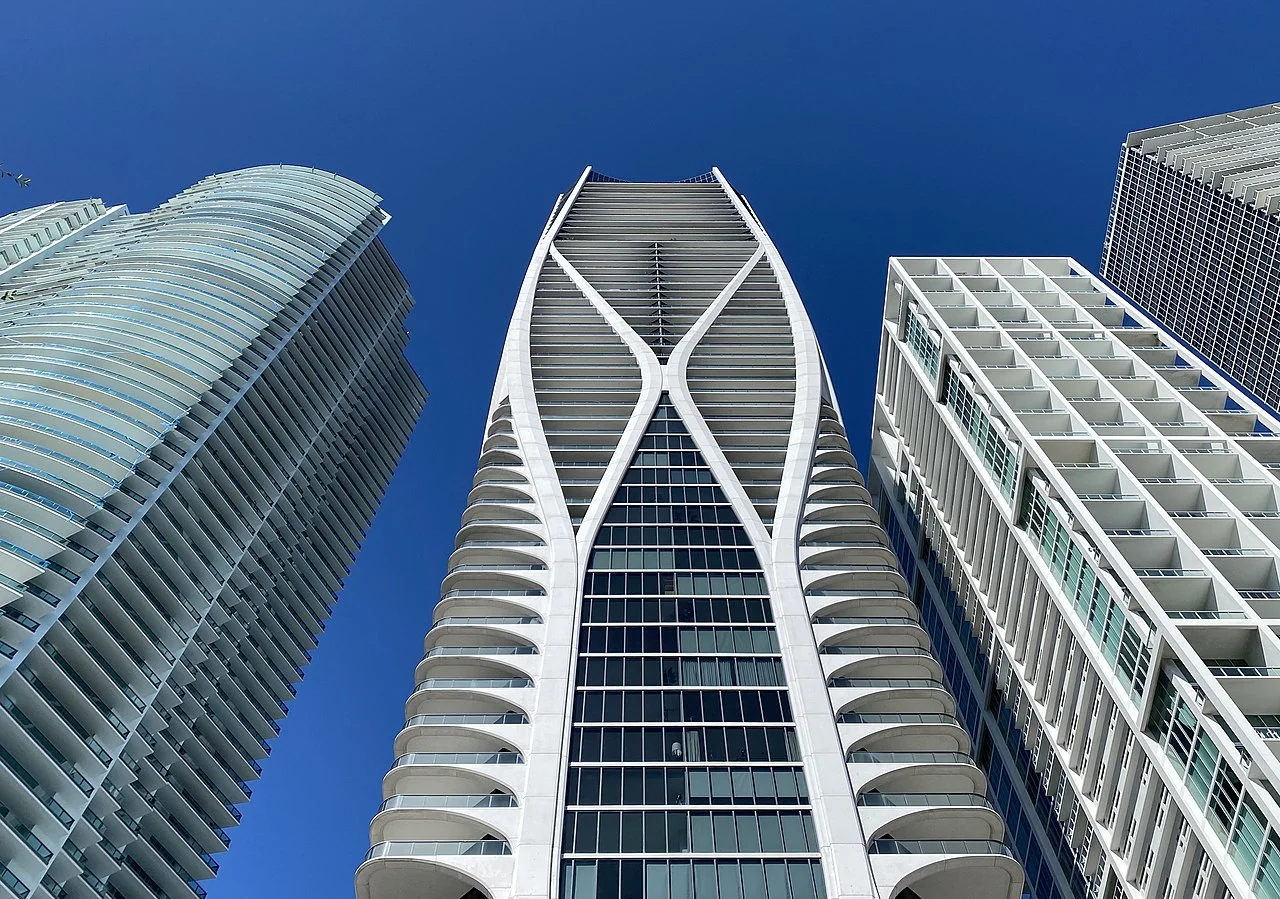
Quick answer: On almost every tall building, the thing holding it up is inside and the thing getting wet is outside. Here they are the same thing. That is what makes the building extraordinary to look at and what makes its maintenance analysis different from every other tower in this collection.
None of this makes the building a poor investment. It makes it a building whose reserve study a buyer should actually read rather than skim.
The tower in outline
| Address | 1000 Biscayne Boulevard, Downtown Miami |
| Completed | 2019 |
| Storeys | 62 |
| Residences | 83 |
| Architect | Zaha Hadid Architects |
| Defining feature | Exterior structural exoskeleton |
| Statutory inspection deadline | about 2044 |
Eighty-three residences over 62 storeys is roughly one and a third per floor. The building was designed around very large single-floor and multi-floor homes, and the low count is a design consequence rather than a marketing decision.
Why an exterior frame moves a budget line
Consider what a facade normally is. On a conventional tower, glass and panels form a weather barrier attached to a concrete frame that sits behind them, protected. If the cladding degrades, you replace cladding. The structure is untouched and largely untouchable by weather.
Move the frame outside and two categories merge:
| On a conventional tower | On an exposed-frame tower |
|---|---|
| Weather acts on cladding | Weather acts on the structure itself |
| Coating failure is a cosmetic issue | Coating failure is a structural protection issue |
| Facade access is for cleaning and glazing | Facade access is also for structural inspection and treatment |
| Repair uses catalogue components | Repair follows the original bespoke geometry |
| Many contractors can bid | A specialist field |
The building is new, engineered to a modern code, and there is no reason to think any of this is a present problem. The point is about categories rather than condition: on this tower, maintaining the coating system is protecting the structure, and that belongs in the reserve study at a structural priority rather than an aesthetic one.
Ask directly whether the study identifies the exoskeleton’s protective system as its own line, on its own interval, with its own funding schedule. That single question separates a study that has looked at this building from one that has been produced for a building of this size.
The design authority question
Zaha Hadid died in 2016, three years before completion. The practice continues and the drawings exist, but the individual whose judgement produced the geometry does not.
That matters less than it sounds for maintenance and more than it sounds for alteration. Repairs follow documented details. Changes (a different coating system, a modified connection, a substituted profile) are judgement calls that on a conventional building would be resolved by a competent engineer and here interact with a design of unusual specificity.
The practical consequence is procedural. Establish whether the association retains a relationship with the original architect or engineer of record for questions of this kind, and whether the as-built documentation is complete and held. A building of this complexity with incomplete records is materially harder to maintain than one with a complete set, and the difference is invisible until the first time it matters.
Eighty-three owners
| A capital project of | Costs each of 83 owners |
|---|---|
| $1 million | about $12,000 |
| $3 million | about $36,100 |
| $5 million | about $60,200 |
Illustrative sums divided by 83, not prices quoted for anything.
This is the second-smallest base in this collection and it sits under a 62-storey tower, which is an unusual combination. A facade access and treatment programme on a building of that height is not a small project, and it divides by a number more typical of a boutique low-rise.
The counterweight is the one that applies across ultra-prime and applies unusually strongly here: an owner base at this level is generally able to fund what the building needs, and a small association can decide quickly. Concentration is a liquidity question rather than a solvency one. How the apportionment itself is set is covered in our special assessments guide.
What the scarcity is actually worth
The costs above are real and they are also, on a building like this, the smaller half of the argument.
Miami has a great many towers with large residences, good views and expensive finishes. It has one completed residential skyscraper by Zaha Hadid, and the architect’s death means the global supply of such buildings is now fixed. That is scarcity in the strict sense rather than the marketing sense: no additional units of this thing can be produced, at any price, by anyone.
Assets with genuinely fixed supply behave differently through a cycle. When Miami condominium pricing softens, it softens because supply competes with supply, and the buildings that compete on comparable attributes take the discount. A building with no comparable does not participate in that mechanism in the same way. Its price is set by how many buyers want the specific thing rather than by what the tower next door is asking.
The corollary is the one to plan around. Prices set by a small pool of specific buyers move in steps rather than smoothly, and the time to find that buyer is longer. This is an asset to hold without a fixed exit date, and financing it in a way that forces a sale on a timetable is the one structural mistake available here. Our rental yield guide covers how to think about carrying costs on an asset whose exit is time-flexible rather than price-flexible.
Insurance on a singular structure
Post-2019 construction is the best position available in Florida on code, wind rating and opening protection, and the building’s location on Biscayne Boulevard is bayfront rather than oceanfront, which is a lower exposure category than Collins Avenue.
What is less standard is the insured value and the basis of reinstatement. A building whose geometry is unique cannot be rebuilt from a catalogue, and the valuation basis in the master policy should reflect that. Ask for the declarations page, the insured value, the basis of settlement and the hurricane deductible with its allocation clause. Then ask when the insured value was last reviewed. Our property insurance costs guide covers what has moved in the wider market.
Your first requests
- The reserve study, with the exoskeleton’s protective system identified as its own line.
- The funding schedule against it, and the interval assumed for facade treatment.
- Confirmation that as-built documentation is complete and held by the association.
- The master policy declarations page, insured value, basis of settlement and deductible allocation.
- Any specialist maintenance or inspection contracts for the structure, with their terms.
- Minutes for the last three years, read end to end.
The first and third items are specific to this building. Everything else is the standard file for a new tower.
What works and what does not
Advantages. A genuinely singular asset by an architect whose completed residential work is scarce, which supports value on a basis unrelated to square-foot comparables. New construction with the strongest code position available and a milestone two decades out. Very large residences at low density. And a bayfront rather than oceanfront exposure, which is a real insurance advantage over the beach towers.
Disadvantages. The structure is weather-exposed, which moves its protection into the structural budget permanently. Only 83 owners carry a 62-storey building. Bespoke geometry means specialist contractors and no catalogue pricing. And the design’s author is no longer available for the judgement calls that alterations require.
Where to walk away
- A reserve study with no line specific to the exterior structure.
- No stated interval or funding schedule for facade treatment.
- As-built documentation that the association cannot confirm it holds.
- An insured value last reviewed years ago on a building that cannot be conventionally rebuilt.
- A seller who treats the exoskeleton purely as a design feature.
Our reading: an exceptional building with one genuinely unusual maintenance category, and the whole analysis is whether the association has recognised that category in writing. If the reserve study names it, this is a straightforward purchase at the top of the market. If it does not, the study has not been done for this building.
For a neighbouring tower whose issue is the district rather than the structure, see our Ten Museum Park review. For the same bespoke-maintenance argument on an oceanfront site, see our Jade Signature review.
Frequently Asked Questions
A 62-storey tower of 83 residences at 1000 Biscayne Boulevard, Downtown Miami, completed in 2019 to a Zaha Hadid Architects design. Its structural exoskeleton is carried on the outside of the building rather than concealed within it.
Because on a conventional tower the load-bearing frame is protected inside the envelope and the weather acts only on cladding. Here the frame itself is the weather-exposed surface, which makes its protective coating a structural maintenance item rather than a cosmetic one.
No. It means an ordinary maintenance category has moved into the structural column of the budget, and a buyer should check that the reserve study has followed it there.
83. That is among the smallest bases of any tower this size in Florida.
On the 25-year coastal trigger a 2019 completion points to roughly 2044.
Sources: address, completion year, storey count, residence count, architect and the exterior structural configuration from Downtown Miami condominium market records and published architectural documentation for One Thousand Museum. The inspection year above is our arithmetic on the coastal trigger, not a published figure. Maintenance observations follow from the building’s published configuration and are not an assessment of this association’s reserve study, which is what the document list above would establish.
Check whether the study names the frame
Send a unit at One Thousand Museum or any architecturally singular Miami tower. We read the reserve study for what it actually covers before you offer.