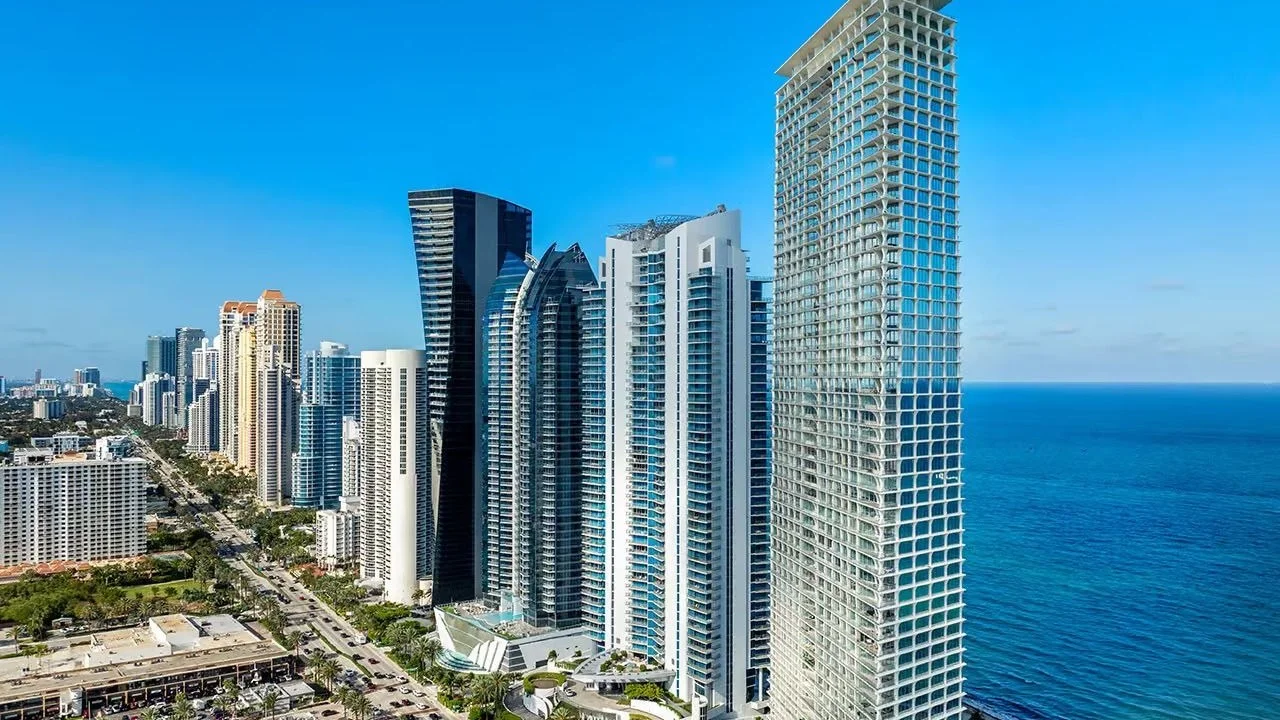
Quick answer: The design is the reason to buy this building and it is also the line item nobody prices. A Pritzker-office envelope on an oceanfront site is not a one-time cost paid at purchase. It is a recurring cost, divided among 192 owners, for as long as the building stands.
This is not an argument against buying it. It is an argument for reading the operating budget with the same attention most buyers give the floor plan.
Building at a glance
| Detail | |
|---|---|
| Address | 16901 Collins Avenue, Sunny Isles Beach |
| Built | 2018 |
| Storeys | 55 |
| Units | 192 |
| Architect | Herzog and de Meuron |
| Milestone deadline, 25-year coastal trigger | about 2043 |
One hundred and ninety-two residences over 55 storeys works out at roughly three and a half per floor. For comparison, a conventional Miami tower of the same height carries two or three times that. The building was designed around large plans and deep terraces rather than unit count, and every consequence discussed below follows from that decision.
Why bespoke construction costs more to keep
Ordinary high-rise maintenance runs on a market. Sealant, glazing units, railing components, door hardware and roofing systems are catalogue items with several suppliers, published prices and contractors who install them weekly.
Architecturally distinctive buildings step outside that market to varying degrees, and the further outside they step, the more the arithmetic changes.
| What changes | Why it costs more |
|---|---|
| Non-standard glazing sizes or profiles | Fabricated to order, longer lead times, no salvage stock |
| Custom railing, soffit and terrace detailing | Fewer contractors able to bid, so fewer competitive quotes |
| Deep cantilevered terraces on an oceanfront site | More exposed waterproofing area per unit of enclosed floor |
| Specified finishes chosen for appearance | Replacement in kind, or a visible compromise owners will resist |
The last row is the one that surprises people. On a conventional building a board can substitute a cheaper equivalent and nobody notices. On a building bought for its architecture, substituting is itself a loss, and owners generally vote to replace in kind. That is a rational choice and it is more expensive.
Salt air is the multiplier
Sunny Isles Beach is oceanfront. Chloride exposure is the single most aggressive environment Florida construction faces, and it acts on precisely the elements a design-led building has more of: sealant joints, exposed metalwork, terrace waterproofing and glazing perimeters.
A 2018 building is nowhere near a structural problem. What it is near is the start of its envelope maintenance cycle, and on an oceanfront site those cycles run shorter than the industry ranges quoted for inland construction.
The practical consequence is that the reserve study for this building should look different from one for an equivalent inland tower, with envelope items appearing earlier and larger. If it does not, either the study is generic or the board has not engaged with the site.
The denominator, and why it bites here
| A capital project of | Costs each of 192 owners |
|---|---|
| $1 million | about $5,200 |
| $3 million | about $15,600 |
| $5 million | about $26,000 |
The left column is hypothetical. Only the division is real.
Two independent factors point the same way: a maintenance profile above the market average, and an owner base well below it. That combination is the building’s real financial signature, and it is entirely manageable if the budget reflects it.
It is worth saying plainly that this is not a defect. Owners at this price point are generally able to fund what the building needs, and a small association with aligned owners can decide and act faster than a 700-unit one. For how the apportionment itself is set, see the special assessments guide.
What the architect’s name is worth on the way out
Design-led ultra-prime behaves differently at resale from conventional luxury stock, and the difference shows up in the wrong metric if you are not looking for it.
A conventional oceanfront tower has a broad buyer pool. Price moves, volume follows, and time on market stays within a normal band because there is always someone for whom the building is simply a good address. A building bought for its architecture has a narrower pool: buyers who want that specific thing, and who will pay for it, but who arrive at their own pace.
The practical result is that architectural buildings tend to hold price and lengthen time on market rather than the reverse. Two consequences follow:
| If you plan to | The relevant question is |
|---|---|
| Hold long and sell once | Price resilience, which favours this category |
| Sell on a fixed timetable | Depth of the buyer pool, which does not |
A seller who needs to transact in ninety days is in the weaker position here than in a mass-market building, whatever the price achieved eventually. That is worth knowing before you buy rather than after, and it argues for holding this kind of asset with no financing pressure attached to it.
The same logic applies to renting. Low density and large plans produce a small, specific tenant pool at the top of the market rather than a deep one, so vacancy periods run longer and each one costs more. Our Florida rental yield guide covers how to model that properly, and the short version is that gross yield on a building like this one is a poor guide to what you will actually receive.
Insurance on a 2018 oceanfront tower
Construction year works strongly in this building’s favour. Post-2010 construction, engineered for a site with the highest wind exposure in the state, is about as well positioned as Florida stock gets on opening protection and structural rating.
Oceanfront location works against it just as strongly. Windstorm pricing is a function of exposure as well as construction, and a first-row building on Collins Avenue is the maximum-exposure case.
Those two pull in opposite directions and the net answer is specific to the policy rather than derivable from the building. Ask for the master policy declarations page, its deductible, and how the deductible is allocated among owners after a named-storm event. On an oceanfront tower that allocation clause matters more than the premium. The wider picture is in our Florida property insurance costs guide.
What to request, in order
- The reserve study, and specifically whether envelope and terrace waterproofing appear with site-appropriate intervals rather than generic ones.
- The funding schedule against it, and the years the envelope items land.
- The last five annual budgets, to see how operating cost has moved since handover.
- Any maintenance or service contracts for specialist building systems, and whether the contractor is sole-source.
- The master policy declarations page, its deductible, and the hurricane deductible allocation.
- Board minutes covering the last three years.
The fourth item is the one specific to this building. Sole-source contracts are common on bespoke construction and they are the mechanism by which a design premium becomes permanent.
Strengths and weaknesses
Advantages. An oceanfront position on the strongest stretch of Sunny Isles with an architect whose name carries genuine international resale weight. Post-2010 construction with a milestone two decades away. Very low density, which delivers the space and privacy the price implies. And a small, capable owner base that can act quickly when it agrees.
Disadvantages. Bespoke construction is more expensive to maintain than catalogue construction and always will be. The oceanfront site accelerates the envelope cycle. A 192-unit denominator concentrates every capital cost. And the buyer pool for a design-led ultra-prime residence is narrower than for conventional stock, which affects time on market at exit rather than price.
What should stop you
- A reserve study with generic component intervals that ignore the oceanfront exposure.
- No envelope or terrace waterproofing line identified separately.
- Operating costs flat since 2018 on a building of this specification.
- Specialist maintenance contracts that cannot be produced.
- A hurricane deductible allocation clause the seller has not read.
Our reading: a genuinely distinguished building with an unusually legible cost structure, provided you look for it. The architecture that justifies the price also sets the operating profile, and the reserve study is where you find out whether the board has understood that.
For a building where the mechanical rather than the architectural specification drives the cost, see our Porsche Design Tower review. For the general shape of the new-build maintenance cycle, see our Brickell Heights review.
Frequently Asked Questions
A 55-storey oceanfront condominium of 192 residences at 16901 Collins Avenue, Sunny Isles Beach, completed in 2018 and designed by Herzog and de Meuron.
Because a bespoke envelope has no off-the-shelf replacement parts. Non-standard glazing, custom terraces and one-off detailing cost more to repair and maintain than conventional construction, permanently.
No, it is unusually few. Roughly three and a half residences per floor means large plans, and it also means a small base to divide any capital cost across.
Not until roughly 2043, since the coastal clock runs 25 years from a 2018 certificate. Structural risk is not the near-term question here.
The operating and reserve budget. On an oceanfront building with a bespoke envelope and a small owner base, that is where the cost lives.
Sources: address, build year, storey count, unit count and architect from Sunny Isles Beach condominium market records for Jade Signature. The 2043 date is our own calculation from the coastal trigger. Maintenance-cycle observations are general to bespoke coastal construction rather than an assessment of this association’s budget. The per-owner column divides an illustrative cost by 192.
Read the reserve study for the envelope
Send a unit at Jade Signature or any oceanfront Sunny Isles tower. We check whether the reserve schedule prices the site rather than a generic building.