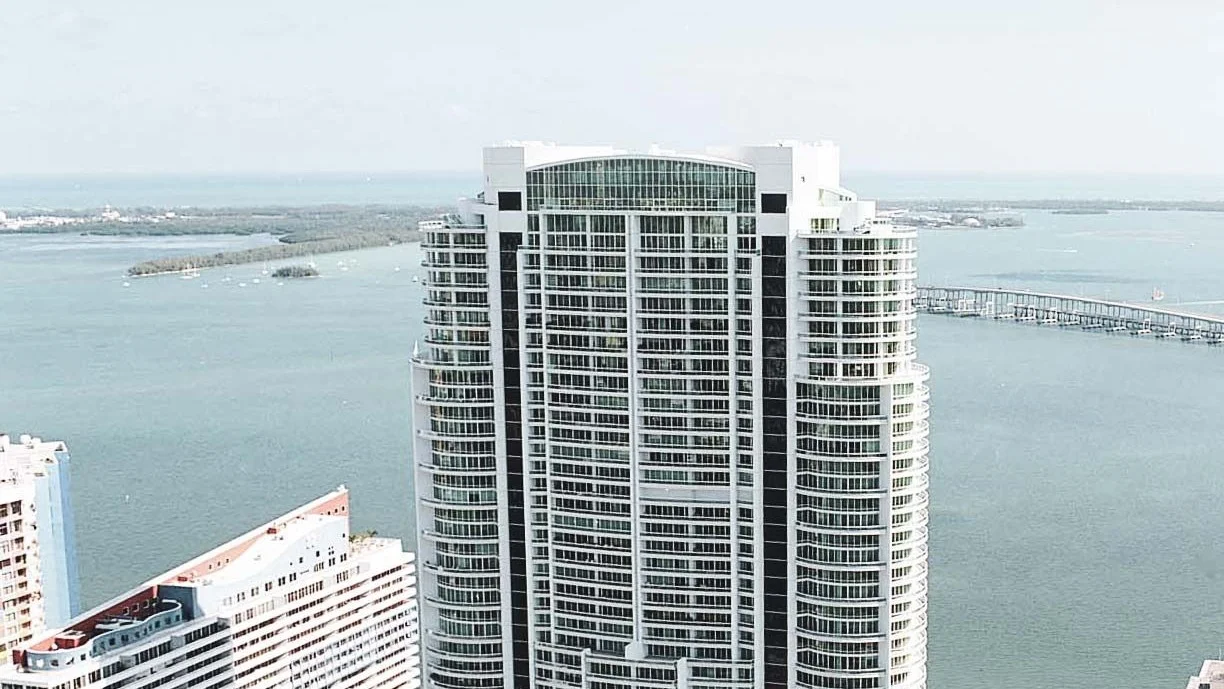
Quick answer: Every other Brickell building on this site is discussed in terms of when its milestone inspection will fall due. Here it has already come and gone. A 1997 building on Brickell Avenue reached its 25-year coastal trigger around 2022, which means the engineer’s report is not a future document. It exists, or its absence is the finding.
This is the most useful position a Florida condominium buyer can find themselves in, and most of them treat it as the worst. An older building past its milestone deadline has been examined by a structural engineer whose report is a matter of association record. You are not guessing.
What the building is
| Item | Detail |
|---|---|
| Address | 1643 Brickell Avenue |
| Built | 1997 |
| Units | 173 |
| Milestone deadline, 25-year coastal trigger | about 2022 |
A hundred and seventy-three units in a full-height Brickell tower means large floor plans and a small owner base. Both are deliberate: this is a low-density building from an era when Brickell Avenue was residential rather than a business district, and it competes on space rather than on amenity count.
What “past the deadline” actually means
The statutory trigger is 25 years from the certificate of occupancy for anything standing within three miles of the coastline, and 30 years for everything further in. Brickell Avenue sits on Biscayne Bay, so the shorter clock is the one that ran here.
A 1997 completion puts the deadline around 2022. So one of three things is true, and establishing which takes a single request:
| Situation | What it tells a buyer |
|---|---|
| Inspection complete, work identified and funded | The liability is quantified and paid. This is the best position available in Florida. |
| Inspection complete, work identified, funding in progress | The number exists. It is negotiable, and it is knowable before you commit. |
| No inspection on record | The building is carrying an unresolved statutory obligation, and you would be buying it. |
Notice that two of those three are good outcomes. The market treats “1997 building” as a warning; the actual information content is far better than that of a 2015 building whose first inspection is still fifteen years away and entirely unpriced.
The denominator is the real constraint
Where the building’s age gives you information, its size takes some of it back.
One hundred and seventy-three owners is a small base for a building of this scale. A capital project that a 1,000-unit tower absorbs quietly lands here in meaningful individual sums.
| Capital cost | Per owner across 173 units |
|---|---|
| $1 million | about $5,800 |
| $3 million | about $17,300 |
| $5 million | about $28,900 |
Division, not estimation. Nobody has quoted a price for work at this building.
That combination, an older building with a small owner base, is precisely why the reserve study matters more here than the price does. A funded reserve turns those numbers into a line already paid. An unfunded one leaves them in front of you, and 173 is not a large number of people to spread them across.
The second deadline, and why it lands harder on 173 owners
The milestone inspection is the deadline everyone talks about. The structural integrity reserve study is the one that decides what a purchase costs.
The same legislation that set the inspection timetable also required associations to commission a reserve study covering the structural components (roof, load-bearing structure, fireproofing, plumbing, electrical, waterproofing, windows and exterior doors) and then removed the option that had made Florida condominium budgets affordable for thirty years. Owners could previously vote each year to waive or reduce reserve funding, and a great many buildings did exactly that, annually, for decades. For the components the study covers, that vote no longer exists.
That change is neutral for a building that funded properly all along. For one that waived, it converts a long habit into a bill.
Here the denominator does the damage a second time. A large association absorbing decades of deferred contributions spreads the catch-up across hundreds of owners and several budget years. Santa Maria spreads it across 173. Whatever the study concluded, the per-owner consequence of an under-funded history is larger in this building than it would be in the towers immediately north of it, and it is larger for the same reason the building is attractive: there are not many units in it.
So the question to put to the association is not whether a reserve study exists. It is what percentage of the study’s recommended funding the current budget actually meets, and how long the board has been at that level. A study filed and ignored is a document, not a defence.
What a 1997 structure means for insurance
Construction year drives Florida windstorm pricing more than any other single input, and 1997 sits in a specific place: after the post-Hurricane Andrew code strengthening of the mid-1990s, and well before the revisions that followed the 2004 and 2005 seasons.
In practice that means better than 1980s stock and materially behind post-2010 construction on opening protection, roof attachment and impact resistance.
What changes the answer for an individual building of this vintage is what has been done since. Window and door replacement programmes, roof replacement and structural remediation all shift a building’s insurance profile, and on a building that has completed milestone work the improvement can be substantial.
Ask for the wind mitigation inspection report alongside the engineer’s report. On a 1997 building it is the document that tells you whether the structure has been brought forward or left as built.
Why this cycle rewards buildings like this one
Florida condominium pricing through 2026 has been reshaped by structural and insurance uncertainty. Condo supply statewide runs at roughly double single-family supply and condo median prices have been flat while houses rose. The repricing has been indiscriminate: buyers have discounted older buildings as a class rather than building by building.
Indiscriminate discounting is where value appears. A 1997 building that has inspected, remediated and funded is objectively lower-risk than an unexamined 2005 building, and frequently trades at a similar or lower level because “1997” reads as old and “2005” does not read as anything.
The work is documentary rather than analytical. We set out the wider argument in our Florida condo price drop guide and the mechanism in our SB 4-D assessment wave update.
What to request, in order
- The milestone inspection report in full. Not a summary, not a cover letter.
- The structural integrity reserve study, and the association’s actual funding level against its recommendations.
- Any remediation contracts and their completion status.
- Board minutes for the last three years, which is where the assessment discussion happened.
- The master policy declarations page, and what the hurricane deductible actually is.
- The estoppel letter for the specific unit, covered in our estoppel letter guide.
The first item is the one that decides this purchase. An association that produces it within a day is well run. One that cannot has told you what you needed to know.
Pros and cons
Advantages. The information exists: this building has been through the process the rest of the market is still anticipating. Large floor plans and low density on Brickell Avenue, which newer towers do not offer at this size. Entry pricing reflects sector-wide discounting of older stock rather than anything specific here. And if the work is done and funded, the largest uncertainty attached to Florida condominiums has been removed rather than deferred.
Disadvantages. A 173-unit denominator makes every future capital event expensive per owner. A 1997 structure insures worse than post-2010 construction, and that gap is permanent. Components across the building are at or past typical service lives. And resale is to a buyer who will run exactly this analysis, so any unfunded liability you accept is discounted again when you sell.
Red flags
- An association that cannot produce a milestone report on a building past its deadline.
- A report supplied as a summary, with the engineer’s findings paraphrased by someone else.
- Low dues on a 1997 building with no reserve contribution identified separately.
- Remediation described as “planned” with no contract and no funding source.
- A listing that emphasises the floor plan and the address and is silent on the structural position.
Our reading: the age is the reason to look, not the reason to leave. Ask for one document. If it arrives, you are further ahead than you would be on almost any newer building in the neighbourhood. If it does not, you have learned that in an afternoon rather than after closing.
For a coastal building approaching rather than past its trigger, see our Akoya review. For one where scale rather than age dominates, see our Icon Brickell review.
Frequently Asked Questions
1997, at 1643 Brickell Avenue. It holds 173 units, which is a small owner base for a Brickell tower.
On the 25-year coastal trigger a 1997 certificate of occupancy points to a deadline around 2022, so the inspection should already be complete and the report should exist. That is the first document to request.
No. An older building that has inspected, identified its work and funded it carries less uncertainty than a newer one that has never been examined. Age determines when you find out, not what you find.
It is a small denominator for a full-size tower. Capital costs divide by 173 rather than by several hundred, so each owner's share of any work is correspondingly larger.
That is itself the answer. A building past its statutory deadline with no report available is carrying an unresolved obligation, and a buyer would be acquiring it.
Sources: address, build year and unit count from Miami condominium market records for Santa Maria, 1643 Brickell Avenue. The 2022 deadline is derived from the statutory trigger rather than reported by anyone; confirming it needs the certificate of occupancy. The per-owner columns are simple division by 173. Statewide supply and price context from Florida Realtors monthly statistics. Verified 27 August 2026.
Ask for the report before you view
Send a unit at Santa Maria or any pre-2000 Florida coastal building. We establish whether the milestone inspection is on record and what it found.