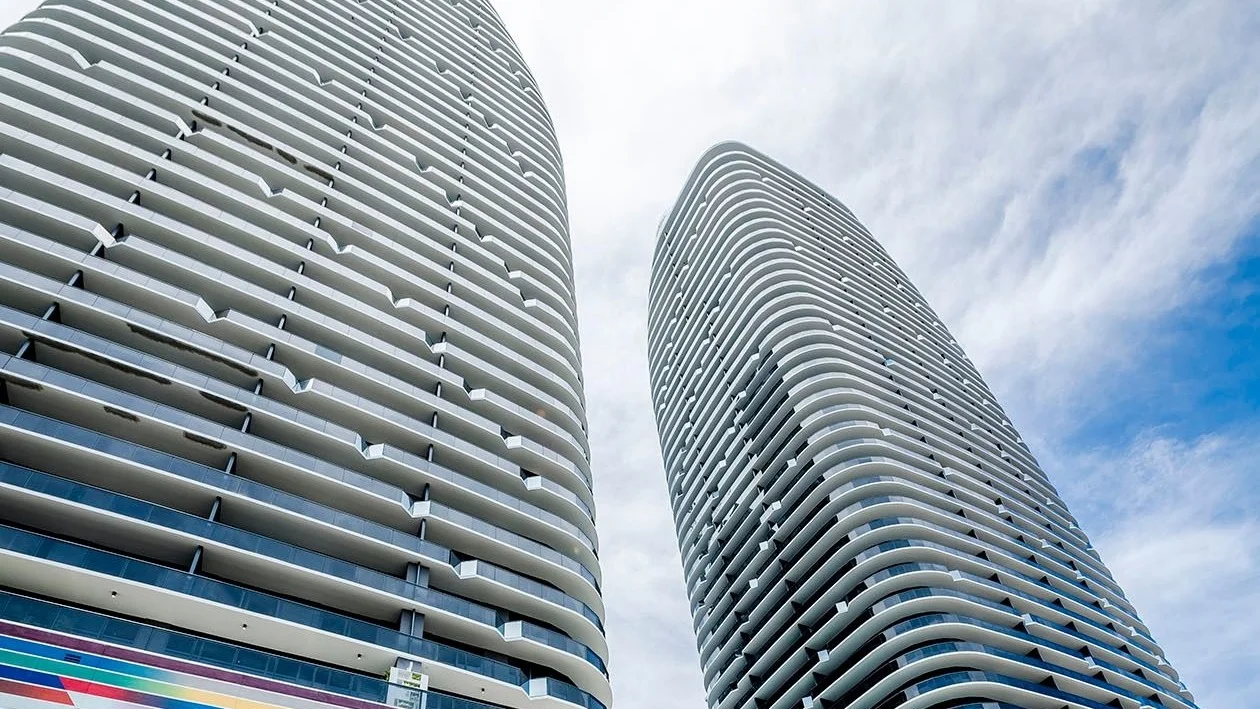
Quick answer: This is the building where the Florida condominium conversation of the last four years does not apply. A 2017 tower has no milestone inspection to worry about, no waived-reserve history and no assessment wave attached to it. What it has instead is a first replacement cycle that nobody discusses because it arrives quietly.
New construction is sold as the absence of problems. It is more accurate to say it is the deferral of a different set of them, on a schedule that is knowable in advance and almost never asked about.
What the buildings are
| Item | East tower | West tower |
|---|---|---|
| Address | 45 SW 9th Street | Brickell Heights West |
| Built | 2017 | 2017 |
| Storeys | 49 | 47 |
| Units | 358 | 332 |
| Developer | Related Group | Related Group |
| Inspection deadline under the coastal trigger | about 2042 | about 2042 |
Six hundred and ninety residences across two towers of near-equal height, delivered together, on the western side of the neighbourhood rather than the avenue.
Genuinely absent here
It is worth being specific about this, because it is the building’s strongest argument and it usually gets stated too vaguely to be useful.
| Concern common on Brickell stock | Position here |
|---|---|
| Milestone inspection due within a hold period | Roughly 2042, so no |
| History of lawfully waived reserves | The building post-dates most of that practice |
| Developer-controlled board setting budgets into a crash | Delivered into a rising market, not a collapsing one |
| Pre-2005 code construction and its insurance penalty | Built to a materially later code edition |
| Unknown structural condition | Twenty-two years of documented service |
Five real advantages, none of them marketing. A buyer choosing between this and a 2004 tower a few blocks away is choosing between a known operating profile and an unknown structural one, and the premium for that is frequently smaller than the difference deserves. The counterpart case, an older building where the report already exists, is in our Santa Maria review.
The cycle that does arrive
Buildings do not stay new. They stop being new component by component, on schedules that have nothing to do with the statutory milestone.
- Mechanical plant. Chillers, pumps and cooling towers on a high-rise typically run fifteen to twenty-five years before major overhaul or replacement. A 2017 building is approaching the near end of that window.
- Elevators. Modernisation on a heavily used residential tower is commonly discussed at around twenty years, and in a 49-storey building the cost is proportional to the rise.
- Envelope sealant and glazing gaskets. Joint sealant on a coastal high-rise has a service life measured in the mid-teens of years. Failing sealant is a water problem before it is a structural one.
- Roof membrane. Depends entirely on the system specified, but this is the decade in which the question opens rather than the one in which it is settled.
- Amenity fit-out. Pools, decks, gyms and lobbies in an amenity-led 2017 tower were specified to sell units. They wear at the rate they are used, and replacing them to the standard the building markets is not cheap.
None of these is a crisis and all of them are budgetable. The question a buyer should put to the association is whether they are in fact budgeted: does the reserve study cover the non-structural components as well as the statutory list, and does the funding schedule reach them.
That distinction is the single most useful thing to check on a building of this age. The law compels funding for the structural components. Everything on the list above sits outside that compulsion, which means it is funded only if the board chose to fund it.
The consequence of not funding it is not an emergency. It is a special assessment on a building that everyone involved still thinks of as new, arriving for a chiller replacement rather than for anything dramatic, and landing on owners who bought partly to avoid exactly that. A board that has scheduled the work and collected against it produces a dues figure that looks high next to a neighbour’s. A board that has not produces a lower one and a bill later. Comparing dues between buildings without opening both reserve schedules mistakes the second for the better building.
There is a reasonable counter-argument, and it belongs here rather than in a footnote. Funding every non-structural component to full replacement is expensive, and some boards deliberately choose to assess when the work arrives instead, on the view that owners should not prepay for a chiller they may never see replaced. That is a defensible policy. What is not defensible is having no policy, and the way to tell the two apart is whether the minutes record a decision or simply never raise the subject.
Reading a 690-unit denominator
| A project costing | Costs each residence |
|---|---|
| $1,000,000 | roughly $1,400 |
| $3,000,000 | roughly $4,300 |
| $5,000,000 | roughly $7,200 |
Illustrative sums divided by the project’s residences, not quoted work.
A project of this size absorbs replacement work about as efficiently as anything in the neighbourhood. What large associations trade away is speed and clarity: more owners, more competing priorities, and on a two-tower project the additional question of whether the towers share a budget at all. That last point is not assumable, and we set out how to establish it in our Plaza on Brickell review.
Insurance on post-2010 construction
Construction year, opening protection and roof age are the three inputs that dominate Florida windstorm pricing, and a 2017 tower is well placed on all three.
That advantage is real, permanent relative to older stock, and smaller than buyers expect in absolute terms, because the whole market repriced. A newer building pays less than an older one and still pays more than it did five years ago. The distinction matters when you compare dues between buildings: a lower premium on a newer tower can be entirely offset by a richer amenity programme to run. Our Florida property insurance costs guide covers what has moved and why.
What to obtain before offering
- The reserve study, and specifically whether it covers non-structural components or only the statutory list.
- The funding schedule against that study, with the years the major items land.
- The last five annual budgets, to see how the amenity operating cost has moved since handover.
- The leasing rules for your tower, the minimum term and the approval process, which can differ between towers.
- The declarations page for the master policy, and the deductible on it.
- Three years of board minutes.
The first two are the whole exercise on a building this age. On an older tower you read the documents to find out what is wrong; here you read them to find out what has been planned for.
The case for and against
Advantages. Post-2010 construction with the insurance and code position that implies. A milestone two decades out, which removes the dominant Florida condominium risk from the hold period entirely. A 690-unit project denominator. And a documented operating history under owner control rather than a developer’s projection.
Disadvantages. Amenity-led towers cost more to run than plain ones, permanently. The first replacement cycle for mechanical, envelope and fit-out begins in this decade and is not covered by the statutory reserve requirement. Entry pricing already reflects the building’s age advantage. And on a two-tower project the rules and budgets have to be checked tower by tower.
Warning signs
- A reserve study limited to the statutory structural list with nothing budgeted beyond it.
- Dues that have not moved since handover, on a building with a large amenity programme.
- No funding schedule showing when major components land.
- Leasing rules quoted from the other tower.
- A pitch that treats the 2042 milestone as though it answered every question about the building.
Our reading: the strongest structural position of any building on this page, and a real operating question underneath it that the sales material has no reason to raise. Read the reserve study for what it excludes rather than what it covers.
For the opposite case, a building whose structural answer already exists on paper, see our Santa Maria review. For one where the demand side rather than the building is the variable, see our 500 Brickell review.
Frequently Asked Questions
The east tower was completed in 2017 with 358 residences over 49 storeys at 45 SW 9th Street. The west tower has 332 residences over 47 storeys. Related Group developed both, 690 residences in total.
About 2042. That is 2017 plus the 25 years the coastal trigger allows. For a buyer today that is not a live question.
Operating cost rather than structure. Mechanical plant, elevators, envelope sealant, roof membrane and amenity fit-out come due on cycles measured in twelve to twenty years, and the first of those cycles begins arriving now.
That has to be read rather than assumed. On multi-tower projects leasing rules, budgets and even association structure can differ between towers, and the declaration is where it is settled.
On arithmetic, considerably. Capital costs across the project divide by a large base. On governance it is the usual trade: large associations move slowly.
Sources: build year, storey counts, unit counts, developer and the east tower address from Miami condominium market records for Brickell Heights. The 2042 date follows from trigger arithmetic rather than from any filing we have seen. Component service lives are general industry ranges for coastal high-rise construction, not an assessment of this building’s plant. The per-residence column is 690 divided into an illustrative cost.
Read the study for what it leaves out
Send a unit at Brickell Heights or any post-2015 Miami tower. We check whether the reserve schedule reaches the non-structural components before you offer.