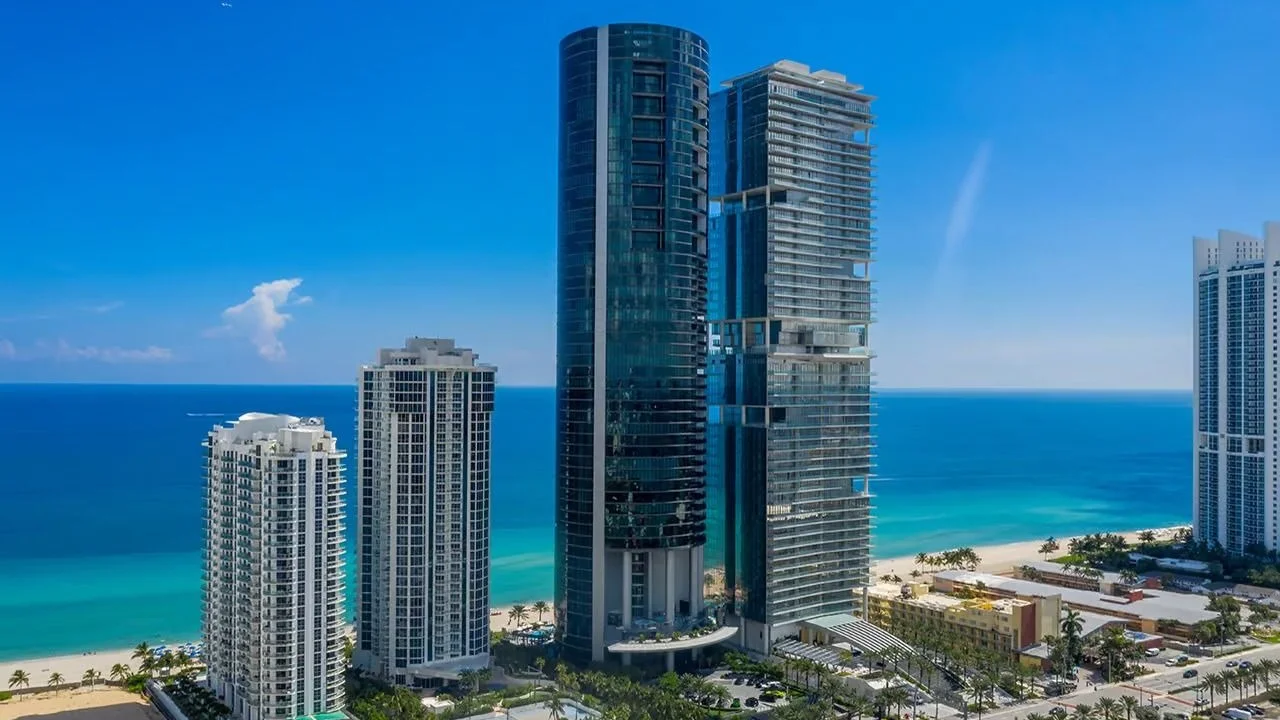
Quick answer: Every review of this building leads with the car lift. That is correct, but for the wrong reason. The vehicle elevator is not a novelty to admire, it is the largest single piece of specialist machinery any Florida condominium buyer will ever take a share in, and the documents that describe how it is serviced and funded are the documents that decide this purchase.
Buildings are usually financed on things with markets. This one has a central component that does not have one, and that is a knowable, readable, entirely manageable fact rather than a hidden risk, provided somebody reads it.
The specification
| Specification | |
|---|---|
| Address | 18555 Collins Avenue, Sunny Isles Beach |
| Built | 2017 |
| Units | 132 |
| Developer | Dezer Development with the Porsche Design Group |
| Defining system | Vehicle elevators serving in-residence garages |
| Coastal inspection due | about 2042 |
Published storey counts vary between sources, with sixty floors the figure most commonly cited and lower counts appearing where above-ground storeys are counted differently. Nothing below turns on the distinction.
Why a one-off system prices differently
Conventional building equipment is cheap to own for a reason that has nothing to do with the equipment. It is cheap because thousands of identical units exist.
That installed base produces four things a condominium board relies on without ever thinking about them:
| What the installed base gives you | What its absence means |
|---|---|
| Several contractors able to service the system | Service is effectively sole-source |
| Published parts pricing and stocked components | Parts are ordered, priced individually, and lead times are long |
| Known service lives from a large sample | Renewal timing is an estimate rather than an actuarial figure |
| Competitive tender at modernisation | The modernisation price is whatever the one capable party quotes |
None of that makes a bespoke system a bad thing to own. It makes it a thing to budget for deliberately, with a contract read in advance rather than inherited at closing.
The board’s position on this is knowable today. Ask for the service agreement, its term, its escalation clause, and whether any other party is qualified to perform the work. Then ask what the reserve study assumes for the system’s eventual renewal, and on what basis.
The denominator concentrates it
| A capital project of | Costs each of 132 owners |
|---|---|
| A $1m programme | $7,600 each |
| A $3m programme | $22,700 each |
| A $5m programme | $37,900 each |
Hypothetical sums, divided. Nothing in that table is a quotation.
One hundred and thirty-two owners is among the smallest bases in oceanfront Miami-Dade for a building of this height and specification. Every cost the building carries (the vehicle system, the oceanfront envelope, the amenity programme) divides across that number.
The offsetting point is real and worth stating. Owners at this price level are generally not funding-constrained, and a small association of aligned owners resolves questions in months where a large one takes years. Concentration is a problem when owners cannot pay. It is an administrative detail when they can. How the apportionment itself is set is covered in the special assessments guide.
What the system is actually worth to an owner
It would be easy to read the two sections above as an argument that the vehicle elevators are a liability dressed as a feature. They are not, and the case for them deserves stating as carefully as the case against.
The system is the reason the building has no substitute. Every other ultra-prime tower in South Florida competes on the same three variables (view, square footage, finish level) and can therefore be compared against, and undercut by, the next tower along the beach. This one cannot, because nothing else offers the same thing. Products without substitutes hold price differently from products with them, and that is a real economic property rather than a marketing line.
It also changes what the buyer pool is. A residence here is bought by someone who wants this specific arrangement, which is a smaller group than the pool for a conventional oceanfront unit but a considerably more motivated one. Our Florida rental yield guide covers how to model the rental side of a narrow-pool asset, where longer vacancy and higher achieved rent pull against each other.
So the honest framing is a trade, not a flaw. The building pays a permanent operating premium for a permanent pricing advantage. Whether that trade is favourable depends entirely on numbers in the association’s own documents, which is why the document list below is the whole of the recommendation.
Oceanfront exposure applies here too
The building sits first-row on Collins Avenue, which is the maximum wind and chloride exposure case in the state.
Construction year works in its favour: 2017 means post-2010 code, engineered for this site, with a milestone two decades out. Location works against it in the underwriting. As with any oceanfront tower, the master policy’s hurricane deductible and the clause allocating that deductible among owners matter more than the headline premium, and both are readable before you commit. What has moved in the wider insurance market is set out in our property insurance costs guide.
There is one specific question this building raises that others do not. Vehicle elevators occupy shafts that penetrate the full height of the structure and terminate in occupied residences. Ask how the system is protected in a storm event, what the association’s procedure is, and whether any insurer condition attaches to it. It is an unusual question because it is an unusual building.
The document list
- The vehicle elevator service agreement in full, with its term, escalation and sole-source position.
- The reserve study line covering that system, and the assumption behind its renewal date and cost.
- The funding schedule against the study as a whole.
- The last five annual budgets, to see how operating cost has moved since 2017.
- The master policy declarations page, its hurricane deductible, and the allocation clause.
- Board minutes for three years, particularly any discussion of the vehicle system.
The first two are the whole exercise. A building that has read its own contract and funded against it is a straightforward purchase. One that has not is carrying an unpriced obligation across 132 owners.
If the association resists producing the service agreement on the grounds that it is commercially confidential, treat that as a finding rather than an obstacle. An owner is a party to the cost of that contract, and a prospective owner is entitled to know what they are joining.
What works and what does not
Advantages. A genuinely singular product with no direct substitute anywhere in Florida, which supports price where ordinary luxury stock competes on square footage. Post-2010 oceanfront construction with a distant milestone. Very low density. And an owner base with the means to fund what the building needs, which is the variable that decides whether concentration is a risk at all.
Disadvantages. The defining system is bespoke, effectively sole-source to service, and hard to price at renewal. Only 132 owners carry it. Oceanfront exposure drives both insurance and envelope maintenance. And the same singularity that supports price narrows the buyer pool, so exit is a matter of finding the right buyer rather than the right price.
Where to walk away
- A service agreement for the vehicle system that cannot be produced on request.
- A reserve study that treats the vehicle elevators as conventional elevators.
- No stated assumption for the system’s renewal cost or date.
- Operating costs flat since handover on a building of this specification.
- A seller who presents the car lift purely as a feature and has never read what it costs to keep.
Our reading: an extraordinary building with one question attached to it, and the question is answerable in an afternoon by anyone who asks. The risk here is not the machinery. It is buying a share in machinery without reading the contract that governs it.
For the architectural version of the same problem, where the envelope rather than the equipment sets the cost, see our Jade Signature review. For the general shape of the new-build replacement cycle, see our Brickell Heights review.
Frequently Asked Questions
An oceanfront condominium of 132 residences at 18555 Collins Avenue, Sunny Isles Beach, completed in 2017 by Dezer Development with the Porsche Design Group. Its defining feature is a set of vehicle elevators that carry cars to garages on the residents' own floors.
Because they are bespoke machinery with no large installed base. Conventional elevator service and modernisation have market pricing built on thousands of comparable units. A one-of-a-kind system does not, which makes both the service contract and the eventual renewal harder to budget and harder to competitively tender.
On the 25-year coastal trigger a 2017 completion points to roughly 2042. Structure is not the near-term question.
132. That is a small base for a building carrying this much specialist equipment, and it is the central fact of the financial analysis.
The vehicle elevator service contract and the reserve line that funds the system's eventual modernisation. Both before the floor plan.
Sources: address, build year, unit count, developer and the vehicle elevator system from Sunny Isles Beach condominium market records for Porsche Design Tower. Storey counts differ between published sources and are therefore given as a range rather than asserted. 2042 is derived from the trigger, and the certificate of occupancy would confirm it. Observations about bespoke equipment pricing are general to low-volume building systems rather than an assessment of this association’s contracts. Per-owner figures divide an illustrative cost by 132.
Ask for the service contract first
Send a unit at Porsche Design Tower or any Sunny Isles oceanfront building. We read the specialist system contracts and the reserve position before you offer.