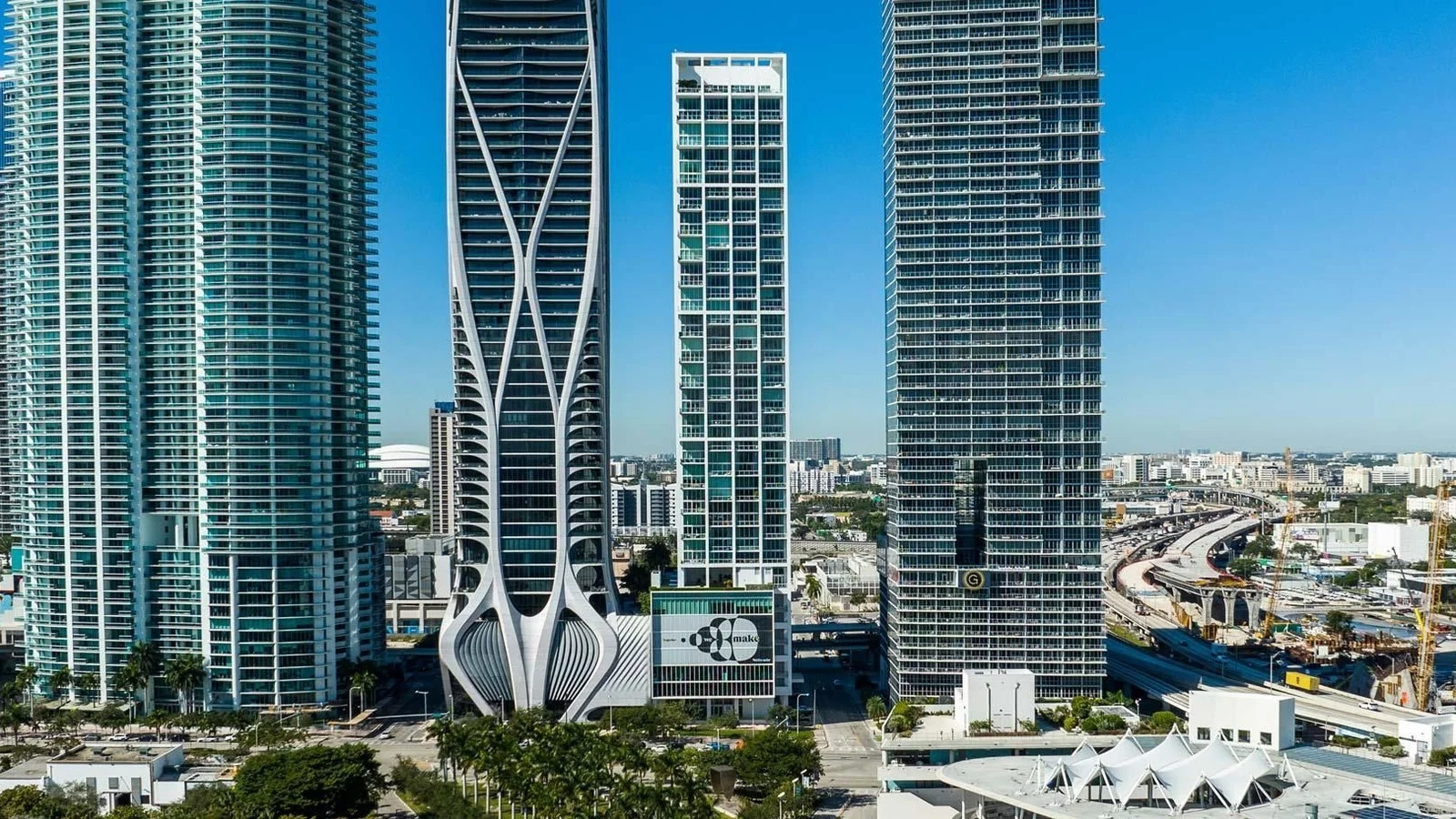
Quick answer: This tower did not move into a good neighbourhood. The neighbourhood was built around it over the following fifteen years. That sequence, rather than anything about the building itself, is what a buyer needs to price.
Early-mover buildings sit in an awkward category that the market handles badly, and the mispricing runs in both directions depending on who is doing the comparing.
The tower in outline
| Address | 1040 Biscayne Boulevard, Downtown Miami |
| Completed | 2007 |
| Storeys | 50 |
| Residences | around 200 |
| Architect | Chad Oppenheim, Oppenheim Architecture |
| Developer | Gregg Covin |
| Milestone year, coastal rule | about 2032 |
Roughly four residences per floor over 50 storeys, which for its date was a low-density configuration on the Biscayne corridor.
Two things that did not happen at the same time
The building’s location and the building’s specification were set fifteen years apart in terms of what the market expected of each.
| Fixed in 2007 | Determined afterwards |
|---|---|
| Ceiling heights, layouts, kitchen and bathroom specification | The cultural institutions now nearby |
| Amenity programme and its scale | The commercial development along the corridor |
| Structural and mechanical systems | Transit and pedestrian improvements |
| Parking ratio and configuration | The area’s residential density and street life |
The left column is what you buy. The right column is what you buy it for. A tower delivered in 2007 was specified against 2005 competition, and the competition it faces on a listing page today was specified against 2020 expectations.
Which comparison you use decides the answer
This is where buyers and sellers talk past each other, entirely predictably.
A seller compares against the newest neighbours, because the address is now shared. A buyer compares against 2007 stock elsewhere, because the specification is. Both comparisons are defensible and both are incomplete, and the gap between them is where the negotiation happens.
The more useful method is to take them apart:
- Establish the price per square foot for 2006 to 2008 towers in comparable but less developed parts of the city. That is the specification value.
- Establish the premium the immediate area now commands over those locations, using newer buildings as the reference. That is the address value.
- Add them. The result is what an early-mover building in an improved district is worth, and it usually sits between the two arguments being made at you.
Where an early-mover genuinely underperforms is on the things a newer building does structurally better: ceiling heights, floorplate efficiency, mechanical systems, and amenity space that meets current expectations. Those cannot be renovated away at unit level. Where it outperforms is on price per square foot for the same address, which is the whole reason to look. Our guide to Miami condos under $500,000 covers where that trade-off falls elsewhere in the city.
What an improving district does to rent
The address argument has a rental counterpart that is easier to verify than the sale-price one, because leases turn over annually and sales do not.
A district that gains institutions, employers and street life gains tenants who want to be near them, and that shows up in rent before it shows up in resale pricing. Rents reprice every twelve months; sale comparables in a 200-unit building might amount to a handful of transactions a year, which is a thin basis for any conclusion.
So a buyer with a rental intention has better data available than one buying to occupy. Pull achieved rents in the building across the last three years, then the same for a comparable-vintage tower in a part of the city where nothing much has changed. The divergence between the two series is the district effect, measured rather than argued.
Two cautions on doing it. Compare like units, since a shift in the mix of what happened to be let will otherwise dominate the signal. And use achieved rents rather than asking rents, because asking rents in a soft quarter describe landlord expectations rather than tenant behaviour.
If the series diverge, the address premium is real and current, and you can size it. If they do not, the district has improved the view from the window without yet changing what anyone will pay to live there, which is a legitimate finding and a reason to price the building on its vintage alone.
The 2007 cohort’s other inheritance
A building completed in 2007 shares the financial history of everything else delivered into that market: developer-set early budgets, an owner transition during a downturn, and years in which reserve funding could lawfully be waived.
That history is readable in the budget sequence rather than in the current dues figure, and we set out the method in full in our Infinity at Brickell review rather than repeating it here. Applied to this building, the specific question is whether the maintenance that an early-mover most needs (mechanical systems, lifts, corridors and lobbies now nearly twenty years old) has been funded or deferred.
That question matters more here than the address question does. A well-maintained 2007 tower in an improved district is a good buy. A deferred-maintenance 2007 tower in an improved district is a good address attached to a bill.
Dividing the costs
| A project costing | Costs each of about 200 owners |
|---|---|
| A $1m programme | $5,000 each |
| A $3m programme | $15,000 each |
| A $5m programme | $25,000 each |
Illustrative sums divided by the residence count. Nothing here has been quoted.
Two hundred owners is a comfortable base: large enough to absorb work without individual shock, small enough that decisions do not take years. For a building of this age approaching a first round of major mechanical renewal, that is close to the ideal size. The apportionment rules sit in our special assessments guide.
Structure, insurance and 2032
The tower is on the bay side of Biscayne Boulevard rather than the ocean, which is a lower windstorm exposure category than the beach towers, and it was built under the code as strengthened after the 2004 and 2005 seasons.
Six years out, the coastal deadline lands near 2032. As with any building at that distance, the near-term question is whether the reserve study exists and what percentage of its recommendation the budget meets, not what the engineer will eventually find. Ask also for the last wind mitigation report and whether windows or the roof have been addressed since delivery, since on a 2007 building those two answers drive the master premium more than the construction year.
The paperwork that decides it
- The last five to eight annual budgets in sequence, not the current one alone.
- The reserve study and the funding percentage the budget meets against it.
- The renewal history and forward schedule for lifts, chillers and other major plant.
- Closed sales in the building over twelve months, plus the same for two 2006 to 2008 towers elsewhere in the city.
- The master policy declarations page, the deductible and the last wind mitigation report.
- The last three years of minutes.
The fourth item is the one this page argues for. It is the only way to separate what you are paying for the address from what you are paying for the building.
Pros and cons
Advantages. An address that has improved substantially since the building was delivered, at a price per square foot set by its vintage rather than by its neighbours’. A bay-side rather than oceanfront exposure. A 200-unit base that divides costs sensibly. And nearly two decades of operating record to judge the association on.
Disadvantages. The specification is fixed at 2007 and cannot be brought forward at unit level. Major mechanical systems are reaching first-renewal age now. The building carries the 2007 cohort’s budget history, including any years in which reserves were waived. And it competes for attention with newer towers on the same street, which affects time on market.
Red flags
- A listing that compares only against post-2018 neighbours.
- No forward schedule for lift or chiller renewal on a building of this age.
- Flat dues across the years when Florida insurance repriced.
- A reserve study whose funding percentage the board cannot state.
- No closed-sale evidence from comparable-vintage buildings offered at all.
Our reading: a sound building in a district that improved around it, which is a favourable position provided the maintenance kept pace. Price the specification and the address separately, then read the budget sequence to see which of the two the association has been funding.
For the newest building on the same street and an entirely different set of questions, see our One Thousand Museum review. For how to read a 2007 cohort budget history, see our Infinity at Brickell review.
Frequently Asked Questions
A 50-storey tower of roughly 200 residences at 1040 Biscayne Boulevard in Downtown Miami, completed in 2007 to a design by Chad Oppenheim of Oppenheim Architecture, developed by Gregg Covin.
The building was finished before the surrounding cultural and commercial development took its present form. Its address improved after delivery, while its specification was fixed by what a 2007 buyer expected.
Because it competes with newer neighbours on location and not on specification. The correct comparison is against buildings of its own vintage, adjusted for the address, rather than against towers finished a decade later.
Frequently good. An improving address attached to an older specification is where an entry price sits below what the location alone would command, provided the building has been maintained.
Around 2032, working forward 25 years from a 2007 completion under the coastal rule.
Sources: address, completion year, storey count, residence count, architect and developer from Downtown Miami condominium market records for Ten Museum Park. Residence counts vary slightly between sources and are given as approximate. 2032 is computed rather than reported. The sequence of surrounding development is drawn from the public record of when those projects opened, not from any assessment of their effect on this building’s pricing, which the closed-sale comparison above is what would establish.
Price the address and the building separately
Send a unit at Ten Museum Park or any early-mover Miami tower. We pull vintage-matched comparables alongside the local ones before you offer.