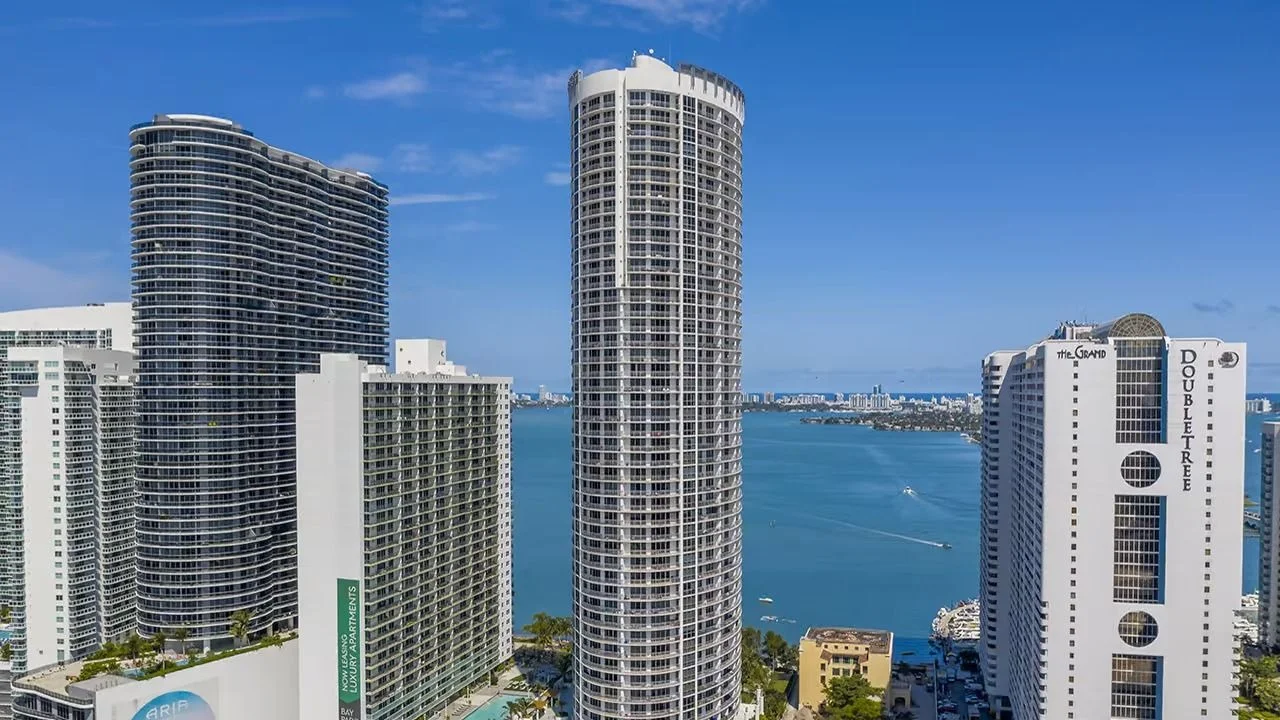
Quick answer: Small units advertise the best gross yields in Miami and deliver some of the least reliable net ones. The reason is arithmetic rather than anything about this building, and understanding it is most of what a buyer here needs.
The building is a perfectly good vehicle for this strategy. The strategy is the thing that needs examining.
The tower in outline
| Figure | |
|---|---|
| Address | 1750 North Bayshore Drive, Edgewater |
| Completed | 2007 |
| Storeys | 55 |
| Residences | 635 |
| Unit sizes | about 503 to 1,048 interior square feet |
| Configurations | studios, one- and two-bedrooms |
| Developer | Florida East Coast Realty |
| Coastal inspection due | about 2032 |
Roughly a dozen residences per floor, in an elliptical plan that gives most units a wrapping terrace.
Why rent per square foot rises as units shrink
A tenant does not rent floor area. They rent somewhere to live, and somewhere to live has a minimum specification below which nothing is rentable at all: a kitchen, a bathroom, a bed, an address, a lift, a door that locks.
That minimum has a cost, and it is largely the same whether it comes attached to 500 square feet or 1,000. Rent therefore has a floor that price does not, and the consequence is a predictable pattern across every urban rental market:
| Unit size | Rent per square foot | Price per square foot | Gross yield |
|---|---|---|---|
| Studio | Highest | High | Highest |
| One-bedroom | Middle | Middle | Middle |
| Large apartment | Lowest | Highest | Lowest |
The right-hand column is what appears in marketing material, and on its own terms it is correct. It is also the wrong column to make a decision from.
What the gross figure leaves out
Ownership costs split into two kinds, and only one of them scales with size.
| Cost | How it scales |
|---|---|
| Association dues | Usually by area or by declared share, so broadly with size |
| Property tax | With assessed value, so broadly with size |
| Insurance on contents and liability | Partly fixed, with a floor |
| Property management fee | Percentage of rent, so with rent |
| Letting or tenant-placement fee | Typically a fixed sum or a month’s rent, per letting |
| Turnover cost: cleaning, repainting, repairs | Per event, largely fixed |
| Vacancy | Per event, in months rather than in square feet |
| Administration, filings, accounting | Per unit, entirely fixed |
The bottom half of that table is the whole argument. Those costs arrive per unit and per tenancy, not per square foot, so they consume a materially larger share of a small unit’s rent.
And they arrive more often. Small units house transient households (people between situations, early in careers, or in the city temporarily) so tenancies are shorter and turnover events more frequent. Each one costs a letting fee, a void period and a make-good. A studio turning over annually and a two-bedroom turning over every three years produce three times the transaction cost on the smaller unit over the same period.
Our gross versus net yield guide works through the arithmetic in full, and our rental yield guide covers how to build the assumptions honestly rather than optimistically.
How to model it properly here
Three adjustments turn a misleading gross figure into a usable net one.
- Assume a realistic tenancy length for the unit type, not a market average across all sizes. On studios, plan for shorter.
- Cost each turnover explicitly: letting fee, void weeks, cleaning and repairs, as a cash sum per event, then divide across the expected tenancy length.
- Treat fixed administrative costs as fixed. They do not shrink because the unit did.
Run the same model on a one-bedroom in the same building and compare the net results rather than the gross ones. Frequently the larger unit wins on net despite losing on gross, and where it does not, at least the decision has been made on the right number.
There is a fourth adjustment that applies specifically to a building with a caretaker or on-site management arrangement, and it works in the small unit’s favour. Where the association handles some of what a landlord would otherwise pay a manager to do, the fixed cost per tenancy falls, and it falls furthest on the units where fixed costs matter most. Establishing what the building does and does not provide is therefore worth more here than in a tower of large apartments.
What 635 units means
| Capital spend of | Per residence, across 635 |
|---|---|
| A $1m programme | $1,600 each |
| A $3m programme | $4,700 each |
| A $5m programme | $7,900 each |
Illustrative sums divided by the residence count.
The wide base is a genuine advantage on capital costs. Against it sits the internal competition problem that every large tower with a uniform product carries: your nearest substitute is on the same lift bank, and a studio is the most substitutable product there is. We set that argument out in our Aria on the Bay review, and it applies here with more force because the units are smaller and more alike.
A 2007 completion also brings the cohort’s financial history, which is read from the budget sequence rather than the current dues figure.
Structure and insurance
Post-2005-code construction, a bayfront rather than oceanfront exposure, and a coastal inspection deadline around 2032. The near-term question is reserve funding rather than structural findings.
Ask for the declarations page, the deductible, the allocation clause and the most recent wind mitigation report. On a 2007 tower, whether windows and roof have been addressed since delivery moves the premium more than the build year.
The paperwork that decides it
- The last five to eight annual budgets in sequence, with the reserve funding percentage.
- Achieved rents and average tenancy length in the building by unit type, if the association or a broker will provide them.
- A count of units currently listed for rent, broken down by type.
- The reserve study, read for the components the statute does not compel.
- What the documents permit on letting: term, approval, and any cap on the number of units.
- The declarations page, its deductible, and who carries it after a storm.
The second item is the one that decides this purchase. Tenancy length is the variable with the largest effect on net yield in small units and the one nobody asks for.
Strengths and weaknesses
Advantages. The lowest entry price in this collection and a genuinely wide cost base. A bayfront Edgewater position with a lower windstorm exposure than the beach towers. Post-2005-code construction with an inspection deadline still years out. And a unit type with consistent tenant demand across cycles, because the bottom of a rental market is the most durable part of it.
Disadvantages. Fixed per-unit costs consume a disproportionate share of a small unit’s rent. Turnover is more frequent and each event carries the same cash cost as on a larger unit. Internal competition is at its most intense where the product is most uniform. And the building carries the 2007 cohort’s budget history.
What should stop you
- A yield figure quoted gross with no turnover assumption behind it.
- No data offered on average tenancy length.
- A high share of units listed for rent simultaneously.
- Flat dues across the years when Florida insurance repriced.
- A reserve study whose funding percentage nobody will state.
Our reading: a sound, large, well-located building carrying a strategy that works only if it is modelled properly. Ask for tenancy length before you ask for anything else. If the answer is short, the gross yield in the brochure is not the return you will receive.
For the opposite unit mix and the governance it produces, see our Elysee review. For the internal competition problem at scale, see our Aria on the Bay review.
Frequently Asked Questions
A 55-storey tower of 635 residences at 1750 North Bayshore Drive in Edgewater, completed in 2007 by Florida East Coast Realty to a Corradino Group design. Units are studios, one- and two-bedrooms from about 503 to 1,048 interior square feet.
Because rent has a floor set by what it costs to house a household at all, while price scales more closely with floor area. A studio at half the size of a two-bedroom does not rent for half as much, so its rent per square foot is higher.
Because a large part of ownership cost is charged per unit rather than per square foot. Management, letting fees, turnover, minimum insurance charges and administrative costs are broadly the same on a studio as on a large apartment, so they consume a bigger share of a smaller rent.
No. It means they must be modelled net rather than gross, and that turnover assumptions matter far more than they do on larger units.
Roughly 2032. The coastal clock runs 25 years from the certificate of occupancy, and this building dates from 2007.
Sources: address, completion year, storey count, residence count, unit sizes, developer and architect from Edgewater condominium market records for Opera Tower. Published storey counts give 55 and 56. The inspection year above is our arithmetic on the coastal trigger, not a published figure. The relationship between unit size, rent and fixed cost is general to urban rental markets rather than a set of figures for this building; the document list above is what would establish those.
Ask for tenancy length, not gross yield
Send a unit at Opera Tower or any small-unit Miami tower. We model the net return with real turnover costs before you offer.