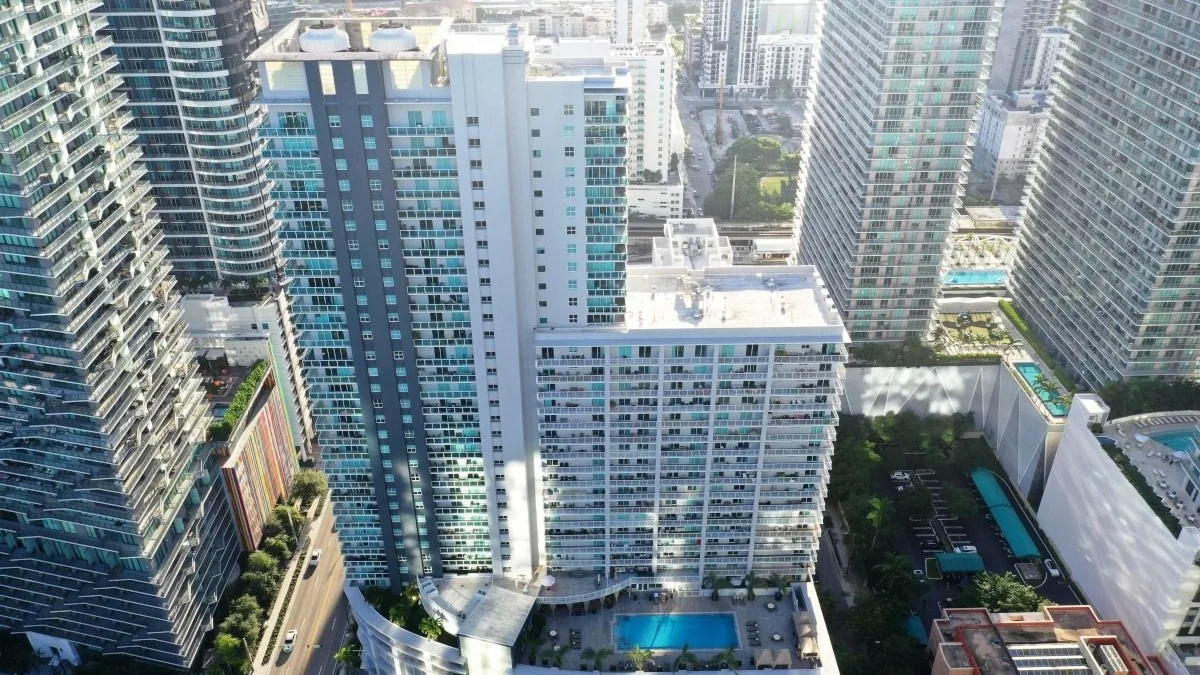
Quick answer: Vue at Brickell does not stand on Brickell Avenue. It stands at 1250 South Miami Avenue, a block inland, and in this neighbourhood that distinction is worth real money in both directions. Buy it as a South Miami Avenue building and the numbers work. Buy it as a Brickell Avenue building and you have overpaid for a name.
Miami condominium names are marketing, and Brickell has more of them than anywhere else in Florida. Half a dozen buildings carry the neighbourhood in the name while standing on side streets, and the listings that follow them quote comparables from the waterfront. This one is a clean example of the problem and an equally clean example of how to solve it.
The basic facts
| Address | 1250 South Miami Avenue |
| Built | 2004 |
| Storeys | 36 |
| Units | 323 |
| Coastal inspection due | about 2029 |
Thirty-six storeys and 323 units works out at roughly nine residences per floor. That is a conventional Brickell floorplate: efficient, corridor-served, with the majority of units in one- and two-bedroom configurations rather than the half-floor layouts of the avenue’s older towers.
The address does the pricing
Brickell is small enough to walk across in twenty minutes and varied enough that two towers four blocks apart are different markets.
Brickell Avenue itself runs along Biscayne Bay. Buildings on its east side have water; buildings on its west side have the avenue. South Miami Avenue, one block further inland, is the retail and restaurant spine, busier at street level, no water, and materially different in what a tenant will pay.
None of that makes an inland building a worse investment. It makes it a different one, and the failure mode is not choosing wrongly, it is comparing wrongly:
| Comparison used | What it produces |
|---|---|
| Priced against Brickell Avenue waterfront | An entry number the resale market will not repeat |
| Priced against South Miami Avenue and side-street stock | A number that holds when you sell into the same pool |
The practical test is simple. Pull the last twelve months of closed sales in the building itself, then the same for two or three towers on the same stretch of South Miami Avenue. If your offer sits inside that band you are buying the block. If it sits above it because the listing invoked the avenue, you are buying the name.
Our Brickell condo investment guide sets out how the sub-markets inside the neighbourhood separate.
Why 2029 is the number that matters
A 2004 certificate of occupancy on a site this close to Biscayne Bay puts the statutory milestone at roughly 2029. Three years out.
That timing is different in kind from the two other cases a buyer meets in Brickell. A 1997 building is past its deadline and has a report on file, as we set out in our Santa Maria review. A 2017 building is two decades away and the question is genuinely dormant. A 2004 building is neither: the inspection falls inside the hold period of anyone buying today with a five-year horizon.
That has three consequences, and they are all timing consequences rather than risk ones.
- The engineer’s report will land while you own the unit, not before you buy and not after you sell.
- Any assessment that follows it will be levied against you, in whatever proportion the declaration sets.
- Your exit, if it happens after 2029, is into a market that knows the answer. That can cut either way, and which way is determined by what the building does between now and then.
Buildings at this point in the cycle are where preparation is visible. A board that has commissioned the study early, funded reserves against it and started the work is a different proposition from one that has scheduled nothing, and the two look identical in a listing.
The distinction shows up in one place only, which is the minutes. Preparation leaves a paper trail: an engineer engaged, a scope discussed, a funding schedule voted on. Absence of preparation leaves nothing at all, and nothing at all is easy to mistake for a building with no problems. Three years before a statutory deadline, silence in the minutes is a finding rather than a reassurance.
Reading a 323-unit denominator
Vue sits in the middle of the range for assessment arithmetic, which is worth stating plainly because the two extremes get all the attention.
| If the building spends | Each of 323 owners pays |
|---|---|
| A $1m programme | $3,100 each |
| A $3m programme | $9,300 each |
| A $5m programme | $15,500 each |
Hypothetical costs put through long division. Nothing here has been priced by a contractor.
Three hundred and twenty-three owners absorb a project without the per-unit shock of a small association, and without the governance friction of a thousand-unit one. It is an unglamorous advantage and a real one. How an assessment is actually apportioned is a separate question, and not always by unit count: we work through it in the special assessments guide.
What 2004 construction means for insurance
The building went up under the Florida Building Code as it stood after the post-Andrew rewrite but before the strengthening that followed the 2004 and 2005 hurricane seasons. That places it above 1990s stock on opening protection and roof attachment, and behind post-2010 towers.
For a buyer the consequence is recurring rather than one-off. Windstorm pricing follows construction year, opening protection and roof age, and a mid-2000s tower will carry a master policy premium above a new one indefinitely. That flows into dues every year you own it, which is why the master policy declarations page belongs in the same document request as the reserve study. The wider market picture is in our Florida property insurance costs guide.
Ask specifically whether the building has replaced windows or the roof since delivery. On a 2004 tower those two answers move the premium more than anything else in the file.
The document list
- The structural integrity reserve study, and the funding percentage the current budget actually meets.
- Board minutes for the last three years, which is where the 2029 planning will appear if it exists.
- The master policy declarations page, its deductible, and the date of the last wind mitigation inspection.
- Any window, roof or envelope contracts since 2004, with completion status.
- Twelve months of closed sales in the building, and the same for two comparable South Miami Avenue towers.
- The estoppel letter for the unit, covered in our estoppel letter guide.
The last of the six is the one people skip. It is also the one that tells you whether the price you are being quoted is a block price or a name price.
The case for and against
Advantages. A mid-size owner base that divides capital costs sensibly. A location on the neighbourhood’s retail spine, which is what a tenant is actually paying for. A milestone date close enough that the board’s preparation, or absence of it, is observable now rather than hypothetical. And an entry level set by inland Brickell rather than by the waterfront, provided you buy it on that basis.
Disadvantages. A 2004 structure insures worse than post-2010 construction and always will. The milestone falls inside a normal hold, so the assessment risk is yours rather than the seller’s or the next buyer’s. No water frontage, which caps the resale pool. And the building’s name invites exactly the mispricing this page is about, which means you will be selling to someone running the same check.
Warning signs
- A listing that quotes Brickell Avenue comparables for a South Miami Avenue building.
- No reserve study on a building whose milestone is three years out.
- Board minutes that do not mention the 2029 date at all.
- Dues that sit below the block average with no separately identified reserve contribution.
- A master policy with no wind mitigation inspection on file since delivery.
Our reading: this is a straightforward building with one specific trap attached to it, and the trap is in the name rather than in the structure. Price it against its own block, read the minutes for evidence that 2029 is on the board’s agenda, and the rest is ordinary due diligence.
For a Brickell building already past its milestone, see our Santa Maria review. For one where scale rather than timing dominates, see our Icon Brickell review.
Frequently Asked Questions
1250 South Miami Avenue, one block inland from Brickell Avenue. The building name refers to the neighbourhood, not to the street it stands on.
2004, 36 storeys, 323 residences. That is a mid-size Brickell tower by unit count and a mid-height one by storeys.
On the 25-year coastal trigger a 2004 certificate of occupancy points to roughly 2029. That falls inside a normal five-year hold, which is the point that matters most here.
It changes the comparables. Rents and resale prices in Brickell vary block by block, and a unit here should be priced against South Miami Avenue stock rather than against Brickell Avenue waterfront.
The reserve study and the last three years of board minutes, because the 2029 date means the assessment discussion either has started or is about to.
Sources: address, build year, storey count and unit count from Miami condominium market records for Vue at Brickell, 1250 South Miami Avenue. An earlier version of this page gave the address as 1611 Brickell Avenue, which was wrong; corrected 28 August 2026. We calculated the 2029 date from the coastal trigger; the certificate of occupancy is what would confirm it. Per-owner figures divide a hypothetical cost by 323.
Price the block, not the name
Send a unit at Vue at Brickell or any South Miami Avenue tower. We pull the building's own closed sales and its reserve position before you offer.