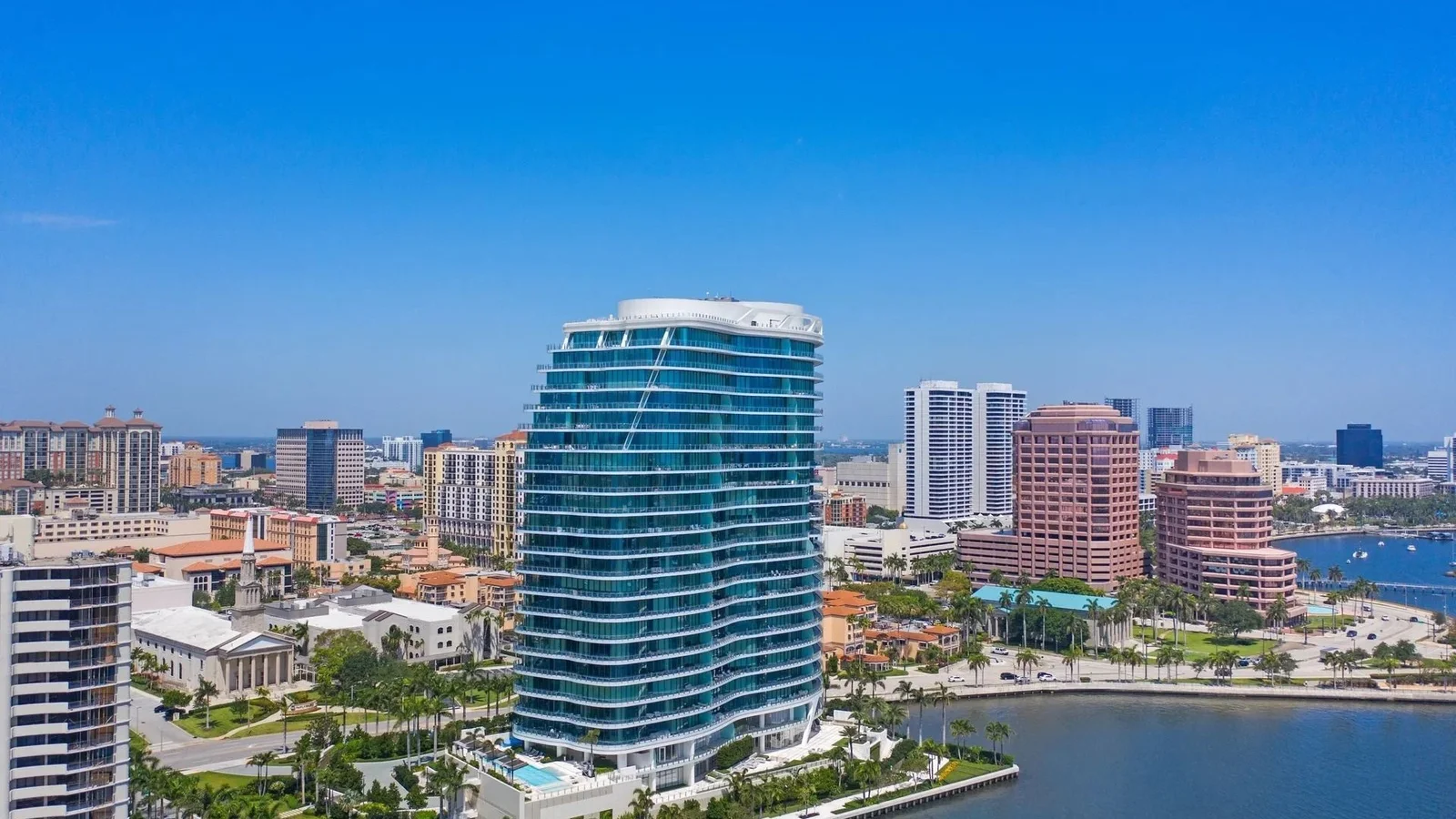
Quick answer: Most property analysis rests on comparable sales. This building was built to have no peer in its market and largely succeeded, which removes the foundation the whole method sits on. That is a manageable situation and it changes how a purchase has to be approached.
Buyers hear “no comparables” as a compliment. Lenders hear it as a problem, and the lender’s reading is the one that determines whether a purchase completes on schedule.
The building in outline
| Figure | |
|---|---|
| Address | 1100 South Flagler Drive, West Palm Beach |
| Completed | 2019 |
| Storeys | 25 |
| Residences | 69 |
| Configurations | three to five bedrooms, all flow-through |
| Sizes | about 3,700 to 9,000 square feet |
| Position | Intracoastal waterfront |
| Statutory inspection deadline | about 2044 |
Fewer than three residences per floor, with every home running the full depth of the building.
How valuation normally works, and why it stalls here
Residential appraisal is a comparison method. An appraiser finds recent sales of similar properties, adjusts for differences, and arrives at a supported figure. The whole apparatus depends on similar properties existing.
| Situation | What an appraiser does | How reliable it is |
|---|---|---|
| Many similar recent sales | Direct comparison with small adjustments | High |
| Few similar sales | Wider search, larger adjustments | Moderate |
| No similar sales in the market | Distant comparables, or a different method entirely | Contested |
A building at the top of its county’s market with a unit type nobody else offers sits in the third row. The appraiser’s options are to reach for properties in another county, to lean on the building’s own limited transaction history, or to use a method other than comparison. Each of those produces a figure that is arguable, and arguable figures are where financing timetables go wrong.
What that means in practice
Four consequences, all practical rather than theoretical.
- Allow more time for financing. An appraisal that requires unusual work takes longer and is likelier to be queried by an underwriter. Build that into the contract timetable rather than discovering it at the deadline.
- Expect a larger deposit requirement, or plan around it. Where an appraisal is uncertain, lenders reduce exposure. A buyer able to complete without financing is in a materially stronger position here than in an ordinary building.
- Negotiate on demand, not evidence. There is no comparable to point at. The argument is about how many other buyers exist for this specific home at this moment, which is a different conversation and one where information is scarce on both sides.
- Use the building’s own history. The one genuine comparable set is prior sales within the building itself. With 69 residences that series is thin, but it is real, and it is the first thing to obtain.
Our guide to due diligence on Florida property covers where transaction records come from, and our closing costs breakdown sets out where a delayed timetable becomes expensive.
The other side of having no peer
Scarcity is not only a valuation inconvenience. It is the reason the building exists and the source of most of its value.
A market with many similar buildings prices by competition: when one seller lowers, the others follow, and the whole segment moves together. A building with no peer does not participate in that mechanism. Its price is set by the intersection of a small supply with a small, specific demand, and that intersection moves in steps rather than smoothly.
The practical translation is the same one that applies to every genuinely scarce asset. Price resilience is good; liquidity is not. An owner without a fixed exit date experiences the first; an owner who must sell by a date experiences the second. Nothing about the building changes between those two cases, which makes the purchase structure the variable worth getting right.
What West Palm Beach adds to the question
The market context matters here in a way it would not for an equivalent building in Miami Beach, and it cuts in two directions at once.
West Palm Beach has drawn a substantial volume of relocation from the north-east over the past several years, much of it at the top of the market, and that demand has been concentrated in a small number of addresses because very little suitable stock existed. A building delivered into that pattern captures a demand that had nowhere else to go.
The offsetting fact is depth. Miami Beach’s ultra-prime market transacts continuously; there is always something trading and always someone looking. Palm Beach County’s is thinner by construction, and a thin market amplifies both of the effects described above. Prices hold better because there is nothing to undercut them, and sales take longer because there are fewer buyers circulating at any moment.
For a buyer the useful consequence is that the timing of a purchase matters more than it would elsewhere. In a deep market, waiting three months costs you the market’s drift. In a thin one, waiting three months can mean the difference between two available homes and none, or between competing with someone and not. That is not an argument for haste. It is an argument for being ready (financing arranged, documents reviewed, decision made) before the home you want appears, because the interval in which it is available may be short.
Dividing the costs
| Capital spend of | Per residence, across 69 |
|---|---|
| $1 million | about $14,500 |
| $3 million | about $43,500 |
| $5 million | about $72,500 |
The left column is hypothetical; only the division by 69 is real.
Sixty-nine owners under a 25-storey building is a concentrated base, though the height keeps the numerator lower than the tall Miami towers face. The mitigation is the standard ultra-prime one: this is an owner base that can fund what it decides to fund. The receivables position in the financial statements is what confirms it, using the method in our Apogee review.
Structure, water and insurance
A 2019 completion means current-code construction and a deadline around 2044, so structure is not a near-term question.
The site is on the Intracoastal rather than the ocean, which lowers windstorm exposure relative to an oceanfront building without eliminating it. Flood is a separate question from wind on any waterway site: ask for the flood zone designation, the master flood cover and its limits, alongside the windstorm declarations page, deductible and allocation clause.
The recurring new-build question applies here as everywhere: does the reserve study reach beyond the statutory structural components to plant, lifts, envelope sealant and amenity fit-out? On 69 residences, an unfunded component is a five-figure letter.
Your first requests
- Every prior sale within the building, with dates, floors and sizes.
- The reserve study and what it covers beyond the statutory list.
- Three years of financial statements, including receivables.
- The flood zone, master flood cover and windstorm declarations page.
- The last four annual budgets since handover.
- Three years of board minutes.
The first item is the only comparable evidence that exists. Obtain it before you make an offer, not after.
What works and what does not
Advantages. A genuinely singular position in its market, which supports price on a basis unrelated to competing supply. Current-code construction with a distant deadline. Flow-through homes with two aspects, which very little Florida stock offers at this size. And a moderate height that keeps capital costs below what comparable Miami towers carry.
Disadvantages. No comparable sales makes appraisal contested and financing slower. Sixty-nine owners is a concentrated base. Liquidity is a function of a small, specific buyer pool. And West Palm Beach’s ultra-prime market is shallower than Miami Beach’s, which compounds the first and third points.
Where to walk away
- A seller unwilling to share the building’s own transaction history.
- A financing timetable written as though the appraisal were routine.
- A reserve study confined to the statutory structural components.
- No flood cover detail on an Intracoastal site.
- An asking price justified by comparables from another county without adjustment.
Our reading: an exceptional building whose principal practical difficulty is procedural rather than physical. Get the in-building sale history first, allow real time for the appraisal, and structure the purchase so that a slow valuation does not become a lost deposit.
For the opposite case, a building where every sale is a true comparable, see our Bay House review. For another small association with a narrow buyer pool, see our Elysee review.
Frequently Asked Questions
A 25-storey waterfront condominium of 69 residences at 1100 South Flagler Drive, West Palm Beach, completed in 2019. Every home is flow-through, running from the Intracoastal on one side to the city on the other, from about 3,700 to 9,000 square feet.
Because valuation in residential property works by comparison. Where a building has no true peer in its county, an appraiser has nothing to anchor to, and a lender relies on that appraisal.
It can slow or complicate financing, and it means a negotiation is about demand rather than about evidence. Buyers who expect to argue from comparable sales find there are none to argue from.
It works in both directions. Without comparables the price is set by how many buyers want this specific thing, which supports value when demand is present and lengthens the sale when it is not.
Around 2044, working forward 25 years from a 2019 completion under the coastal rule.
Sources: address, completion year, storey count, residence count, configurations and sizes from West Palm Beach condominium market records for The Bristol. The 2044 date is computed from the statutory coastal trigger. Observations about appraisal method are general to residential valuation practice rather than an account of any specific transaction at this building.
Get the in-building sale history first
Send a residence at The Bristol or any building with no market peer. We assemble what comparable evidence exists before you commit to a timetable.