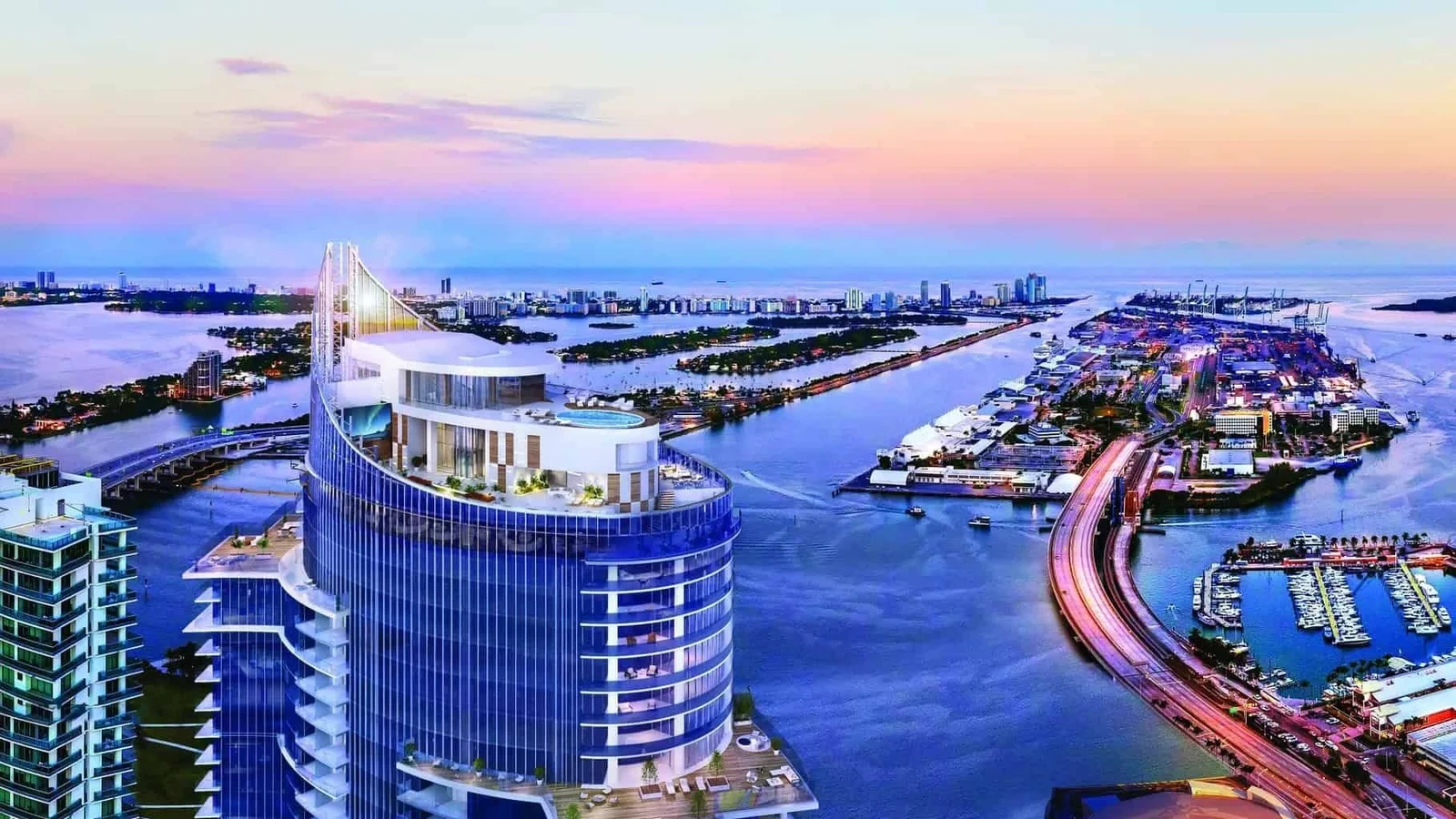
Quick answer: The amenity list is the building’s marketing and it is also, item by item, a schedule of future capital expenditure. Read it that way once and the whole purchase looks different.
Nobody is arguing that a rooftop observatory is a bad thing to have. The argument is that it is a roof, a structure and a set of finishes, and roofs, structures and finishes are renewed.
The tower in outline
| Attribute | |
|---|---|
| Address | 851 NE 1st Avenue, Downtown Miami |
| Completed | 2019 |
| Height | about 700 feet |
| Storeys | 55 or 60, depending on source |
| Residences | between about 470 and 569, depending on source |
| Inspection deadline under the coastal trigger | about 2044 |
The spread in published counts is unusually wide for a building of this profile. Confirm the figure from the declaration before relying on any per-owner arithmetic, including the arithmetic below.
An amenity is a component
Reserve studies work by listing components, assigning each a service life and a replacement cost, and scheduling the money. The list is what determines whether a building is funded.
A conventional tower’s list is short and predictable: roof, lifts, plant, envelope, corridors, lobby, pool and deck. An amenity-led building adds a great deal to it, and each addition carries its own cycle:
| Amenity type | What actually wears |
|---|---|
| Sports pitches and courts | Playing surfaces, fencing, netting, lighting |
| Pools and water features | Plant, finishes, decking, waterproofing below |
| Indoor sports and fitness rooms | Flooring, equipment, ventilation |
| Simulators and technology-based rooms | Equipment obsolescence, well before wear |
| Rooftop structures and observatories | Roofing, waterproofing, glazing, access systems |
| Landscaped decks and gardens | Waterproofing beneath, irrigation, planting |
The last row is the one boards underestimate most reliably. Anything green sitting on a structure has waterproofing beneath it, and replacing that waterproofing means removing everything above it first.
None of this is hypothetical or specific to this building. It is the ordinary arithmetic of amenity ownership, and the only question is whether the association’s own schedule reflects it.
Technology amenities have a shorter clock
One category deserves separating out, because its economics differ from everything else.
A golf simulator, a media room’s equipment or any technology-based amenity does not usually fail. It becomes dated, and owners want it replaced long before it stops working. The effective service life is set by expectation rather than by wear, and expectation moves faster than concrete.
There is a related category worth naming plainly: amenities built for a use that has not arrived. A structure provided against a future that may or may not materialise still has to be maintained, insured and eventually renewed, and it generates no offsetting benefit while it waits. This is not an argument against ambition in a building’s design. It is an argument for asking what each element costs to keep and what proportion of owners use it, because those two numbers together are the whole case for or against any amenity.
Dividing the costs
| Spend of | Per residence, across about 569 |
|---|---|
| $1,000,000 | roughly $1,800 |
| $3,000,000 | roughly $5,300 |
| $5,000,000 | roughly $8,800 |
Illustrative amounts divided by the higher published residence count. If the true figure is nearer 470, each row rises by roughly a fifth.
A base of this size is a genuine advantage and it is the reason an amenity programme of this breadth is affordable at all. Divided among a hundred owners the same list would be unmanageable; divided among several hundred it becomes a monthly figure. That is precisely why large towers can offer amenities small ones cannot, and why the amenity level and the unit count should be read together rather than separately. How the apportionment is set is covered in our special assessments guide.
What the amenities are worth on the other side
The section above is a cost argument and it would be dishonest to leave it standing alone, because in a district like this one the amenities are also the answer to a real commercial problem.
Downtown Miami has added a very large number of towers with broadly comparable apartments. A one-bedroom with a city view in a 2019 building is close to a commodity: several thousand of them exist within walking distance of each other, and a tenant choosing between them has little to go on beyond price. That is the position we describe in our Aria on the Bay review, and it compresses achievable rent.
Amenities are the main lever a building has against that. They are the reason a tenant picks one commodity apartment over another, and they support both rent and time-to-let in a way that finishes and views largely do not, because everyone has finishes and views.
So the sensible way to hold both halves of the argument at once is this:
| The amenity programme | What it does |
|---|---|
| As a cost | Lengthens the component schedule and raises the operating budget |
| As a product | Differentiates a commodity apartment in a saturated district |
An investor should want the amenities and should want them funded. The failure case is not an expensive amenity programme; it is an expensive amenity programme that has not been provided for, because that combination delivers the cost without the durability. Our gross versus net yield guide covers how to carry both the higher dues and the shorter vacancy through to a net figure instead of arguing about the gross one.
Structure and insurance
A 2019 completion is a strong position on code, opening protection and structural rating, and Downtown Miami is an inland-of-the-beach exposure rather than an oceanfront one.
Two insurance points are specific to an amenity-led building. The insured value includes all those structures and their contents, so it is higher than a plain tower’s per unit of residential floor area. And rooftop and deck installations are exposed elements in a windstorm, which affects both the premium and what a claim looks like. Request the declarations page, the deductible, the allocation clause and the schedule of insured amenity assets.
What to ask for, and in what order
- The reserve study’s component schedule in full, with amenities itemised rather than aggregated.
- The funding schedule against it, and which years the amenity items land in.
- The last four annual budgets, with amenity operating cost separated if the format allows.
- A confirmed residence count from the declaration.
- The leasing rules, minimum term and approval process.
- The insurance schedule of amenity assets, with the declarations page and deductible.
The first item answers the question this page raises. An itemised schedule means the board has understood what it owns; a single line for amenities means it has not.
Pros and cons
Advantages. An amenity programme with genuine breadth, which is a real draw for tenants and a real differentiator at resale in a district full of similar towers. New construction with a strong code position and a deadline two decades out. A large owner base that makes the programme affordable per unit. And a Downtown location with a lower windstorm exposure category than the beach.
Disadvantages. A long component schedule means more to renew and more to get wrong. Technology-based amenities date faster than they wear. Any element built for a use that has not materialised still costs money to keep. And published unit counts vary widely enough that a buyer must confirm the denominator before trusting any per-owner figure.
Red flags
- A reserve study that shows amenities as one aggregated line.
- No stated service life or replacement cost for the sports and rooftop elements.
- Waterproofing beneath landscaped decks not identified as its own component.
- Dues unchanged since 2019 on a building carrying this much to maintain.
- A residence count quoted from a listing rather than from the declaration.
Our reading: a genuinely well-provided building where the provision is the thing to examine. The amenities are an asset in both senses of the word, and the reserve schedule is where you find out whether they have been treated as one.
For an amenity-led building where the cost is payroll rather than components, see our Carillon review. For what scale does to a landlord’s rental position, see our Aria on the Bay review.
Frequently Asked Questions
A residential tower at 851 NE 1st Avenue in Downtown Miami, completed in 2019, rising to roughly 700 feet. Published sources give storey counts of 55 and 60 and unit counts between about 470 and 569.
Because each one is a physical asset that wears out. A soccer pitch, tennis courts, pools, an indoor court, a golf simulator and a rooftop observatory all carry surfaces, equipment and structures with finite service lives, and replacing them is a capital cost the owners fund.
Over a full ownership cycle, generally yes. It costs more to run day to day and it carries a longer schedule of components to renew. Whether that is worth paying depends entirely on how many of them you use.
Not until roughly 2044, since the coastal clock runs 25 years from a 2019 certificate.
The reserve study's component schedule, checking that the amenities appear in it individually rather than as one line.
Sources: address, completion year, height and the amenity programme from Downtown Miami condominium market records for Paramount Miami Worldcenter. Storey counts and residence counts differ materially between published sources and both ranges are reported rather than a single figure asserted. The inspection year above is our arithmetic on the coastal trigger, not a published figure. Service-life observations are general to amenity assets rather than findings about this association’s schedule.
Ask for the component schedule
Send a unit at Paramount or any amenity-led Miami tower. We check whether the reserve study itemises what the building actually owns.