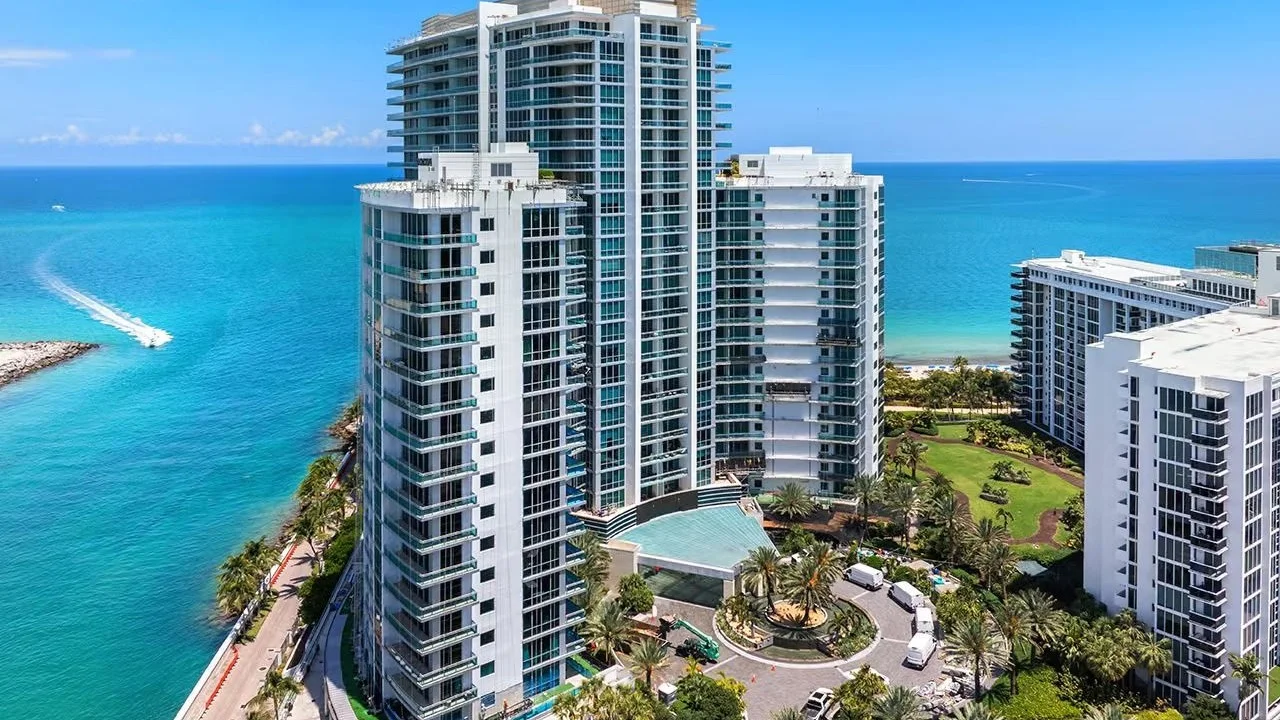
Quick answer: This building was finished in 2007 and its developer filed for bankruptcy protection in August 2008. That single fact changes what a buyer should read, because it removed the party who would normally have answered for anything the building turned out to need.
Almost every Florida building completed in 2007 and 2008 has a difficult story. This one has a specific and documented version of it, which is more useful to a buyer than a general sense of unease about the vintage.
The tower in outline
| Address | 10295 Collins Avenue, Bal Harbour |
| Completed | 2007 |
| Storeys | 26 |
| Units | around 185 |
| Developer | WCI Communities |
| Architects | Nichols Brosch Sandoval |
| Coastal inspection due | about 2032 |
Published unit counts give 184 and 185 depending on whether a particular residence is counted, which makes no difference to anything below.
What a developer bankruptcy actually removes
Florida gives a condominium association several routes when construction turns out to be defective, and they are not equally durable.
| Route | Runs against | Survives the developer’s failure? |
|---|---|---|
| Statutory and contractual warranty | The developer | No, in practice |
| Construction defect claim | Developer, and often the general contractor | Partly, where other parties remain |
| Claims against subcontractors | The trades who did the work | Yes, subject to time limits |
| Claims on the contractors’ liability insurance | Insurers | Yes, where cover responds |
| Turnover audit remedies | The developer | No |
A failed developer removes the first and the last, which are the two fastest and cheapest. What remains is slower, narrower and dependent on other parties still existing and on statutory time limits not having run.
That matters most in the years immediately after handover, which for this building coincided almost exactly with the filing. Anything identified in that window had a much weaker route to recovery than it would have had in an ordinary market, and anything not recovered was funded by the owners.
What to read, and why it is readable
The good news is that this is entirely documented, because associations record precisely this kind of thing.
- The turnover audit. Florida requires an accounting when control passes from the developer to the owners. It states what the association received and what it was owed. On this building, the timing makes it the single most informative document in the file.
- Board minutes from 2008 to about 2013. Any defect discovered, claim considered, settlement reached or work funded will appear there. Five years of minutes is a few hours of reading and it answers the question this page raises.
- Litigation history. Claims against contractors, subcontractors or insurers are matters of public record and their outcomes are usually recorded in the minutes as well.
- The repair history since. What has actually been done to the envelope, the plumbing, the waterproofing and the structure, and who paid.
If those documents show problems found, pursued and repaired, the building is in a better position than an equivalent tower where nobody ever looked. Our guide to due diligence on Florida property sets out the general document list; the four items above are what this specific history adds to it.
The 2032 date and what it now means
A 2007 completion puts the coastal milestone around 2032. On most buildings of that age the inspection is a routine future event.
Here it carries a second function. A milestone inspection is a structural engineer examining the building on a statutory basis, and on a tower whose original defect route closed early, it is the first comprehensive independent look many such buildings receive. That is genuinely valuable information, and it arrives whether or not the association wants it.
A prudent board on a building with this history would not wait for 2032. Ask whether any structural or envelope assessment has been commissioned voluntarily, and what it found. A board that has already looked is telling you something about how it has been run.
There is a further wrinkle worth understanding, because it explains why the reading list above is weighted towards the early years rather than the recent ones. Construction defect claims in Florida are subject to time limits that run from completion or from discovery, depending on the claim, and those limits are long but finite. On a 2007 building they have largely expired. That is not a reason to skip the history: it is the reason the history is now purely informational rather than actionable. What you are establishing is not whether the association can still recover, but whether the building was ever examined and what examination found.
The distinction matters for how you price it. On a newer building, an unresolved defect is a claim with a value. Here, an unresolved defect is simply a future capital item, and it belongs in the reserve analysis rather than in a legal one. Our rental yield guide covers how recurring capital charges of that kind should feed into a net return rather than being treated as one-off surprises.
Dividing the costs
| A capital project of | Costs each of about 185 owners |
|---|---|
| A $1m programme | $5,400 each |
| A $3m programme | $16,200 each |
| A $5m programme | $27,000 each |
Illustrative sums divided by the unit count, not prices anyone has quoted.
One hundred and eighty-five is a middling base: large enough to absorb ordinary work without drama, small enough that a major envelope programme is felt. Combined with a history in which the developer route closed early, that argues for reading the reserve funding percentage carefully rather than the dues figure. Apportionment mechanics are in our special assessments guide.
Insurance and the oceanfront position
The tower is oceanfront in Bal Harbour and was built under the code as strengthened after the 2004 and 2005 seasons, which is a reasonable position for its age and materially better than the 1990s stock further south.
Request the master policy declarations page, the hurricane deductible and the clause that allocates the deductible among owners, together with the date of the last wind mitigation report. On any building of this vintage, whether windows and the roof have been replaced since delivery moves the premium more than the construction year does.
The document list
- The turnover audit from the transition to owner control.
- Board minutes covering 2008 to 2013, then the last three years.
- Any construction defect claim history and its outcomes.
- The reserve study and the funding percentage the current budget meets.
- The repair history for envelope, plumbing and waterproofing, with who paid.
- The master policy, its hurricane deductible and the allocation clause.
The first three are what this building’s history requires. They are unusual requests and they are entirely reasonable ones.
The case for and against
Advantages. An oceanfront Bal Harbour position, which is among the most supply-constrained addresses in the county. Post-2005-code construction. A middling owner base that divides costs sensibly. And nearly two decades of operating history under owner control, which is a longer and more honest record than any newer building can offer.
Disadvantages. The developer failed a year after completion, so the warranty and turnover routes closed early and anything found afterwards was largely the owners’ cost. Entry pricing does not obviously reflect that history, because most buyers do not know it. Oceanfront exposure drives insurance and envelope maintenance. And the 2032 milestone will produce the first statutory structural examination the building has had.
Warning signs
- A turnover audit that cannot be produced.
- No minutes available from the years immediately after handover.
- A repair history that shows nothing at all in the first decade.
- Reserve funding well below the study’s recommendation on a building with this history.
- An agent unaware that the developer went into Chapter 11.
Our reading: a good building carrying a specific historical fact that changes the reading list rather than the verdict. If the association looked, claimed and repaired, this is a straightforward oceanfront purchase. If nobody ever looked, the 2032 inspection is where the looking starts, and you would rather know that now.
For a mixed-ownership Bal Harbour site, see our St Regis review. For the wider 2007 to 2009 cohort and how to read its budgets, see our Infinity at Brickell review.
Frequently Asked Questions
Completed in 2007 at 10295 Collins Avenue, Bal Harbour, by WCI Communities, with Nichols Brosch Sandoval as architects. It runs to 26 storeys and around 185 units.
WCI Communities filed for Chapter 11 bankruptcy protection on 4 August 2008, roughly a year after the building was completed.
Because warranty obligations and construction defect claims run against the developer. When that party fails, the association loses its most direct route to recovery for anything found afterwards, and whatever was not fixed became the owners' cost.
No. It means the usual safety net was removed, so the association's own records of what was found, claimed and repaired matter more here than they would elsewhere.
About 2032. That is 2007 plus the 25 years the coastal trigger allows.
Sources: address, completion year, storey count, unit count, developer and architects from Bal Harbour condominium market records for One Bal Harbour. The WCI Communities Chapter 11 filing of 4 August 2008 is a matter of public record reported contemporaneously in the trade and general press. 2032 follows from applying the 25-year coastal rule to the completion year. No defect or claim history is asserted for this association; the document list above is what would establish it.
Read the turnover audit
Send a unit at One Bal Harbour or any Florida building whose developer failed. We establish what was claimed, what was repaired and who paid before you offer.