Quick answer: Most condominium analysis assumes one kind of owner with one kind of interest. This site has four, they want different things, and the agreement that divides costs between them is worth more attention than anything in the sales material.
None of this is unusual for a branded resort residence. What is unusual is how rarely a buyer asks to see the document that governs it.
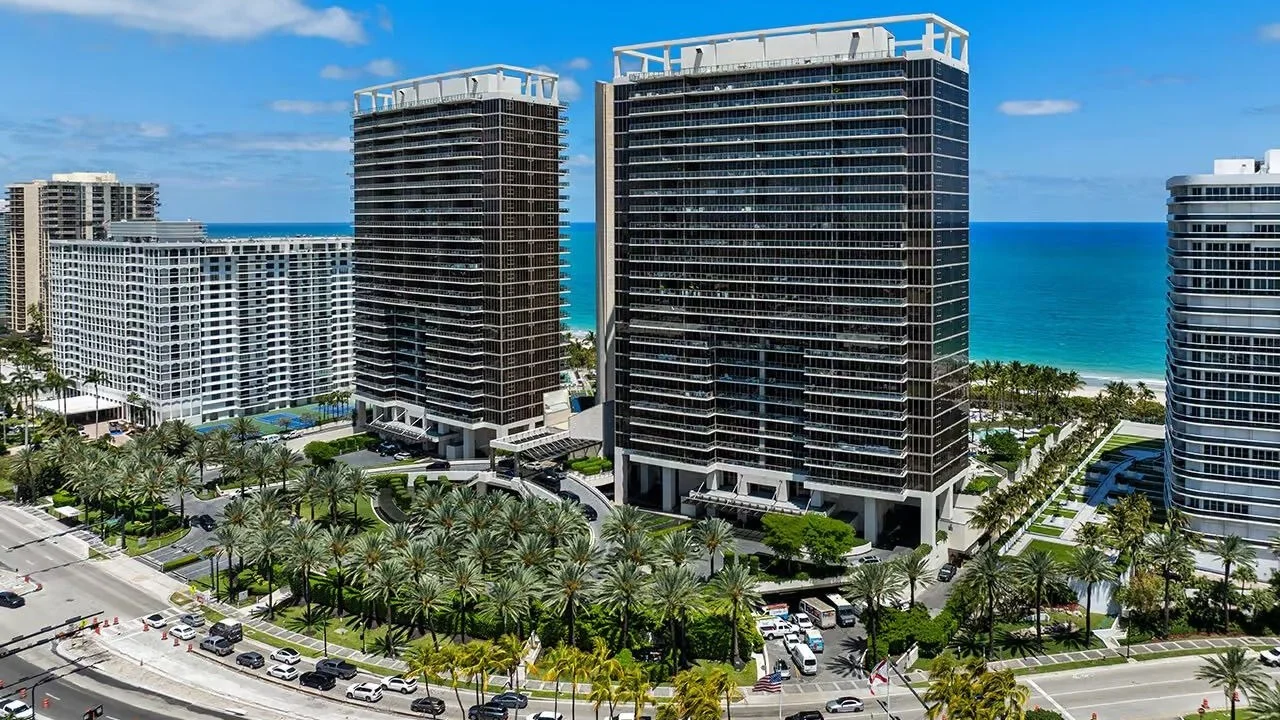
The site in outline
| Location | Collins Avenue, Bal Harbour |
| Completed | 2012 |
| Towers | Three, 27 storeys each |
| Ownership classes | Private residences, hotel rooms, condominium-hotel suites, fractional residence-club units |
| Original developer | Starwood Hotels and Resorts |
| Milestone, 25-year coastal trigger | about 2037 |
On unit counts the published record is inconsistent: the figure of 268 appears both as the number of private residences and as the total across the site, depending on the source. Rather than pick one, treat it as a question for the declaration.
Four owners, four different incentives
Put four classes of interest in one building and the disagreements are predictable, because each class is optimising for something different.
| Class | What they want from the building | Where it conflicts |
|---|---|---|
| Private residence owners | Long-term condition, quiet, controlled cost | Resists heavy amenity spending they do not use |
| Hotel operator | Guest experience, brand standard, refresh cycles | Wants frequent, visible capital spend |
| Condominium-hotel suite owners | Rental income net of costs | Wants the hotel standard, resists paying for it |
| Fractional owners | Low annual cost per share | Resists almost all discretionary spend |
Every one of those positions is rational. The building’s budget is the negotiated outcome between them, and the mechanism of that negotiation is the shared-cost agreement plus whatever the declaration says about voting.
The practical consequence for a residence buyer is that your dues are not set by people who share your interests. They are set by a process in which your interest is one of four.
What the shared-cost agreement has to answer
Ask for it by name, and read it for five things specifically.
- Which components are shared and which are exclusive. Lifts, lobbies, the envelope, plant, the pool deck, the beach club, each is allocated somewhere.
- The allocation formula. By square footage, by unit count, by usage, or by negotiated percentage. Each produces a very different bill for the same work.
- Who controls the capital decision. An operator with the right to require brand-standard refurbishment can generate cost the residential owners must fund.
- What happens if the brand changes. Hotel management agreements have terms. A change of operator can alter standards, costs and the value of the name on the door.
- Dispute resolution. Where four interests share a building, the mechanism for resolving disagreement is load-bearing.
Our guide to HOA restrictions for Florida investors covers the residential documents; the shared-cost agreement sits alongside them and is frequently not offered unless requested by name.
Fractional ownership changes the arithmetic of a vote
This is the part that has no equivalent in a conventional building.
A fractional residence-club unit is a single unit in the declaration, but the economic owners behind it can number a dozen or more, each holding a few weeks a year. Their annual cost per share is small, and any capital spend divides across them in a way that makes even modest work feel disproportionate relative to their use of the building.
Aggregate that across the fractional inventory and you have a bloc whose consistent incentive is to defer. That is not misconduct; it is the predictable consequence of the ownership structure. It matters to a residence buyer because deferral is precisely the behaviour that produces large assessments later, and because the milestone and reserve obligations are not deferrable.
Establish from the declaration how fractional interests vote, and whether their assessment liability is proportionate to their share of the building or to their share of its use. Those are different, and the difference lands on the residence owners.
Dividing the costs
| A project costing | Divided across 268 | Divided across a larger site total |
|---|---|---|
| $1 million | about $3,700 | less, in proportion |
| $3 million | about $11,200 | less, in proportion |
| $5 million | about $18,700 | less, in proportion |
The left column divides an illustrative sum by 268. Because the sources disagree on what 268 counts, the right column is left as a direction rather than a figure.
That ambiguity is the point. On most buildings the denominator is a fact you can look up. Here it depends on how the declaration allocates liability across classes, which is exactly why the document matters more than the arithmetic. Apportionment mechanics generally are covered in our special assessments guide.
Structure, insurance and the 2037 date
A 2012 completion means post-2010 construction with the code and insurance position that implies, and a coastal milestone around 2037. Neither is a near-term concern in itself.
What is near-term is whether the reserve study covers the shared components on the same basis the shared-cost agreement allocates them. A study that prices the residential elements and stops short of the hotel-shared plant, envelope and lifts leaves the largest items unfunded from the residence owners’ perspective, whoever ends up paying.
There is a second near-term question that mixed-use sites raise and single-purpose buildings do not, and it concerns wear rather than structure. Hotel operation runs a building harder than residential occupancy does. Lifts serving guest floors cycle several times more often than lifts serving residences, corridors and lobbies see continuous traffic, and plant runs to a commercial rather than a domestic duty. Where those systems are shared, the residential owners are contributing to equipment ageing on a hotel’s schedule.
That is not an argument against a branded residence. It is an argument for checking that the allocation formula reflects use rather than merely floor area, because the two produce materially different bills on exactly the components that cost most to renew. If the formula is by square footage alone, residence owners are subsidising intensity they do not generate, and the effect compounds over a holding period. Our rental yield guide covers how to fold recurring costs of this kind into a net figure rather than a headline one.
Ask for the master policy, the hurricane deductible, and how that deductible is allocated across the four classes. On a shared site the allocation clause is where a named-storm event becomes a specific number for you.
What to request, in order
- The shared-cost agreement between the residential association and the hotel and other interests.
- The declaration, with the definition of the unit classes and how each votes.
- The reserve study, checked against the shared-component list.
- The hotel management agreement’s term, or at least its expiry, and what happens on a change of operator.
- The master policy, its hurricane deductible and the allocation clause.
- Board minutes for three years, including any inter-class dispute.
The first item is the whole exercise. Everything else describes a building; that one describes what share of it is yours to pay for.
Pros and cons
Advantages. A first-rank oceanfront position in Bal Harbour with a service infrastructure no standalone condominium could support. Post-2010 construction with a milestone over a decade away. A brand that supports both resale and short-let demand. And a site large enough that shared costs divide across a substantial base, if the agreement allocates them that way.
Disadvantages. Four classes of owner means your dues are negotiated rather than simply calculated. Fractional interests have a structural incentive to defer capital spend. A hotel operator can generate cost through brand standards. And the effective denominator is a documentary question rather than a published number.
Red flags
- A shared-cost agreement that is referred to but not supplied.
- A reserve study limited to residential components on a shared site.
- No clarity on how fractional interests vote or are assessed.
- A hotel management agreement whose term nobody can state.
- Unit counts quoted from a listing rather than from the declaration.
Our reading: a strong asset with a genuinely complicated ownership structure, and the complication is entirely readable in advance. Read the shared-cost agreement first. If it is well drafted and the allocations are clear, most of the concerns on this page dissolve into ordinary due diligence.
For a site where a hotel brand sits alongside a historic structure, see our Surf Club review. For one where the surrounding district rather than the building carries the dependency, see our Faena House review.
Frequently Asked Questions
Three oceanfront towers of 27 storeys each on Collins Avenue in Bal Harbour, completed in 2012, holding private residences alongside hotel rooms, condominium-hotel suites and fractional residence-club units.
Because four classes of owner with different economics share the same lifts, lobbies, pools and building envelope. How costs are divided between them is set by a shared-cost agreement, and that agreement determines what a private residence owner actually pays.
Published sources differ on whether the figure of 268 describes the private residences alone or the site as a whole. Both readings appear in print, so the number should be confirmed from the declaration rather than taken from a listing.
A single fractional residence can have many owners, each holding a small share and each with an interest in keeping costs down. That changes the politics of any vote to spend money on the building.
The 25-year rule applies within three miles of the coast, so a 2012 building comes due around 2037.
Sources: location, completion year, tower configuration, ownership mix and original developer from Bal Harbour condominium market records for St Regis Bal Harbour. Published sources disagree on whether the figure of 268 counts private residences or the whole site, and both readings are reported rather than one asserted. The 2037 date is calculated from the statutory coastal trigger. Descriptions of how ownership classes behave are general to mixed-use resort condominiums, not findings about this association.
Ask for the shared-cost agreement
Send a unit at St Regis Bal Harbour or any branded resort residence. We read how costs divide between the residential and hotel interests before you offer.