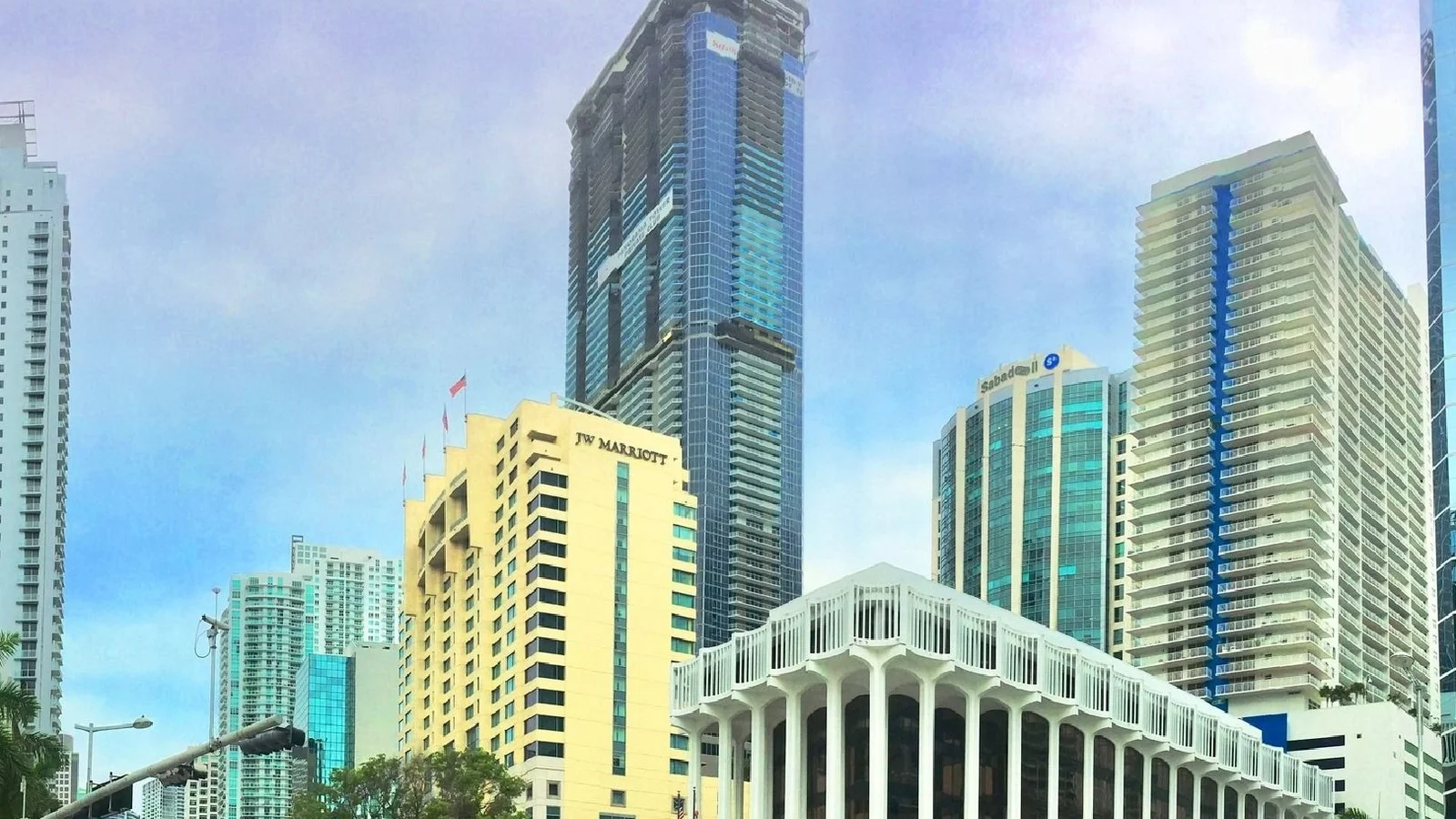
Quick answer: Before you evaluate this building as an investment, establish whether it is one. Panorama Tower was built and is operated as a rental tower by its developer, and in 2024 that developer refinanced it with a single $420 million loan. You do not refinance a building you have sold off unit by unit. Broker pages offering “Panorama Tower condos for sale” are abundant, and abundance is not availability.
This page used to be titled a review of “Miami’s tallest condo” and carried an entry price. Both of those framed a purchase that we cannot confirm is available, so this version starts from the question rather than assuming past it.
Why this distinction traps buyers
An investor searching by building name gets the same class of result whether a building sells units or not. Broker sites publish a page for every recognisable tower in Miami, because those pages rank, and a page titled “Panorama Tower Condos for Sale” can exist for years with no inventory behind it at all.
The market has three quite different structures that look identical in a search result:
| Structure | Can you buy a unit | What you are dealing with |
|---|---|---|
| Condominium | Yes | An association, a declaration, an estoppel letter, other owners |
| Single-owner rental tower | No | One landlord, a leasing office, no association |
| Condo-hotel or mixed | Sometimes, with conditions | A rental programme, an operator agreement, restricted use |
Everything an investor normally asks about a Miami building assumes the first row. Reserve funding, milestone status, rental minimums, dues, the estoppel letter: none of those exist in a single-owner rental tower, because there is no association to produce them.
That is why this is the first question and not a detail. If the answer is that no units are for sale, every other question is moot, and you have saved yourself the diligence.
What the building verifiably is
| Item | Detail |
|---|---|
| Address | 1100 Brickell Bay Drive |
| Completed | 2018 |
| Developer | Florida East Coast Realty, the Hollo family firm |
| Height | 85 storeys |
| Residential units | 821 |
| Hotel units | 208 |
| Retail | about 83,000 square feet |
| Office | about 39,000 square feet |
| Pedestal | 13 storeys |
| Amenities | more than 100,000 square feet |
| Refinancing | $420 million, 2024 |
Florida East Coast Realty is one of the oldest development firms in the city, founded by Tibor Hollo, and the tower is commonly described as the tallest multi-family building on the eastern seaboard south of New York.
Advertised rental units run roughly 1,125 to 2,191 square feet with asking rents starting near $3,805 per month. Those are asking figures on the operator’s own listings and not achieved rents.
How to establish the position yourself
Three checks, each of which takes minutes and none of which requires an agent.
The property appraiser record. A condominium is recorded as many separate parcels, one per unit, each with its own folio number and owner. A single-owner rental tower is recorded as one parcel with one owner. Pull the folio for the address on the county property appraiser site and count.
The condominium declaration. If the building were a condominium, a declaration would be recorded in the county’s official records, along with the association’s registration. No declaration, no condominium.
The financing. A $420 million loan against the whole building in 2024 is a single-asset financing. Individual condominium owners cannot pledge a building they do not collectively own, and lenders do not write one loan against 821 separately owned units.
Any one of those settles it. The third is already answered above and points clearly in one direction.
Reading a property appraiser record, in practice
This is the check that answers the question, and it is worth learning once because it works on every building in Florida.
Every county maintains a property appraiser site with a public parcel search. Search by address. What comes back tells you the ownership structure immediately, if you know what you are looking at.
A condominium returns many records for one address. Each unit is its own parcel with its own folio number, its own owner name, its own assessed value and its own tax bill. Searching the street address of a 400-unit condominium returns 400 results, or a building record that expands into them.
A single-owner rental tower returns one record. One folio, one owner, usually a limited liability company, one assessed value covering the whole structure. There are no unit-level records because there are no units in the legal sense; there are apartments inside one parcel.
A mixed structure returns a small number of records, typically separating the residential, hotel, retail and parking components, each held by a related entity.
Three further things the record gives you free:
- The owner’s name, which tells you whether the developer still holds the building.
- The year built, which starts the milestone clock.
- The sale history, which shows whether units have ever traded individually.
That last one is decisive. A condominium has a transaction history of individual unit sales going back to its first closings. A building with no unit-level sale history has never sold units, whatever a listing page says.
The whole check takes about three minutes and costs nothing. It is the single highest-value habit an out-of-state or overseas buyer can acquire, because it is the one piece of diligence that no agent, portal or brochure will do for you, and it is the one that can save you from spending weeks evaluating a transaction that does not exist.
What the mixed-use programme means either way
Whatever the ownership structure, the composition of this building is worth understanding, because it shapes what living or investing there is actually like.
A 13-storey pedestal holding retail and office means the residential floors sit high above street level. That is good for views, noise and privacy, and it means the residential experience begins after a lift ride through a commercial podium.
Two hundred and eight hotel units introduce transient occupancy into the same structure. Hotel guests use lobbies, lifts and sometimes amenities, and they generate a different pattern of activity from residents.
More than 100,000 square feet of amenity space is a very large programme even by current Brickell standards. In a rental building, its cost sits in the rent. In a condominium, it would sit in the dues. Either way somebody is paying for it monthly, and the scale of the space is a reliable predictor of how much.
The third structure: condo-hotel and rental programmes
The middle row of the table at the top of this page is where most buyers actually get caught, because it looks like a condominium and behaves like a business.
In a condo-hotel or a building with a mandatory rental programme, you own a unit and simultaneously agree to constraints on how it is used. The common ones are worth knowing by name.
Owner-use limits. Many programmes cap the number of nights per year the owner may occupy their own unit, sometimes at a few weeks. The unit is an income asset first and a residence second, by contract.
Mandatory operator participation. Where the programme is mandatory, you cannot let the unit yourself, cannot choose your own manager and cannot set your own rate. The operator does all three and remits a share.
Revenue pooling. Some programmes pool revenue across participating units and distribute by formula, which means your income depends on the building’s performance rather than your unit’s.
Financing consequences. Lenders treat condo-hotel units as a distinct and less attractive class. Fewer lenders participate, loan-to-value ratios are lower and rates are higher, which narrows your buyer pool at resale as well as your options at purchase.
Resale consequences. The buyer for a restricted unit is another investor willing to accept the same restrictions. That is a smaller pool than the one for an unrestricted condominium, and it is the reason these units frequently trade at a discount that is not visible until you try to sell.
None of this makes the structure a bad purchase. Well-run programmes in strong locations produce real income with genuinely passive ownership, which is exactly what some buyers want. It makes it a different purchase, and one whose documents have to be read rather than skimmed: the operator agreement, the rental programme terms and the declaration together define what you actually own.
If it is a rental building, is it still relevant to an investor?
Yes, in two ways that have nothing to do with buying a unit in it.
As a competitor. Eight hundred and twenty-one professionally managed rental units in the middle of Brickell compete directly with every individually owned condominium being let in the same submarket. An institutional operator with a leasing office, concierge and an amenity programme sets a service standard and a price point that a single-unit landlord has to answer. If you are underwriting a Brickell condo for long-term rental, this building is part of your competitive set whether you like it or not.
As a benchmark. Asking rents in a professionally managed tower are published, updated and visible. That is unusually good data in a market where most rental evidence is anecdotal. Use it to sanity-check what a broker tells you a comparable unit will achieve.
Our Florida rental yield guide sets out how to convert those rents into a net position, and current supply conditions across the market are in our Florida inventory tracker.
Pros and cons, stated conditionally
If units are purchasable, the advantages would be a 2018 construction standard that insures well, a Brickell Bay position, and an amenity programme with real scale. A newer building also sits far from its milestone window: on the 25-year coastal trigger a 2018 certificate points to roughly 2043.
The disadvantages would be the mixed-use complexity described above, a very large amenity programme to fund, and the presence of a substantial commercial and hotel interest in any governance structure.
If units are not purchasable, none of that applies, and the building’s relevance to you is as competition and as a source of rental benchmarks.
We have written it this way deliberately. A page that assumes a transaction is available, when we cannot confirm it is, is worse than a page that says so.
Red flags on any building of this type
- A listing site page for a building with no active MLS inventory behind it, which is common and is not dishonest so much as automated.
- An entry price quoted for a building where no unit has traded. Ours quoted one, until this update.
- Yield figures derived from asking rents rather than achieved rents.
- Any pitch that treats a condo-hotel or rental-programme unit as equivalent to an unrestricted condominium. The use restrictions are the product.
- A building described by a superlative rather than by its structure. “Tallest”, “most luxurious” and “iconic” are facts about marketing; the folio count, the year built and the declaration are facts about the asset.
- An agent who cannot name the association or produce a recent estoppel letter for a building they describe as a condominium. In a genuine condominium both exist and both are routine to obtain.
One further note on sources of confusion. Rental towers frequently appear in condominium comparison articles, ranking lists and “best buildings in Brickell” round-ups, because those articles are assembled from building names rather than from ownership records. Seeing a tower listed alongside genuine condominiums in a published comparison is not evidence that it sells units either, and the same caution applies to any list that mixes the two without saying which is which.
Our reading: the useful skill this building teaches is checking the ownership structure before anything else. It costs one search of the property appraiser record, and it is the check that most out-of-state and overseas buyers never think to run.
For a Brickell building where the ownership structure is unambiguous and the scale question is the interesting one, see our Icon Brickell review. For a building already inside its milestone window, see our Akoya review. The full purchase document list is in our due diligence guide.
Frequently Asked Questions
That is the question to answer before anything else. The tower was developed and operated as a rental building by Florida East Coast Realty and was refinanced with a $420 million loan in 2024, which is what a single owner does. Broker pages advertising units for sale are common and are not proof that inventory exists.
An 85-storey mixed-use tower at 1100 Brickell Bay Drive completed in 2018, with 821 residential units, 208 hotel units, about 83,000 square feet of retail and 39,000 square feet of office in a 13-storey pedestal.
Florida East Coast Realty, the Hollo family firm founded by Tibor Hollo. It is described as the tallest multi-family building on the eastern seaboard south of New York.
Because only one of them can be bought. A single-owner rental tower has no association, no estoppel letter, no reserve study and no units to purchase, however many search results say otherwise.
Listed rental units run roughly 1,125 to 2,191 square feet, with advertised rents starting near $3,805 per month. Those are asking rents on the operator's own listings rather than achieved figures.
Sources: address, completion year, developer, height, unit counts, retail and office areas, pedestal height and amenity area from public records and market reporting on Panorama Tower; the $420 million 2024 refinancing from commercial real estate trade press; advertised rents from the operator’s own listings. Ownership structure should be confirmed against the county property appraiser record before any purchase decision. Verified 27 August 2026.
Check the ownership structure before the yield
Send any Miami building name. We pull the property appraiser record and tell you whether it is a condominium with purchasable units, a single-owner rental tower, or a condo-hotel with use restrictions.