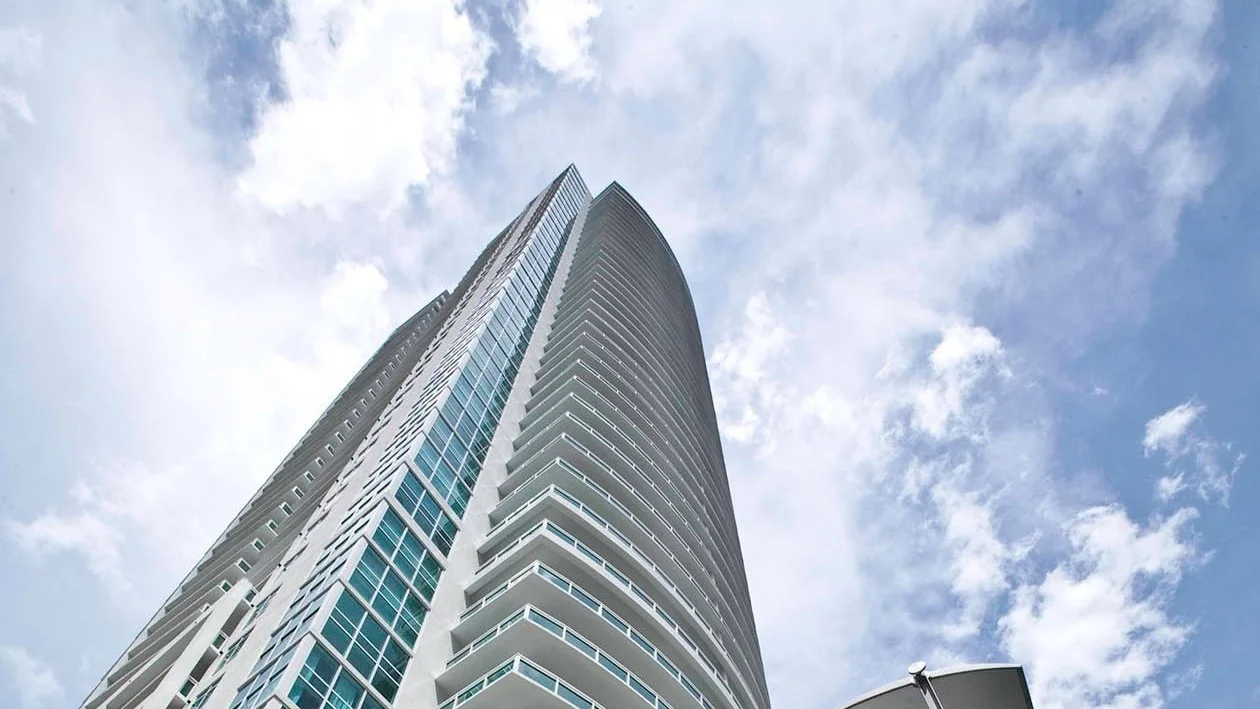
Quick answer: Before anything else about this building, establish which tower you are buying in and whether the two towers are one condominium or two. Everything else (the price, the view, the dues) sits downstream of that answer, because it determines whose bill you are on when the shared podium below both towers needs work.
Most Miami condominium due diligence starts with the reserve study. On a two-tower project it starts one step earlier, with the question of which reserve study applies to you.
What the buildings are
| Item | 950 Tower | 951 Tower |
|---|---|---|
| Address | 950 Brickell Bay Drive | 951 Brickell Avenue |
| Built | 2007 | 2007 |
| Storeys | 56 | 43 |
| Units | 560 | 440 |
| Statutory inspection deadline | about 2032 | about 2032 |
The two towers stand at the corner of Brickell Avenue and Southeast 9th Street, in the northern part of the financial district, with a retail level at the base connecting them. That connection is not an amenity detail. It is the structural fact this page is about.
Why the shared podium is the whole question
A tower standing alone has a simple ownership structure. Its owners hold units, the association holds the common elements, and the boundary between the two is set by the declaration.
Put two towers on a joined base and a third category appears: structure that belongs to neither tower exclusively. In Florida that is usually resolved in one of three ways, and they produce very different outcomes for a buyer.
| Structure | Who pays for the shared elements |
|---|---|
| One condominium covering both towers | Every owner, by their declared percentage, wherever the work is |
| Two condominiums with a master or shared-facilities agreement | Split by the formula in that agreement, which is negotiable only in principle |
| Two condominiums with separately owned components | Each association pays for what it owns, and the boundary is where the arguments happen |
The components at issue are the expensive ones. Podium waterproofing, the garage structure below it, and the transition between the podium and each tower are precisely the items a structural engineer flags and precisely the items that produce assessments in the millions rather than the tens of thousands.
Once liability is established, apportionment is its own subject, worked through in the special assessments guide. This page is about the step before that.
How to establish the structure without waiting for the seller
You do not need the association’s cooperation to answer the central question, and you should not wait for it.
Two public sources settle it between them. Florida condominiums are created by a declaration recorded in the county’s official records, and every condominium association is separately registered as a corporation. One recorded declaration covering both towers means one condominium. Two declarations, and two corporate registrations under distinguishable names, mean two.
The registration record is the faster of the two. It shows each association as its own entity with its own officers and its own filing history, and where a project also operates a master association, that entity appears alongside them. Three registrations rather than one is itself the answer, and it takes minutes rather than days.
What the public record will not tell you is the cost-sharing formula. That lives in the shared-facilities agreement, which is a private contract between the associations, and obtaining it is the one part of this that requires a request. Make the request early. An association that produces the agreement promptly is telling you it has nothing awkward in it; one that treats a straightforward document request as an imposition is telling you something else.
None of this substitutes for a lawyer reading the declaration before you close. It does mean you walk into that reading already knowing what shape the answer takes, which is a materially better position than discovering the structure from the estoppel letter.
Two different denominators in one project
If the towers are separate condominiums, the arithmetic differs between them, and the difference is not small.
| Capital cost | Across 1,000 units | Across 560 units | Across 440 units |
|---|---|---|---|
| $1 million | about $1,000 | about $1,800 | about $2,300 |
| $3 million | about $3,000 | about $5,400 | about $6,800 |
| $5 million | about $5,000 | about $8,900 | about $11,400 |
Long division across the three possible bases. None of it is a quoted price.
Read across a row. The same job costs an owner in the smaller tower more than twice what it costs an owner under a combined structure. That spread is the financial content of a governance question that most listings do not mention and most buyers never ask about.
It also cuts the other way. Under a combined structure, an owner in one tower funds work on the other. Neither arrangement is better in the abstract; what matters is knowing which one you are in before you commit, and pricing accordingly.
What 2007 construction means
Both towers went up under the Florida Building Code as strengthened after the 2004 and 2005 hurricane seasons, which places them ahead of the mid-2000s stock completed just before that revision and behind post-2010 towers.
The insurance consequence is ordinary rather than dramatic: a master policy premium in the middle of the range for Brickell, and a wind mitigation report that will matter more than the construction year alone. Ask for the last one filed, and for any window or roof work since delivery. The wider market picture sits in our Florida property insurance costs guide.
On structure, a 2007 completion puts the milestone around 2032, which is far enough away that the near-term question is funding rather than findings. That is the same position as most of the 2007 to 2009 Brickell cohort, and we set out how to read it in our Infinity at Brickell review.
Your first requests
- The declaration of condominium for the tower you are buying in, in full.
- Any master association or shared-facilities agreement, and the cost-sharing formula inside it.
- The structural integrity reserve study that applies to your tower, and the funding percentage the budget meets.
- Confirmation in writing of which association is responsible for the podium, the garage and the transition details.
- Board minutes for three years, including the master association’s if one exists.
- Whichever master policy covers your tower, with its declarations page and deductible.
The first two decide the size of your exposure. The rest describe it. Reversing that order is the most common mistake made on projects with more than one tower, and it is not recoverable after closing.
What works and what does not
Advantages. A thousand residences across the project means depth of comparable sales, which makes both pricing and exit unusually legible for Brickell. Post-2005-code construction. A location at the north end of the financial district with retail at the base. And where the towers do share liability, the combined denominator is among the most favourable in the neighbourhood.
Disadvantages. The ownership structure is a real variable that a buyer must resolve document by document rather than assume. The shared podium and garage are the components most likely to generate a large bill. Two towers of different heights and unit counts do not necessarily trade alike, so comparables need to be tower-specific. And 2007 construction insures worse than new stock, permanently.
Where to walk away
- An agent who cannot say whether the towers are one condominium or two.
- A shared-facilities agreement referred to but not produced.
- A reserve study that covers tower components and is silent on the podium and garage.
- Comparable sales drawn from both towers indiscriminately.
- Minutes from your tower’s board that mention a dispute with the other association without resolution.
Our reading: this is a well-located project with an ordinary structural profile and one genuine complication, and the complication is contractual rather than physical. It takes an afternoon with the declaration to resolve, and no amount of inspection substitutes for that reading.
For a single-tower building of the same vintage, see our Infinity at Brickell review. For one where the address itself is the mispricing, see our Vue at Brickell review.
Frequently Asked Questions
Two towers completed in 2007, joined by a retail podium. The 950 Tower stands at 950 Brickell Bay Drive with 56 floors and 560 units; the 951 Tower stands at 951 Brickell Avenue with 43 floors and 440 units. A thousand residences in total.
It can matter a great deal. Whether the towers form one condominium or two, and how the shared podium and garage are owned, determines whether an owner in one tower can be assessed for work on the other.
In the declaration of condominium and any master or shared-facilities agreement. Those documents, not the listing, define the boundary of your liability.
On the 25-year coastal trigger a 2007 completion points to roughly 2032 for both towers. If they are separate condominiums, each files its own report.
It creates a class of common elements that neither tower owns alone. Waterproofing, structure and the garage below a shared podium are exactly the components most likely to generate a large bill.
Sources: addresses, build year, storey counts and unit counts from Miami condominium market records for Plaza on Brickell, 950 Brickell Bay Drive and 951 Brickell Avenue. Both 2032 dates are calculated from the trigger and would need each certificate of occupancy to confirm. The per-owner columns divide hypothetical costs by the counts above. The ownership structures described are the three arrangements Florida two-tower projects commonly use; which one applies here must be read from the declaration.
Read the declaration before the listing
Send a unit at Plaza on Brickell or any multi-tower Florida project. We establish which association carries the shared structure before you offer.