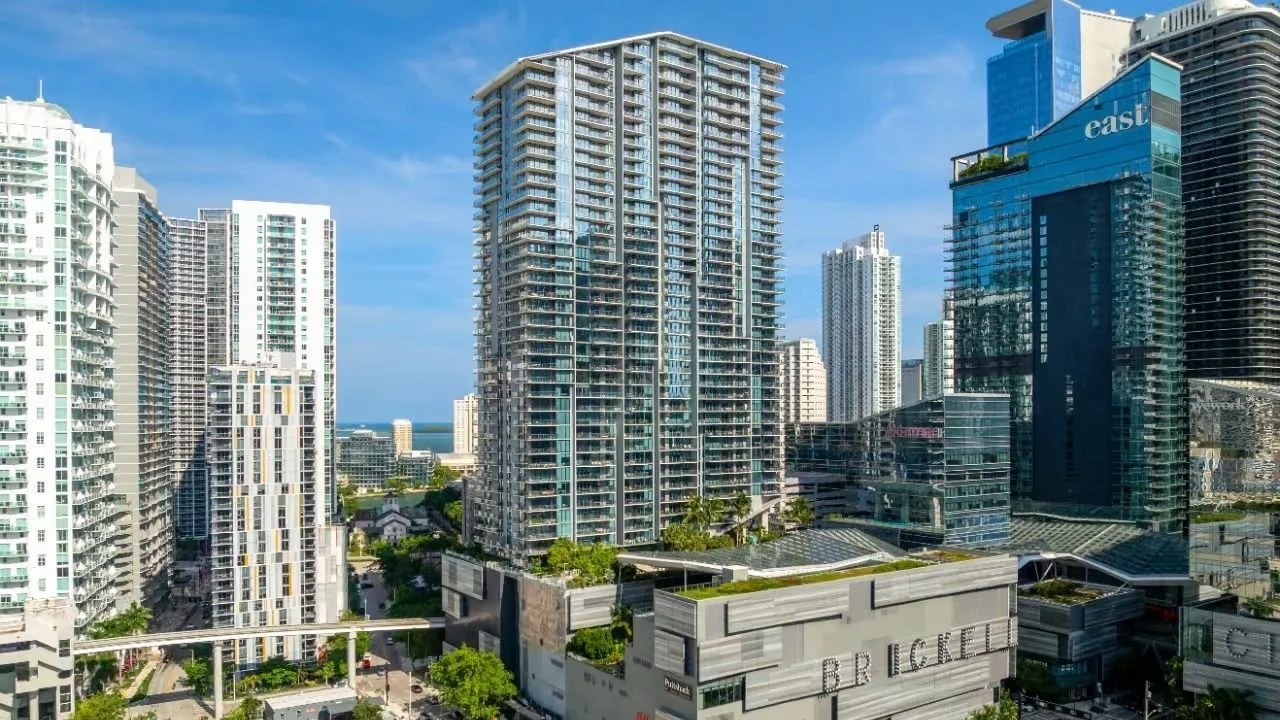
Quick answer: A green certificate is awarded once and never expires in the buyer’s mind. The systems it was awarded for degrade continuously, and whether anyone is looking after them is a line in the operating budget rather than a plaque in the lobby.
This is a good building with a specific and rarely asked question attached, and the question has a documentary answer.
The tower in outline
| Attribute | |
|---|---|
| Address | 68 SE 6th Street, Brickell |
| Completed | 2016 |
| Storeys | 43 |
| Residences | 390 |
| Sizes | about 810 to 4,346 square feet |
| Architect | Arquitectonica |
| Common areas | Richardson Sadeki |
| Developer | Swire Properties |
| Coastal inspection due | about 2041 |
A size range of more than five to one within a single building, spanning one-bedroom apartments to homes of over four thousand square feet.
What certification actually certifies
A green rating is a documented assessment of a building’s design, its specified systems and, usually, a commissioning process confirming they were installed and set up as intended.
What it does not do is promise that any of that continues.
| What was assessed | What happens over a decade |
|---|---|
| High-efficiency plant | Fouls, drifts from design duty, loses output |
| Controls and sequences | Overridden manually, then never restored |
| Sensors | Drift out of calibration, quietly |
| Water fixtures and irrigation | Replaced ad hoc, not always in kind |
| Envelope performance | Sealant and glazing seals degrade |
| Metering and monitoring | Falls out of use when nobody reads it |
Every row is ordinary and none of it is negligence. It is what happens to any building that is not actively managed against its original design, and it is why the discipline of recommissioning exists.
The consequence for an owner is direct. The capital cost of high-performance systems was paid at construction and is in the purchase price. The savings only arrive if the systems perform. A building that has drifted charges its owners for the equipment and returns none of the benefit.
Recommissioning, and why it is a good deal
Recommissioning is a structured re-check: comparing how the systems are actually running against how they were designed to run, then correcting the differences.
It is unglamorous work with an unusual economic profile, because most of what it finds costs little to fix. A setpoint returned to its design value, a sequence restored, a sensor recalibrated, a manually overridden control put back into automatic. The equipment is already installed and already paid for; recommissioning is about making it do what it was bought to do.
For a buyer, three questions establish where a building stands.
- Has the building been recommissioned since handover, and when?
- Does the operating budget show common-area energy and water as separate lines, and what has happened to them since 2016?
- Is there any ongoing monitoring, and does anyone review it?
A building that can answer all three is being run properly. One that cannot has an efficiency asset it is not using, which is a soft cost rather than a crisis and is worth knowing about before you buy into the dues.
There is a second reason the answer matters, and it is about the equipment rather than the bills. Plant run outside its design conditions wears faster than plant run within them. A chiller working against a drifted control sequence, or a pump cycling more than it should, reaches its replacement date earlier than the reserve study assumed. Deferred attention to controls therefore turns into an earlier capital call, which is a considerably more expensive way to discover the problem.
Our HOA restrictions guide covers the wider documentary set.
Dividing the costs
| Capital spend of | Per residence, across 390 |
|---|---|
| $1 million | about $2,600 |
| $3 million | about $7,700 |
| $5 million | about $12,800 |
Hypothetical amounts put through long division; nothing here has been priced.
A 390-unit base is comfortable, and combined with a 43-storey height it gives a reasonable ratio between what the building costs to maintain and how many owners share it. That matters more than it sounds, and we set the argument out in our Echo Aventura review.
The recurring new-build question applies as it does everywhere: whether the reserve study reaches beyond the statutory structural list to plant, lifts, envelope sealant and amenity fit-out. On a building whose selling point is its systems, the plant line is worth reading closely.
The wide size range raises a fairness question
Residences here run from around 810 square feet to over 4,300, a spread of more than five to one. Very few Miami buildings cover that range in one association.
Assessments are generally allocated by declared share, which usually tracks floor area. Many of the services a building provides, though, are consumed per household rather than per square foot: the concierge desk, the lift journey, the security presence, the administration of an account.
| Cost type | Scales with |
|---|---|
| Structure, envelope, roof, plant capacity | Area, broadly |
| Concierge, security, administration, lift use | Households |
Where a declaration allocates everything by area, larger residences carry more of the per-household costs than their use of them warrants; where it allocates by unit, the reverse. Neither is wrong, and the buyer’s interest simply depends on which end of the range they are buying at. Read the declaration’s allocation provisions and work out which side of that line your unit falls on.
Structure, insurance and the district
A 2016 completion means post-2010 code construction and an inspection deadline around 2041, so structure is not a near-term question. Brickell is inland of the beach, a lower windstorm exposure category than Collins Avenue.
Ask for the declarations page, the deductible and the allocation clause. Ask also whether any part of the wider Brickell City Centre development shares structure, plant or access with the residential condominium, and if so where the cost boundary sits: on any mixed-use site that boundary is a document rather than an assumption, and we set out how to establish it in our Plaza on Brickell review.
On rental, the location is the strongest argument here. Direct access to retail and to the Brickell core supports both achieved rent and time-to-let, and our gross versus net yield guide covers how to carry that through to a net figure.
What to request, in order
- Any recommissioning report since 2016, and the date of the last one.
- Common-area energy and water costs across the last four budgets.
- The reserve study, with the plant and controls identified.
- The declaration’s assessment allocation provisions, and any shared-cost arrangement with the wider development.
- The rules on letting, minimum term and approval.
- The declarations page, deductible and allocation clause.
The first two together answer the question this page raises, and they take one email.
Strengths and weaknesses
Advantages. One of the best-connected residential positions in Brickell, with retail and the business core immediately at hand. Post-2010 construction with a distant deadline. A 390-unit base under a moderate height, which is a good cost ratio. And a building specified to a standard that, if maintained, keeps operating costs below its neighbours’.
Disadvantages. Certification is a snapshot, and its benefit depends on maintenance nobody advertises. A five-to-one size range makes the assessment allocation worth checking against your own unit. A mixed-use setting means a cost boundary to establish. And Brickell continues to add competing residential supply.
What should stop you
- No recommissioning since handover on a building sold on its efficiency.
- Common-area energy costs not separately visible in the budget.
- A reserve study that treats specialist plant as generic equipment.
- An allocation provision the seller has not read.
- A shared-cost arrangement with the wider development that cannot be produced.
Our reading: a strong building in a strong position with one question its marketing does not raise. Ask when it was last recommissioned. The answer costs nothing to obtain and tells you whether the premium you are paying for the specification is still doing any work.
For a newer Brickell tower and its own replacement-cycle question, see our Brickell Heights review. For how amenity assets enter a reserve schedule, see our Paramount review.
Frequently Asked Questions
A 43-storey tower of 390 residences at 68 SE 6th Street in Brickell, completed in 2016 by Swire Properties to an Arquitectonica design, with common areas by Richardson Sadeki. It forms part of the Brickell City Centre development and is LEED-certified.
Because certification records a design and a commissioning result at a point in time. The savings come from equipment, controls and sensors that drift, foul and fail like any other equipment. Left alone, a certified building consumes like an uncertified one.
A structured re-check of a building's systems against how they were designed to operate: controls, setpoints, sequences, sensors and equipment performance. It typically recovers a meaningful share of drifted efficiency for a fraction of the cost of replacement.
In the common-area energy and water lines of the operating budget, which flow into dues. A certified building whose systems have drifted charges its owners for the equipment and delivers none of the savings.
Around 2041, working forward 25 years from a 2016 completion under the coastal rule.
Sources: address, completion year, storey count, residence count, unit sizes, architect, common-area designer, developer and certification status from Brickell condominium market records for Reach at Brickell City Centre. The 2041 date is computed from the statutory coastal trigger. The account of how building systems drift and what recommissioning addresses is general building-services practice, not a finding about this association, which the documents listed above are what would establish.
Ask when it was last recommissioned
Send a unit at Reach or any certified Miami building. We check whether the efficiency premium you are paying for is still being delivered.