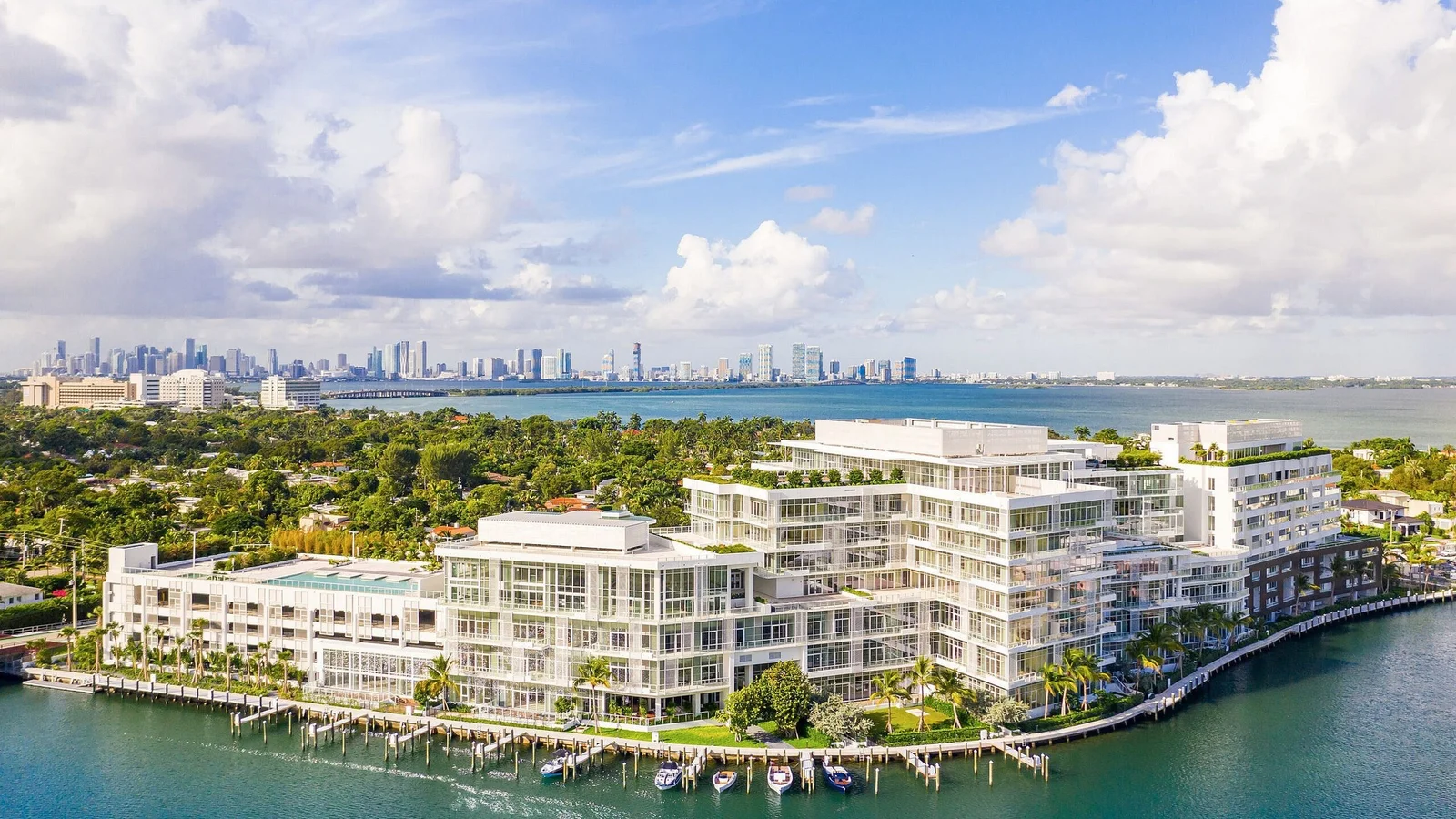
Quick answer: Branded residences usually sit alongside a hotel, and the hotel pays for a great deal of what the residents enjoy. This one has no hotel. The service is real, and so is the arithmetic that follows from around 111 homes funding all of it.
That is not a criticism. It is the single fact that distinguishes this building from every other branded residence in South Florida, and it should be priced deliberately rather than discovered later.
The property in outline
| Detail | |
|---|---|
| Address | 4701 North Meridian Avenue, Miami Beach |
| Completed | 2019 |
| Residences | around 111, plus a small number of villas |
| Sizes | about 1,700 to over 10,000 square feet |
| Architect and interiors | Piero Lissoni |
| Developer | Lionheart Capital with Elliott Management |
| Hotel component | none |
| Inspection deadline, coastal rule | about 2044 |
An earlier version of this page described the building as being on Lincoln Road. That was incorrect and is corrected here: the site is in the Nautilus area on the bay side, some distance north of Lincoln Road.
What a hotel normally pays for
On a combined hotel-and-residence site, a large part of the visible service is funded by a business with its own revenue.
| Service | Who funds it with a hotel present | Who funds it without one |
|---|---|---|
| Front desk and concierge coverage | Shared with hotel operation | Residents |
| Housekeeping and engineering staff | Hotel payroll, partly allocated | Residents |
| Amenity operation and upkeep | Shared, often heavily | Residents |
| Food and beverage availability | Hotel business, subsidising presence | Residents, or absent |
| Brand standard compliance | Hotel drives and funds it | Residents |
Remove the hotel and each of those moves entirely into the association budget. The service does not get worse; it gets more expensive per residence, because the number of people paying for it falls to the number of homes.
That is the whole of the financial case here, and it produces a dues level that should not be compared with a conventional condominium’s or with a hotel-branded one’s. Our Carillon review sets out the resort-operation version of the same cost, and our St Regis Bal Harbour review the version where a hotel and several ownership classes share it.
What the absence of a hotel gives back
The trade runs both ways and the advantages are substantial for a resident.
- No commercial traffic. Lifts, lobbies and grounds carry residents only, so wear runs to a residential rather than a commercial duty cycle.
- No competing interest in the budget. An operator with brand-standard refurbishment rights can generate capital cost the residents must fund. Here the residents decide.
- No allocation dispute. The single most contentious document on a mixed-use site is the cost-sharing agreement. There is no counterparty to disagree with.
- Genuine privacy. The thing buyers at this level most often say they want, and rarely get on a hotel-and-residence site.
An owner who wanted a hotel’s amenities and its buzz would be better served elsewhere. An owner who wanted the service without the hotel is buying exactly the right thing, and paying for it directly rather than through a shared arrangement.
There is a durability argument in the residents-only structure that is worth drawing out. On a shared site, the residents’ service level is downstream of decisions a hotel operator makes for its own commercial reasons: a repositioning, a change of segment, a cost programme. None of those decisions is put to the residents, and each of them changes what living there is like. Here the only party that can change the service level is the association itself. That is a smaller upside than a hotel’s economics provide, and it is far more predictable, which at this end of the market is frequently what buyers were actually paying for.
Dividing the costs
| Capital spend of | Per residence, across about 111 |
|---|---|
| $1,000,000 | roughly $9,000 |
| $3,000,000 | roughly $27,000 |
| $5,000,000 | roughly $45,000 |
Illustrative sums divided by the residence count. Villas may be assessed differently, which the declaration settles.
A hundred and eleven owners is a concentrated base, and it applies to both the annual service cost and any capital event. The mitigation is the one common to all ultra-prime: owners at this level fund what they decide to fund, and a small association acts quickly. Apportionment mechanics sit in our special assessments guide.
Questions the management arrangement raises
Where there is a brand but no hotel, the service is delivered under a management or branding agreement between the association and the operator. That agreement is the document to read.
- What is its term, and what are the renewal or termination provisions?
- What service levels does it commit the operator to, and what does it commit the association to fund?
- Is there a brand-standard clause that can require capital expenditure, and who decides?
- What happens on expiry: does the name go, does the staffing arrangement change, and is there a transition provision?
The last question matters more here than at a hotel-and-residence property. When a brand leaves a site with a hotel, the hotel continues under new management and the residences keep a functioning service infrastructure. When a brand leaves a standalone residential property, the association must procure the entire service itself. That is manageable and it is a project, and knowing whether it is five or twenty-five years away is worth establishing before purchase.
Our HOA restrictions guide covers the rest of the governing documents.
Structure and insurance
A 2019 completion is the strongest structural position in this collection: current code, engineered opening protection, and an inspection deadline around 2044.
The site is bay side rather than oceanfront, which is a lower windstorm exposure category than Collins Avenue. Ask for the declarations page, the deductible and the allocation clause, and establish the flood zone and the master flood cover separately, since on a bayfront site those are distinct questions.
As with every recent building, the live question is whether the reserve study reaches beyond the statutory structural list to plant, lifts, envelope sealant and amenity fit-out. On a base of 111 homes carrying a full service infrastructure, an unfunded component is a meaningful individual number.
What to ask for, and in what order
- The management or branding agreement, with its term and any brand-standard provisions.
- The reserve study, checked against the components the statute leaves optional.
- The last four annual budgets, with the service payroll identified if the format allows.
- The declaration, including how villas are assessed relative to residences.
- Windstorm and flood cover separately, with the deductible and who bears it.
- Three years of board minutes, read for what the board has and has not raised.
The first and third together tell you what the service costs and how long it is contracted for. That is the purchase.
Strengths and weaknesses
Advantages. A branded service standard with no hotel traffic, which is the combination buyers at this level most often want and rarely find. New construction with the best available code position and a deadline two decades out. A Lissoni design with genuine architectural coherence. And no cost-sharing counterparty to negotiate with.
Disadvantages. Around 111 homes fund the entire service infrastructure, with no guest revenue offsetting it, so dues are high by design. The management agreement has a term. The residence base is concentrated for capital events. And the bay-side Nautilus location is quieter and less liquid than the oceanfront or South Beach markets.
What should stop you
- A management agreement whose term nobody can state.
- A reserve study confined to the statutory structural components.
- Dues compared favourably against a conventional Miami Beach tower’s.
- No clarity on how villas are assessed against residences.
- Any listing still describing the building as being on Lincoln Road.
Our reading: a coherent and unusually private proposition whose cost structure is a direct consequence of what makes it attractive. Read the management agreement and the budget together, and treat the dues as the price of the product rather than as a number to negotiate down.
For the version where a hotel and three other ownership classes share the cost, see our St Regis Bal Harbour review. For a design-brand building with no service operation at all, see our Missoni Baia review.
Frequently Asked Questions
4701 North Meridian Avenue, in the Nautilus area of Miami Beach on the bay side, not on Lincoln Road. An earlier version of this page placed it on Lincoln Road, which was wrong.
There is no hotel on the site. It is one of a small number of standalone Ritz-Carlton residential properties worldwide, so the service standard is delivered to residents only.
Because on a hotel-and-residence site, guest revenue supports the cost of staff, amenities and common areas. Without a hotel, the residents fund the entire service standard themselves, across a small number of homes.
Around 111 condominium residences from about 1,700 to over 10,000 square feet, alongside a small number of villas. Completed in 2019, designed by Piero Lissoni.
About 2044. That is 2019 plus the 25 years the coastal trigger allows.
Sources: address, completion year, residence count and sizes, villa component, architect, developer and the absence of a hotel component from Miami Beach condominium market records for the Ritz-Carlton Residences Miami Beach. The previous version of this page gave the location as Lincoln Road and described a different market position; both are corrected here as of 28 August 2026. The 2044 date is computed from the statutory coastal trigger. The management agreement’s terms are documents to request rather than facts asserted.
Read the management agreement
Send a unit here or at any standalone branded residence. We establish what the service costs, who delivers it and for how long, before you offer.