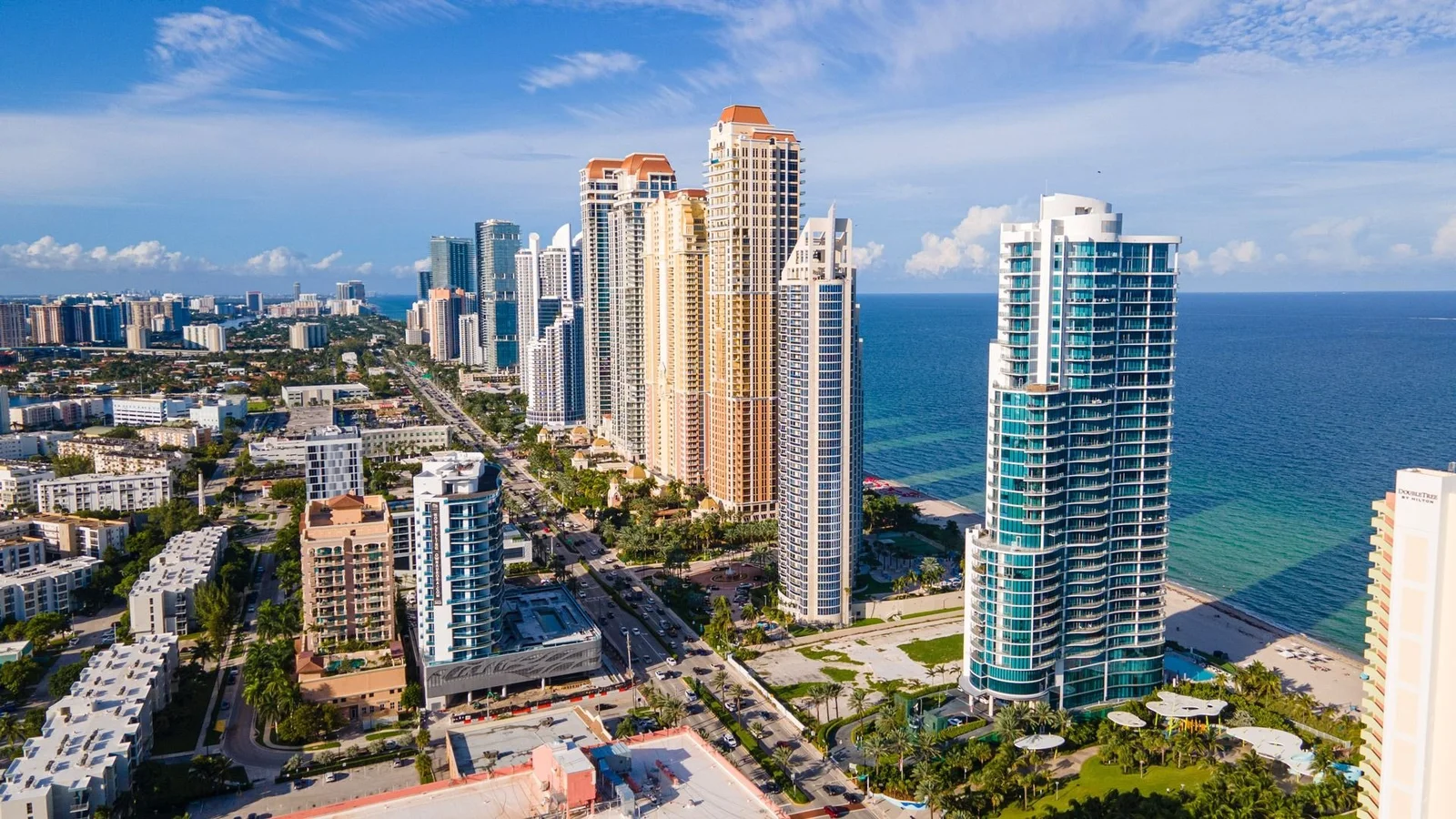
Quick answer: The beach is the reason to buy an oceanfront building and the one element nobody treats as a component. Florida beaches are engineered, eroded and rebuilt on cycles, and the sand in front of a tower exists because a programme keeps putting it there.
None of this is a reason to avoid oceanfront property. It is a set of questions that oceanfront buyers almost never ask and that have real answers.
The property in outline
| Figure | |
|---|---|
| Addresses | 16047 and 16051 Collins Avenue, Sunny Isles Beach |
| Towers | Two |
| Storeys | about 37 to 38 each |
| Residences | around 260 in total, about 130 per tower |
| Density | around four residences per floor |
| Beach frontage | roughly 650 feet |
| North tower completed | 2006 |
| Structural review due | about 2031 for the 2006 tower |
Four homes per floor across two towers is a low-density configuration, which is what produces the size of the individual residences and the small owner base behind them.
Beaches are built, lost and rebuilt
Sand moves. Wave action, currents and storms transport it along and away from a shoreline continuously, and coastal development interrupts the natural supply that would otherwise replace it.
Florida’s response, over decades, has been organised beach renourishment: sand is dredged or trucked and placed on eroded beaches, and the process is repeated as the placed sand erodes in turn. The programmes are typically organised at county and state level with federal participation, and they run on multi-year cycles.
For an oceanfront owner that produces a set of facts worth understanding:
| Fact | Consequence |
|---|---|
| Beach width varies over time | The frontage in a photograph is a snapshot, not a constant |
| Renourishment is periodic, not continuous | There are years when the beach is narrower and years when it is wide |
| Programmes depend on funding and sand supply | Both have been constrained at times |
| Placed sand erodes | The cycle repeats indefinitely |
A buyer viewing on a wide-beach year and a buyer viewing on a narrow-beach year are looking at the same property in different phases of the same cycle.
The financial consequence is indirect and real. Beach width affects what an oceanfront address is worth in the market’s eyes, and it affects the exposure of the structures behind it: a wider beach absorbs storm energy that a narrow one delivers to the dune, the pool deck and eventually the building. Owners therefore have an interest in the renourishment cycle that goes well beyond the view, and the association’s minutes are where any local participation, contribution or objection will be recorded.
What a buyer can establish is straightforward. Ask when the beach in front of the property was last renourished, whether a further placement is scheduled, and what the association’s role and cost exposure has been. Those are questions with dates and figures attached, and an association on a beachfront site should know all three.
What the regulatory line governs
Florida designates a coastal construction control line, seaward of which construction and certain works require additional state permitting on top of anything local.
For an association that matters wherever it wants to do something near the beach: dune restoration and planting, beach walkovers and access structures, pool decks and terraces that sit close to the line, and any protective structure. Each of those is a permitting exercise rather than a straightforward contract, and permitting adds both time and cost.
The practical questions for a buyer are:
- Where does the control line run relative to this property’s seaward structures?
- Are there existing permits, and are any conditions attached to them ongoing?
- What dune or vegetation maintenance obligation does the association carry?
- Has the association contributed to, or been asked to contribute to, any coastal programme?
The last question is the one with a number attached. Local participation in coastal works is frequently funded through public mechanisms, and oceanfront property owners are the beneficiaries and sometimes contributors. It is worth knowing which applies here, and board minutes are where it appears.
Two towers, one site
The property is two buildings, which raises the standard multi-tower question: whether they form one condominium or two, and how shared elements (grounds, beach access, pool deck, any joint plant) are owned and funded.
That determines whether a capital cost divides across roughly 260 owners or roughly 130. On a beachfront site with shared frontage, the shared-element list is longer than usual, so the answer matters more than usual. The method for establishing it from public records is in our Plaza on Brickell review, and the case where two towers of different ages diverge is in our Continuum review.
| Capital spend of | Across about 260 | Across about 130 |
|---|---|---|
| $1,000,000 | roughly $3,800 | about $7,700 |
| $3,000,000 | roughly $11,500 | about $23,100 |
| $5,000,000 | roughly $19,200 | about $38,500 |
Illustrative amounts divided by the two possible bases. Which column applies is a declaration question, not an arithmetic one.
The 2031 review and the coastal position
A 2006 completion puts the statutory structural review around 2031, five years out. On an oceanfront site that review will examine the elements most exposed to chloride: the envelope, exposed metalwork, terraces, and the parking structure, which we treat at length in our Trump Palace review because it is where findings most often originate.
Our SB 4-D safety guide sets out how the regime works. The practical instruction at five years out is the same everywhere: a board that surveys, scopes and funds ahead of the deadline pays less than one that waits for it.
On insurance, request the declarations page, the hurricane deductible and its allocation clause, the last wind mitigation report, and the flood zone with the master flood cover. A first-row oceanfront site is the maximum wind exposure category in the state, and the flood answer is separate from the wind answer.
What to ask for, and in what order
- The declaration, and whether the towers are one condominium or two.
- The reserve study, with envelope and parking structure priced separately.
- Any coastal permits, dune obligations and their conditions.
- Board minutes for three years, including any coastal programme contribution.
- The windstorm declarations page, deductible and allocation clause, plus flood cover.
- The last five annual budgets and the reserve funding percentage.
The third item is the one specific to a beachfront association and the one nobody asks for. It is also the request most likely to reveal whether the board understands its own site, which is worth knowing independently of the answer.
Pros and cons
Advantages. A substantial stretch of oceanfront in Sunny Isles at very low density, with around four residences per floor and large individual homes. Post-2005-code construction. A moderate tower height by Sunny Isles standards, which keeps facade and lift costs below the taller neighbours’. And a structural review close enough that a well-run board will already hold information a buyer can read.
Disadvantages. Beach width is a managed variable rather than a fixed attribute of the site. Coastal permitting constrains what the association can do near the water. A small per-tower owner base concentrates capital costs if the towers are separate condominiums. And oceanfront exposure drives both insurance and the envelope maintenance cycle.
Red flags
- A beach photograph presented as a permanent feature of the property.
- No knowledge of the coastal control line’s position relative to the site.
- A reserve study that omits the parking structure or the envelope as separate lines.
- No survey of the structure five years before a statutory review.
- Uncertainty about whether the two towers share liability.
Our reading: a low-density oceanfront property whose distinguishing asset is the one most people assume is permanent. Ask about the beach the way you would ask about a roof, then run the ordinary checks on a 2006 coastal building.
For the parking structure question in detail, see our Trump Palace review. For bespoke oceanfront maintenance economics, see our Jade Signature review.
Frequently Asked Questions
Two oceanfront towers of about 37 to 38 storeys at 16047 and 16051 Collins Avenue, Sunny Isles Beach, holding roughly 260 residences in total with about 130 in each tower and around four per floor. The north tower dates from 2006.
Because Florida beaches erode and are periodically rebuilt through publicly organised renourishment programmes. The sand in front of a building is the product of an ongoing management process, not a permanent feature of the site.
A state-designated line seaward of which construction and certain works require additional permitting. Anything an association wants to do near the dune or the beach face is governed by it.
It can. Dune maintenance, vegetation, walkovers and any seaward structure carry permitting and upkeep obligations, and an association's share of a wider coastal programme is a possible future cost.
Around 2031 for the tower completed in 2006, working forward 25 years under the coastal rule.
Sources: addresses, tower configuration, storey counts, residence counts, per-floor density, beach frontage and the north tower’s 2006 completion from Sunny Isles Beach condominium market records for Turnberry Ocean Colony. Published storey counts give both 37 and 38. The 2031 date is computed from the statutory coastal trigger. The descriptions of beach renourishment and the coastal construction control line are general Florida coastal management background rather than findings about this association’s permits or obligations.
Ask about the beach and the line
Send a unit at Turnberry Ocean Colony or any Florida beachfront building. We check the coastal permits and dune obligations alongside the usual file.