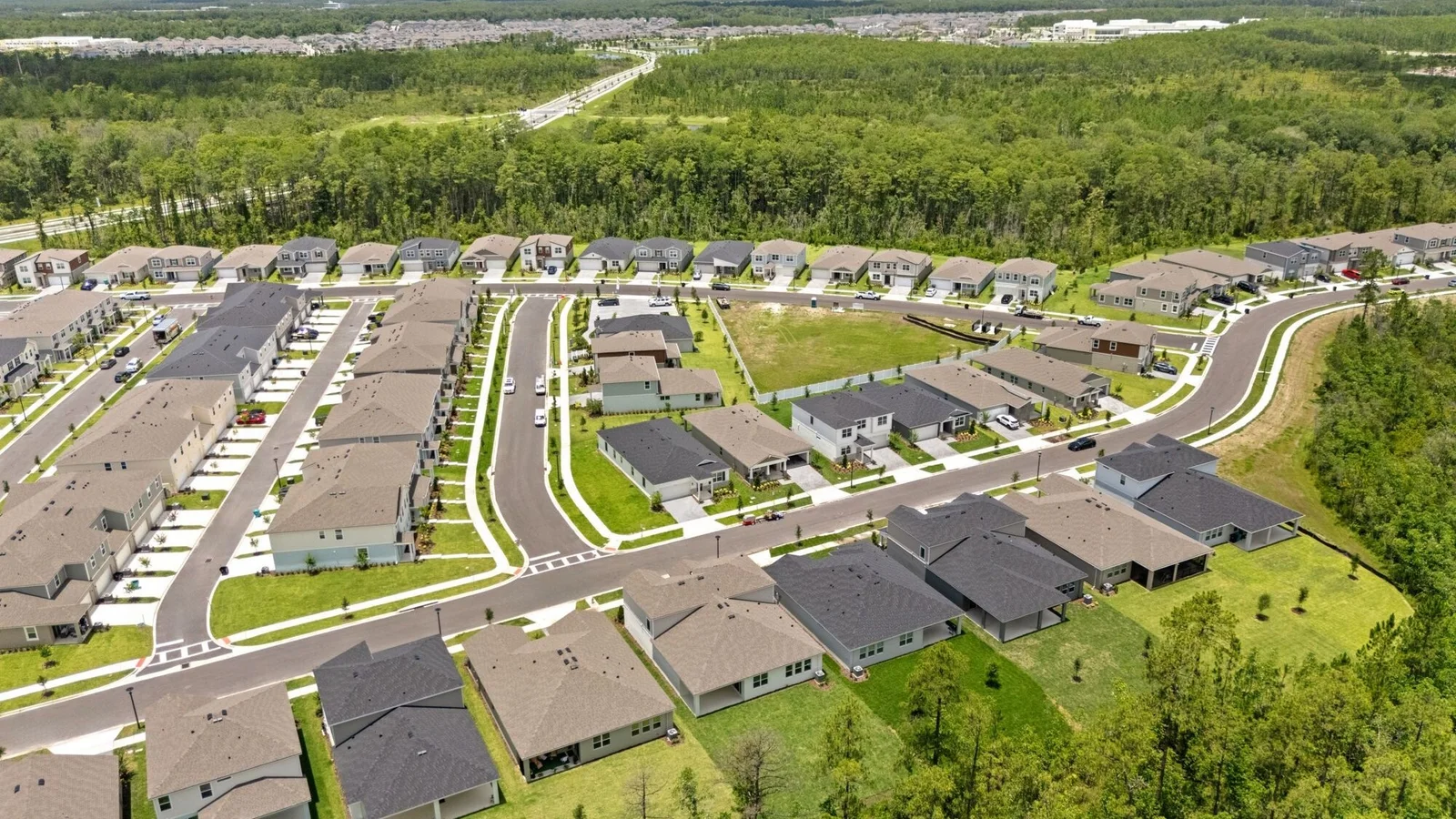
Quick answer: a CDD fee is an annual assessment charged by a Community Development District, a special-purpose Florida government that financed a community’s infrastructure with 20-to-30-year bonds, and it typically adds $1,000 to $3,000 per year on top of any HOA fee, collected as a non-ad-valorem line on the November property tax bill.
The term appears constantly in Florida new-construction contracts, tax bills, lender escrow analyses, and resort-community listings, yet it is quoted correctly less often than almost any other line in Florida buyer math. This entry defines the assessment precisely, shows how the two components behave, and gives the 10-minute verification method. For strategy, negotiation angles, and corridor-by-corridor cost tables, the full guide is CDD fees in Florida explained for investors.
What does a CDD fee consist of?
A CDD fee typically consists of two components billed together as non-ad-valorem assessments: fixed debt service repaying the district’s construction bonds over 20 to 30 years, and an operations and maintenance levy the board rebudgets annually and that never expires. Florida Estate models the two lines separately, because they age in opposite directions.
| Component | Typical share | Behavior |
|---|---|---|
| Debt service | 40% to 70% | Fixed schedule, ends at bond maturity |
| Operations and maintenance | 30% to 60% | Annual budget, permanent |
The split matters because the two lines age differently. A community built in 2005 may have retired its bonds entirely, leaving $200 to $800 of O&M, while a 2022 phase of the same corridor carries $1,500 to $3,000 of combined assessment for decades. Two visually identical homes one phase apart can differ by $1,000 or more per year on bond vintage alone, a spread the listing data almost never shows.
How is a CDD fee different from an HOA fee?
A CDD assessment is levied by a government district and collected on the county tax bill with lien priority similar to taxes, while an HOA fee is billed directly by a private association under recorded covenants. Many Florida master-planned communities charge both, commonly $1,000 to $3,000 of CDD on top of $200 to $400 of monthly HOA, and our underwriting always confirms both before modeling.
| Dimension | CDD assessment | HOA fee |
|---|---|---|
| Levied by | Special-purpose government | Private association |
| Collected via | November tax bill | Direct billing |
| Funds | Bond repayment, district infrastructure | Private amenities, management, rules |
| Ends? | Debt portion at maturity | Never |
| In mortgage escrow? | Yes, with taxes | No |
The practical consequence for buyers: a portal listing that shows “HOA $310/month” on a Davenport home in a district charging $2,600 per year is understating true carrying cost by roughly $217 per month, and the missing number is sitting in public view on the tax collector’s parcel record. The comparison guide CDD vs HOA fees covers where each bites hardest.
What does a typical CDD fee cost in Florida?
Florida CDD assessments typically cost $1,000 to $2,500 per year combined, with high-amenity resort communities reaching $3,000 or more and retired-bond communities dropping to $200 to $800 of operations-only cost. The Orlando resort corridor, the Tampa suburbs, and Lakewood Ranch carry the densest concentrations of district-financed communities.
Reference points from our data, by corridor:
- Osceola and Polk County vacation-rental communities commonly assess $1,500 to $3,000, reflecting resort-scale amenities
- Wesley Chapel and New Tampa parcels range from $200 O&M-only to $2,500 with full debt outstanding
- Lakewood Ranch assessments commonly run $1,600 to $3,000 and are unusually well documented
On rental property the assessment is a fixed expense line: $2,000 per year removes roughly a full percentage point of net yield from a typical $200,000-revenue short-term rental model, which is why the rental yield guide treats the CDD alongside insurance rather than as a rounding item.
How do you verify a parcel’s CDD assessment?
Verifying a parcel’s exact CDD requires about 10 minutes, two public sources, and $0 in fees: the county tax collector’s record shows the current non-ad-valorem lines, typically $1,000 to $3,000 combined, and the district administrator confirms the payoff balance, remaining bond term, and next year’s adopted budget.
The checklist our underwriting runs:
- Pull the parcel on the county tax collector’s website and read every non-ad-valorem line.
- Identify the district from the line item and find its site, usually run by a management company.
- Request the current assessment, remaining bond term, and a per-parcel payoff quote from the administrator.
- Read the adopted budget for the coming year, because O&M changes are voted before bills go out.
- Confirm with your lender that the assessment is inside the escrow estimate behind your pre-approval.
A prepaid parcel, one whose owner has already paid off the bond principal, carries permanently lower bills and often sells at ordinary prices because agents rarely market the payoff. Asking the administrator which parcels are prepaid is the cheapest edge in district-community shopping.
Which related terms should buyers learn next?
Five terms typically travel with the CDD fee in Florida transaction documents, and each carries its own dollar consequence: the homestead exemption reduces ad-valorem tax but never touches non-ad-valorem CDD lines, while the tourist development tax adds 5% to 6% on short-term rental revenue in the same resort corridors where districts cluster.
- Homestead exemption, which reduces ad-valorem tax but does not touch non-ad-valorem CDD lines
- Tourist development tax, the other levy that surprises short-term rental owners
- Doc stamp tax, the transfer-side closing cost
- Full strategy guide: CDD fees in Florida for investors
- Pre-offer checklist: Florida property investment checklist
Frequently Asked Questions
An annual assessment, typically $1,000 to $3,000 for 20 to 30 years, that repays the bonds a Community Development District sold to build a Florida community's infrastructure, collected on the property tax bill separately from any HOA fee.
No. Districts concentrate in master-planned communities built after 1980, especially the Orlando resort corridor, Tampa suburbs, Lakewood Ranch, and newer Jacksonville and Fort Myers corridors. Older in-town neighborhoods and most condo towers have none.
The debt portion ends at bond maturity, typically 20 to 30 years from construction. The operations and maintenance portion continues permanently, usually $200 to $800 per year in mature districts.
The assessment itself is not negotiable, but buyers negotiate around it: builders sometimes prepay bonds as an incentive, and on resales a documented $2,600 assessment supports a matching price or credit ask, especially against comparable retired-bond homes.
As one or more non-ad-valorem assessment lines on the November county bill, named for the district, separate from the ad-valorem property tax that scales with assessed value. Lenders escrow the full bill, so the assessment lands inside the monthly payment.
Applying this to a real purchase?
Tell us your budget and target corridor and we will send a shortlist with verified CDD, HOA, and county rule status within one business day.