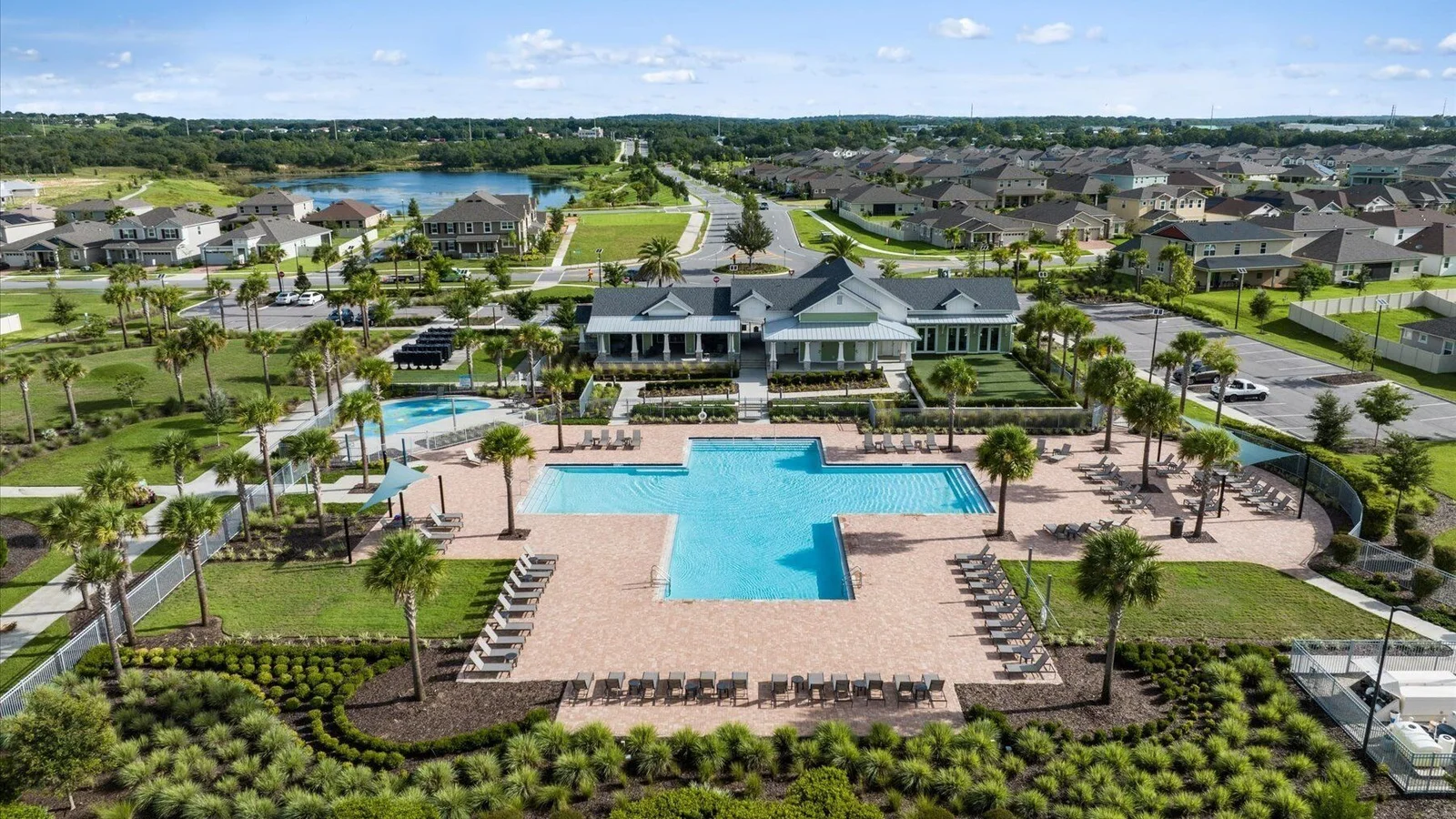
Quick answer: a CDD fee is a bond-repayment assessment charged by a Community Development District on top of your HOA fee, and it typically adds $1,000 to $3,000 per year to a Florida new-construction home for 20 to 30 years. It appears on the November tax bill, not in most listings, which is why our underwriting treats it as the most commonly missed number in Florida buyer math.
A buyer we advised last year modeled a Davenport vacation rental to the dollar: $415,000 purchase, $310 monthly HOA, projected 58% occupancy. The model cleared. Then the first November tax bill arrived $2,340 heavier than projected, with two unfamiliar lines: a debt assessment and an O&M assessment from a development district the listing never mentioned. The yield he thought was 5.1% net was 4.2% before he had hosted a single guest.
Nothing about that bill was hidden in any legal sense. The district was disclosed in the contract package, the assessment was on the prior owner’s tax bill, and the community’s pools and boulevards were built with exactly that money. But CDD assessments live in documents most buyers never read, quoted by agents as afterthoughts if at all, and they are absent from the monthly-cost widgets on every major listing portal.
This guide explains what a CDD actually is, what it costs across Florida’s major investment corridors, how the debt and operations components work, how to verify the exact figure for any parcel in about ten minutes, and when a CDD is worth paying versus avoiding. For the one-paragraph definition, see the CDD fee glossary entry; for how the assessment fits the wider cost stack, pair this with the rental yield guide.
What is a CDD and why does it exist?
A Community Development District is a special-purpose local government, authorized by Florida statute in 1980, that sells tax-exempt bonds repaid over 20 to 30 years to finance a new community’s infrastructure before homes exist to pay for it. Florida has more than 600 active districts levying assessments that typically run $1,000 to $3,000 per parcel per year.
The mechanism solved a real problem. A developer planning a large community needs roads, stormwater ponds, water and sewer lines, streetlights, and often a clubhouse and resort pool before the first closing, infrastructure that can cost $20 million to $60 million up front. Rather than pricing it into homes or waiting years for county capital budgets, the developer establishes a district, the district issues the bonds, and every parcel repays its share through an annual assessment for the 20-to-30-year bond term, commonly $100 to $300 per month in effective carrying cost.
What buyers should understand about the structure:
- The district is a government, not a company. Its board levies assessments with the force of a tax lien; nonpayment carries the same consequences as unpaid property tax.
- The assessment runs with the land. Selling the home transfers the remaining obligation to the buyer automatically.
- Boards transition over time. Early boards are developer-controlled; resident majorities typically take over as build-out completes, which is when O&M budgets start reflecting owner priorities.
- The money built what you see. Gated entries, boulevard landscaping, lagoon pools, and fiber trunks in newer communities are usually bond-financed district property.
Our underwriting treats the CDD as neither good nor bad in itself: it is deferred infrastructure cost made explicit. The failure mode is not paying it; the failure mode is not knowing it exists until November.
How much do CDD fees cost in Florida in 2026?
Florida CDD assessments typically run $1,000 to $2,500 per year combined, high-amenity communities reach $3,000 or more, and mature districts with retired bonds drop to $200 to $800 of operations-only cost. Budget $100 to $300 per month on top of the HOA fee for most new-construction product.
Representative ranges from the corridors our clients buy in:
| Corridor | Typical combined CDD | Notes |
|---|---|---|
| Orlando resort corridor (Osceola, Polk) | $1,500 to $3,000 | Resort amenities push the top of the band |
| Tampa suburbs (Wesley Chapel, New Tampa) | $1,000 to $2,500 | O&M-only parcels as low as $200 to $800 |
| Lakewood Ranch (Manatee, Sarasota) | $1,600 to $3,000 | Long-running district, well documented |
| Jacksonville growth corridors | $1,200 to $2,200 | Newer districts, full debt service outstanding |
| Fort Myers / Cape Coral new build | $1,000 to $2,000 | Varies sharply by amenity load |
Three factors move a specific parcel inside those ranges. Bond vintage matters most: a community built in 2005 may have retired its original debt, while a 2022 phase carries full service. Amenity scale is second: lazy rivers and staffed clubhouses are financed square footage. Lot size is third: many districts apportion debt by lot width or product type, so a townhome and an estate lot in the same community can carry assessments $800 apart. The only reliable figure is the parcel’s own tax bill, which is why the verification section below starts there rather than with the sales office.
How is the assessment split between debt and operations?
Every CDD assessment divides into two components with different behavior: fixed debt service that repays the original construction bonds over 20 to 30 years, and an operations and maintenance levy that the district board resets annually and that never expires. The November tax bill lists them as separate non-ad-valorem lines.
| Component | Typical share | Behavior | Ends? |
|---|---|---|---|
| Debt service (capital assessment) | 40% to 70% of the bill | Fixed schedule set at bond issuance | Yes, at bond maturity |
| Operations and maintenance | 30% to 60% | Rebudgeted annually by the board | No |
Bond vintage, budget drift, and prepayment rights turn that two-line split into real money, and our underwriting checks all three items on every district parcel we model for clients. Two identical homes one phase apart can differ by $1,000 or more per year purely on when their bonds were issued, because a 2006 phase may be down to operations-only cost while a 2022 phase carries full debt service for decades. District O&M budgets face the same insurance and labor inflation as HOA budgets, so the variable half of the bill drifts upward in most adopted budgets we read. And most districts will quote a one-time payoff, often near $15,000 against a $1,400 annual debt line, that permanently deletes the largest line from the tax bill. In detail:
- Age is a discount. Two visually identical homes in adjacent phases can differ by $1,000 or more per year purely on bond vintage. Buying the older phase captures the same amenities at retired-debt pricing.
- O&M drifts upward. Districts face the same insurance and labor inflation as HOAs, and 91% of Florida community associations reported unexpected cost increases in 2026; district O&M budgets have moved the same direction. Read the current adopted budget, not last year’s bill.
- Prepayment is possible. Most districts quote a bond payoff per parcel, removing the debt line permanently. On a payoff of roughly $15,000 against a $1,400 annual debt line, the implied return near 9% beats most alternatives for a long-hold owner, and a seller who has prepaid owns a genuinely cheaper-to-carry home that listings rarely know how to advertise.
Red flag worth naming: a district that is still developer-controlled late into build-out, with O&M rising and amenities unfinished, deserves a harder look at board minutes before you rely on the current budget.
Why do CDD fees blindside so many buyers?
Listing conventions, not concealment, create the surprise: portals and MLS feeds display HOA fees in their monthly-cost fields, while CDD assessments live on the tax bill, so the standard buyer workflow never surfaces them. Florida’s disclosure requirement is real but arrives inside the contract package, pages deep, after the emotional decision is made.
| Where buyers look | What it shows | What it misses |
|---|---|---|
| Portal monthly-cost widget | HOA fee | The entire CDD line |
| Seller’s tax bill total | One combined number | Flat non-ad-valorem charges inside it |
| Lender pre-approval | Estimated escrow | Assessment often added later |
The gap compounds through four mechanisms we see repeatedly:
- The tax-bill illusion. Buyers who check the seller’s total tax bill see one number and assume it is all ad-valorem property tax that will scale with their own assessed value. The non-ad-valorem CDD lines inside it are flat charges that do not respond to value at all.
- The escrow surprise. Lenders escrow the assessment with taxes, so the monthly payment quoted at pre-approval rises when the escrow analysis catches up, occasionally by $200 or more per month.
- Agent shorthand. Out-of-area agents quote “HOA $310” accurately and omit the district entirely, sometimes because they do not know the community has one.
- New-construction framing. Builder sales offices present the CDD as a routine line in a long closing sheet; buyers anchored on base price and incentives rarely reprice the deal for a 30-year assessment.
A buyer scenario from our files makes the stakes concrete. Two clients compared near-identical 4-bedroom pool homes in Davenport listed at $409,000 and $415,000, both zoned for short-term rental in Polk County. The cheaper home sat in a district whose 2021 bonds carry $2,600 of combined annual assessment; the dearer one sat in a 2006 district down to $700 of operations-only cost. Over a seven-year hold at those rates the “cheaper” home costs roughly $13,300 more, before any O&M inflation, and the gap widens every year the newer district’s budget drifts. The $6,000 sticker difference reversed into a five-figure carrying-cost advantage that no listing field showed, and that quiet reversal is the single most common CDD finding in our underwriting files.
How do CDD fees change investment math on a rental?
An assessment of $2,000 per year removes roughly a full percentage point of net yield from a typical $200,000-revenue Orlando short-term rental model, and about half a point from a $400,000 long-term rental grossing $30,000. CDD cost is flat, so its yield impact is largest exactly where nightly-rate models look thinnest.
Worked comparison at 2026 operating norms:
| Model | Without CDD | With $2,400 CDD | Net yield change |
|---|---|---|---|
| Davenport STR, $415K, $65K gross | ~4.9% net | ~4.3% net | -0.6 pt |
| Kissimmee STR, $380K, $58K gross | ~4.6% net | ~4.0% net | -0.6 pt |
| Tampa LTR, $360K, $28K gross | ~3.9% net | ~3.2% net | -0.7 pt |
Three adjustments follow in our underwriting. First, model the CDD as a fixed expense line alongside insurance, never as part of a percentage management assumption, because it does not scale with revenue. Second, compare CDD and non-CDD communities on delivered amenity value: resort amenities financed by the district are often precisely what earns a Champions Gate or Storey Lake home its nightly rate, so the assessment can be revenue-productive in STR corridors while being pure cost in a commuter suburb. Third, check the county STR rules and Polk County rules alongside the district documents, because the same master-planned corridors that carry CDDs are the ones zoned for nightly rental, and the two documents together define the real operating envelope. Our Orlando vacation rental guide and the community reviews carry per-community context, including Solterra Resort and Champions Gate.
How do you verify the exact CDD figure for any parcel?
Verifying a parcel’s exact CDD requires only ten minutes, two public sources, and $0 in fees: the county tax collector’s parcel record shows the current non-ad-valorem lines, and the district administrator confirms the payoff and the adopted budget for the next 12 months. Never rely on the listing, and never rely on averages, including ours.
Florida Estate’s verification checklist, in order:
- Pull the parcel on the county tax collector site. Read every non-ad-valorem line on the current bill. Note debt and O&M separately if itemized.
- Identify the district. The line names it. The district’s own site, usually run by a management company, publishes budgets, meeting minutes, and the administrator’s contact.
- Request three numbers from the administrator: current-year total assessment for the parcel, remaining bond term, and the prepayment payoff amount.
- Read the adopted budget for next year. O&M changes are voted before tax bills go out; the budget tells you the direction early.
- Check board composition. Resident-controlled boards late in build-out are the stable case; developer control plus rising O&M is the pattern that deserves minute-reading.
- Confirm with the lender that the assessment is inside the escrow estimate your pre-approval used.
Insider tip: ask the administrator whether any parcels in the community have prepaid their bonds and how the MLS remarks usually show it. Prepaid parcels surface as ordinary listings at ordinary prices more often than you would expect, because agents rarely understand what “bond paid in full” is worth. Buying one captures $1,000 to $1,800 of permanent annual savings that the market failed to price, and we have never seen a portal filter for it.
When is a CDD worth paying, and when should you avoid it?
Paying a CDD makes sense when the financed amenities earn revenue or lifestyle value you would otherwise buy separately, and it fails when an equivalent non-district alternative sits nearby at $1,000 to $2,000 less per year of carrying cost. The assessment is a price for infrastructure; the only question is whether that infrastructure works for your strategy.
Cases where our data supports paying it:
- STR resort corridors. Nightly rates at amenity-rich communities near Disney depend on the pools, slides, and clubhouses the bonds built. The assessment behaves like a revenue expense, and guests repay it.
- Retired-bond communities. O&M-only parcels at $200 to $800 deliver mature landscaping and infrastructure at a fraction of new-phase carrying cost.
- Prepaid parcels. As above: full amenities, no debt line, rarely priced in.
Cases where we counsel avoiding or discounting hard:
- Commuter LTR models. A long-term tenant in Wesley Chapel pays little premium for resort amenities; $2,400 a year is pure yield erosion.
- Full-debt new phases beside retired-debt resales. Same community, same amenities, $1,000+ annual difference; buy the older phase unless builder incentives close the gap.
- Thin-margin deals. If a fixed $2,000 breaks the model, the model has no margin for Florida’s other moving costs either, insurance first among them; see the insurance cost guide.
For buyers still choosing between product types, the CDD question folds into the larger one: condo fees, HOA dues, and district assessments are three different names for shared-infrastructure cost, and the condo versus house comparison plus the 2026 condo repricing guide show how each is currently priced by the market.
What should a buyer do before offering on a CDD home?
Verify the parcel’s assessment on the tax collector’s record, obtain the payoff and budget from the district, and reprice the offer or the model with the confirmed figure: the sequence takes about an hour, costs $0, and routinely moves $10,000 or more of value over a typical 5-to-7-year hold. Negotiation follows naturally, because a documented $2,600 assessment is leverage.
Concrete asks that have worked for our clients this year:
- Builder deals: request the builder prepay or buy down the bond as an incentive; in a 12.9-months-of-supply condo market and a cooling new-build market, incentive budgets exist and this is a legitimate target for them.
- Resales: where the seller’s phase carries full debt and a comparable retired-debt resale exists, present both tax bills with your offer. The arithmetic argues for you.
- Any purchase: align the purchase contract’s prorations so the closing statement splits the current year’s assessment to the day.
If you want the district math done for you, request a free shortlist with your budget, target corridor, and rental strategy, and we will return specific communities with verified CDD, HOA, and county rule status within one business day. The Florida investment checklist carries the full pre-offer document list this guide plugs into.
Frequently Asked Questions
An assessment charged by a Community Development District, a special-purpose government that sold bonds to build a community's roads, drainage, and amenities. It repays those bonds plus annual operations, appears as a non-ad-valorem line on the November tax bill, and typically adds $1,000 to $3,000 per year for 20 to 30 years. It is separate from, and additional to, any HOA fee.
Most run $1,000 to $2,500 per year combined; high-amenity resort communities reach $3,000+. Mature districts with retired bonds drop to $200 to $800 of operations-only cost. The exact figure is parcel-specific: check the county tax collector's record, not the listing.
No. The CDD is a government district collecting through the county tax bill; the HOA is a private association billing directly. Many communities charge both, and a listing quoting only HOA understates carrying cost by $100 to $300 per month.
The debt-service portion ends at bond maturity, typically 20 to 30 years after the infrastructure was built. The operations and maintenance portion continues permanently. Older phases with retired debt can cost $1,000+ less per year than identical new phases.
Most districts quote a per-parcel payoff that permanently removes the debt line while O&M continues. Against a typical $1,400 annual debt line, a roughly $15,000 payoff implies a return near 9% for long-hold owners. Prepaid parcels also resell with a genuine carrying-cost advantage that listings rarely price.
Yes. Because the assessment rides the tax bill, lenders escrow it and include it in debt-to-income. A $2,400 assessment is $200 per month of qualifying cost, enough to move a marginal approval, so confirm it is inside the escrow estimate behind your pre-approval.
Many do, including Champions Gate, Storey Lake, and Solterra Resort. The resort amenities that earn the nightly rate are usually what the bonds financed, so in STR corridors the assessment can be revenue-productive, while in commuter suburbs it is pure cost. Model it as a fixed line: $2,000 a year is about one point of net yield on a typical Orlando STR.
Pull the parcel on the county tax collector's website and read the non-ad-valorem lines, then ask the district administrator for the current assessment, remaining bond term, and payoff quote, and read next year's adopted budget. The whole check takes about ten minutes and binds, unlike listing data.
Get a shortlist with the CDD math done
Tell us your budget, corridor, and rental strategy. We reply within one business day with communities, verified CDD and HOA figures, and county rule status.