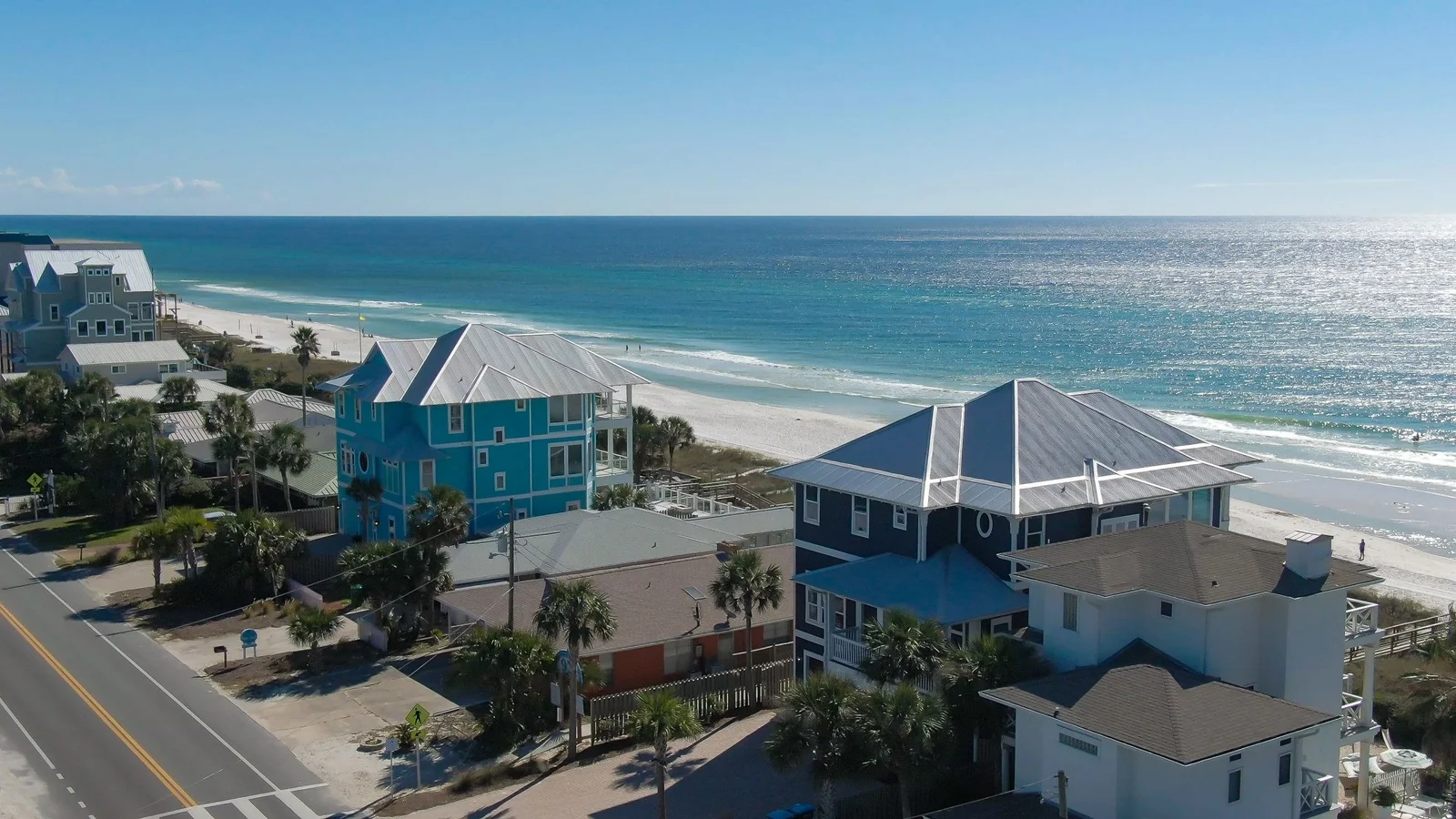
Quick answer: Two maps govern a rental in this county and neither is the county boundary. One decides whether you owe the 5% bed tax, because Bay collects it inside a defined special taxing jurisdiction rather than everywhere. The other decides who your building will let you rent to during the eight weeks that used to be the most profitable of the year.
Most Florida counties apply their tourist tax to the whole county and leave the geography question to zoning. Bay does something less common: it draws the tax itself on a map, so two properties in the same county with the same use can have different filing obligations.
Layered on top is a city that has spent years reshaping its highest-demand season by ordinance, and a private layer of building rules that goes further than the city does.
The jurisdiction that decides whether you file
The Bay County bed tax is collected from a special taxing jurisdiction. The boundary is specific, and it is worth reading against a parcel rather than assumed from a postal address.
| Area inside the jurisdiction |
|---|
| City limits of Panama City Beach |
| City limits of Panama City |
| City limits of Mexico Beach |
| South of Panama City Beach Parkway, from the Phillips Inlet Bridge to the Hathaway Bridge |
| The area surrounding the PCB Sports Complex |
| East of Tyndall Air Force Base and south of the Intracoastal Waterway |
The practical effect is that the tax question and the zoning question have different answers and different maps. An owner can confirm that a property may be let and still not know whether the county bed tax applies to the rent, because that turns on a separate boundary drawn for a different purpose.
Confirm the position with the Bay County Clerk of Court, which administers the tax, using the parcel identification rather than the street name. Corridor boundaries defined by bridges and parkways do not follow neighbourhood lines.
What Panama City Beach requires on top
Inside the city, Ordinance 1632 requires a valid Vacation Rental Certificate before a property operates. The registration fee is 250 dollars, and the certificate sits alongside three other registrations.
| Requirement | Issued by |
|---|---|
| Vacation Rental Certificate | City of Panama City Beach |
| Vacation rental licence | Florida DBPR |
| Business tax receipt | Local authority |
| Tourist development tax registration | Bay County Clerk of Court |
The detail that tells you most about this regime is administrative rather than legal. The city runs vacation rental certification through its fire department, as a fire inspection function.
That framing sets what inspectors care about. Egress, smoke and carbon monoxide alarms, extinguishers, occupancy limits relative to exits, pool barriers and posted evacuation information carry more weight than they would in a purely planning-led process. An owner preparing for the inspection should prepare for a life-safety visit, because that is what it is.
It also means the inspection is repeatable and objective. There is little discretion in whether an alarm works, so a properly prepared property passes and a poorly prepared one fails for reasons that are fixable and specific.
What the tax stack comes to
| Component | Rate | Collected by |
|---|---|---|
| Bay County tourist development tax | 5% | Bay County Clerk of Court |
| Florida state sales tax | 6% | Florida Department of Revenue |
| Combined inside the jurisdiction | about 11% |
Eleven percent puts Bay at the lower end of the Florida range, level with the neighbouring panhandle counties and around two points below the Gulf coast counties further south. On a property grossing six figures that spread is real money, and it is one of the few advantages the panhandle holds over the peninsula on pure arithmetic.
The season the city legislated against
Panama City Beach built its reputation on spring break and then spent years reducing it. Enforcement now concentrates in March and April, with heightened noise enforcement and ordinances restricting alcohol on the beach during defined spring break periods.
For an investor this is a demand-side fact rather than a compliance one, and it cuts in a specific direction.
The old model treated March and April as the revenue peak and accepted the operational cost: damage, complaints, staffing, turnover. That model has been deliberately dismantled. What replaced it is a longer, calmer season built on families and older visitors, with lower peak rates and materially lower operating friction.
Buildings went further than the city. Many condominium associations now require renters to be 25 or older during the spring break season, and some apply that year-round. This is a private rule, imposed by the association rather than by any government, and it is enforceable against the owner regardless of what the city permits.
The consequence for underwriting is direct. A pro forma built on historic March and April rates from the old regime describes a market that no longer exists.
Reading the building rules before the ordinances
Because the age restriction is private, it does not appear in any city or county record. It appears in association documents, and it varies building by building along the same stretch of beach.
Three questions settle it during diligence:
- Does the association impose a minimum guest age, and does it apply year-round or seasonally?
- Are there occupancy caps below what the unit could physically sleep, and do they count children?
- Does the association impose its own registration, key or parking-pass process on top of the city certificate?
Each of these directly changes achievable revenue, and none of them is visible from outside the building.
Our insider tip: ask the association for the rules that apply to renters, not the declaration. The declaration is the long recorded document everyone requests and it often says little about guests. The board-adopted rules are shorter, more recent, and they are where the age limits, occupancy caps and parking allocations actually live.
Pros and cons of the Bay County market
Advantages. A tax stack at the low end of the Florida range. A certification process that is objective and safety-led rather than discretionary. Entry pricing well below the 30A market immediately east. And a season that is now longer and less destructive than the one this coast is remembered for.
Disadvantages. The special taxing jurisdiction adds a boundary question that most counties do not have. Peak-season rates are lower than the old spring break economics implied. Private age restrictions can exclude a whole guest segment without warning, and they can be introduced by an association after purchase.
Red flags on a Panama City Beach listing
- Revenue history drawn from the pre-enforcement spring break years, presented as a forward projection.
- A certificate that lapsed between owners, which means the fire inspection has to be redone before letting resumes.
- Sleeping capacity advertised above the association’s occupancy cap or above what the egress arrangement supports.
- No tourist tax registration on a parcel that sits inside the special taxing jurisdiction, on the assumption that the tax is city-only.
- Parking advertised for more vehicles than the association allocates passes for, which is the most common source of guest complaints on this coast.
Which buyer this coast suits
Suits. An owner targeting family and older-visitor demand across a long shoulder season, who values a low tax stack and an inspection regime with clear pass conditions.
Suits differently. A buyer in the unincorporated county outside the special taxing jurisdiction, whose filing obligations and zoning position both need establishing individually rather than by analogy.
Does not suit. An investor underwriting the spring break economics of a decade ago. The city has spent considerable effort ensuring that market does not return.
Compare the enforcement-led regime next door in our Walton County STR rules, the mid-length military demand in our Okaloosa County STR rules, and a county that went further and banned nightly letting outright in our Volusia County STR rules. State licensing is in our DBPR vacation rental licence guide, rates in tourist development tax by county, and the yield method in our Florida rental yield guide.
Frequently Asked Questions
No. The 5% bed tax is collected within a defined special taxing jurisdiction rather than county-wide, so whether a property owes it depends on where the parcel sits on that map.
It includes the city limits of Panama City Beach, Panama City and Mexico Beach, the corridor south of Panama City Beach Parkway between the Phillips Inlet and Hathaway bridges, the area around the PCB Sports Complex, and land east of Tyndall Air Force Base south of the Intracoastal Waterway.
The registration fee is 250 dollars. The certificate is required under city Ordinance 1632 alongside a state DBPR licence, a business tax receipt and tourist development tax registration.
Because the certificate is issued against a life-safety inspection. Panama City Beach treats vacation rental compliance as a fire and safety matter first, which shapes what inspectors look for.
Many buildings impose a minimum guest age during the spring break season, and some apply it year-round. That is a private rule set by the association, separate from any city ordinance.
Through enhanced noise enforcement concentrated in March and April and ordinances restricting alcohol on the beach during defined spring break periods.
Sources: Bay County Clerk of Court and Comptroller, tourist development tax and special taxing jurisdiction; City of Panama City Beach short-term rentals, fire inspections division, Ordinance 1632; Florida Department of Revenue. Verified 27 August 2026.
Check the jurisdiction and the building rules
Send a Bay County address. We confirm whether the parcel sits inside the special taxing jurisdiction and pull the association rules that govern guest age and occupancy.