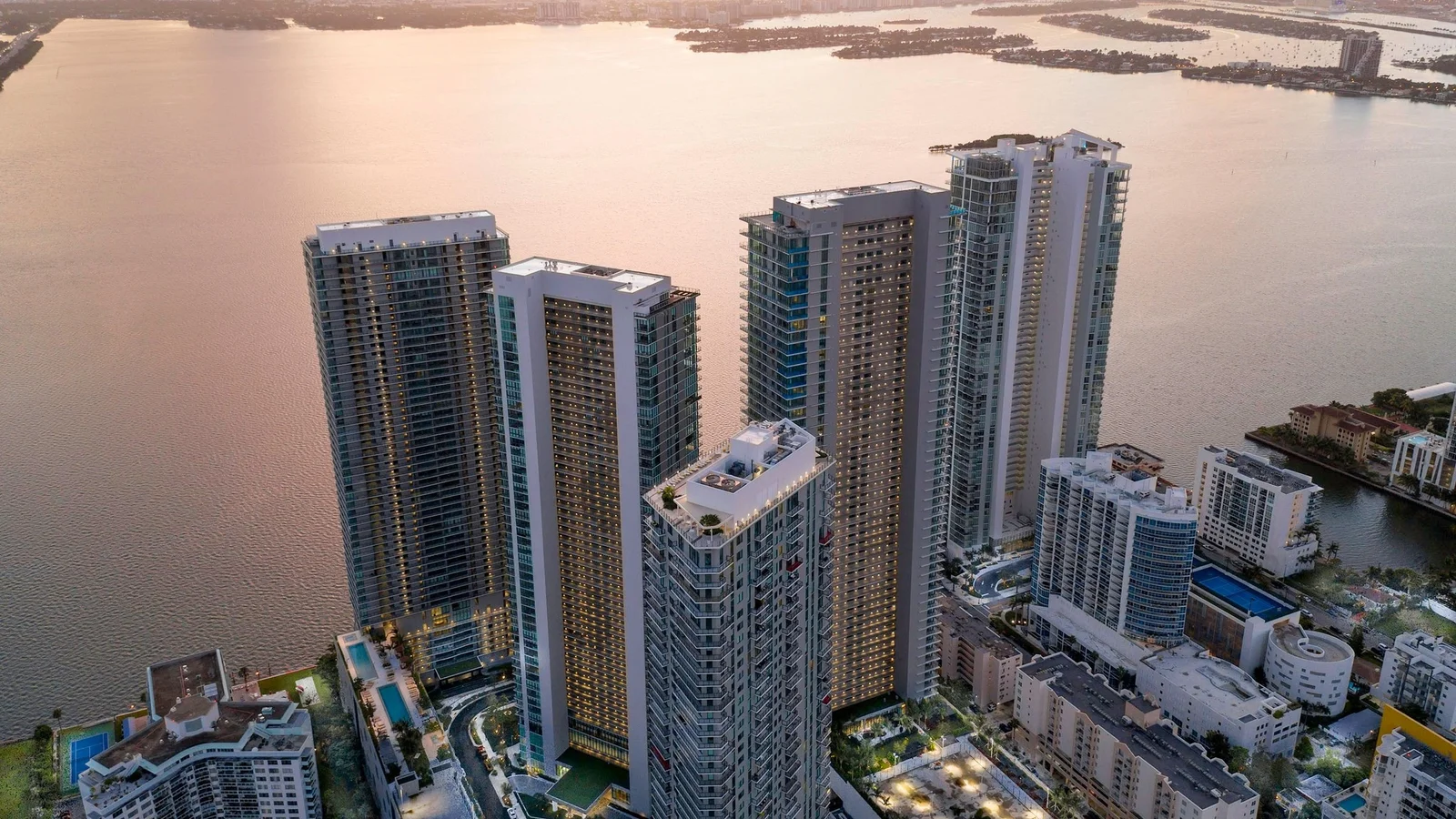
Quick answer: Two facts decide whether this building is on your list at all. There is no small residence, the smallest standard layout is about 1,124 square feet, so the entry price is near $1.4 million rather than the several hundred thousand a Brickell search leads people to expect. And two associations bill the owner, the condominium and the Paraiso Bay master. Any monthly figure quoted without the second one is incomplete.
There is no cheap way into this building
Most Miami towers offer a studio or a small one-bedroom that lets a buyer take a position at the bottom of the price list. This one does not.
Standard residences begin at about 1,124 square feet. At roughly $1,330 per square foot the arithmetic produces an entry near $1.4 million, and the range runs to $6.0 million before penthouses. That single design decision changes who the building is for and how it behaves.
It removes the investor buying a small unit for yield, because there is no small unit. It removes the first-time Miami buyer. What remains is a resident buyer or a second-home buyer at a price point where the monthly carrying cost is a smaller share of the decision. That produces a quieter building with fewer transactions, which owners generally like, and a thinner resale market, which sellers generally do not.
Set it against the district. Quantum on the Bay, the 2008 tower a few blocks south, holds 698 units and trades far below this per foot. Same neighbourhood, same bay, entirely different product: 273 large residences against 698 mixed ones, and a decade between their milestone inspections.
Two associations, two bills
Florida’s corporate registry shows both a One Paraiso Condo Association and a Paraiso Bay Master Homeowners Association, the latter covering the wider Paraiso Bay development rather than this tower alone.
Two-tier structures are normal in master-planned campuses and they are also where quoted carrying costs go wrong. A listing that states a monthly association fee is usually stating the condominium fee. The master assessment is separate, it funds shared campus elements, and it has its own budget, its own reserve study and its own capacity to rise.
Before modelling anything here, ask for six documents rather than three:
| Document | Condominium association | Master association |
|---|---|---|
| Current adopted budget | required | required |
| Reserve study and funding percentage | required | required |
| Three years of fee history | required | required |
The master level deserves particular attention because campus infrastructure, landscaping by a named designer, shared amenity decks and access roads are expensive to maintain and are funded by a group of buildings whose interests do not always align. A tower that has funded its own reserves well can still be exposed to a master association that has not.
Thirty days is not the restrictive part
The rules are a 30-day minimum lease and board approval for every tenant.
The 30-day floor is ordinary for Miami and it removes nightly letting, as almost every serious building in the district does. The approval requirement is the clause a landlord actually feels. It means a vacancy ends when an approved tenant is found rather than when a willing one appears, and it means an application can be refused.
In practice that adds days or weeks to every turnover and it adds uncertainty to a signed deal until the board has acted. For a building where the entry price is $1.4 million, a two-week extension of vacancy is real money against gross rent, and it belongs in the model rather than in a footnote.
Ask three specific questions: the average board turnaround on a tenant application, whether any application has been refused in the last two years, and what documentation the board requires from an overseas tenant. The answers vary widely between Miami associations and they are knowable before you buy.
2018 vintage, and what the premium buys
A 2018 certificate of occupancy places the 25-year coastal trigger near 2043, comfortably beyond a standard ten-year hold. The SB 4-D milestone and reserve framework will govern this building eventually, but not during most buyers’ ownership.
That is a large part of what the price per foot buys, and it is worth naming plainly. In Edgewater a buyer can pay far less per foot for a 2008 tower and accept a structural inspection inside their hold, or pay this premium and move the event beyond it. Neither choice is wrong; they are different risk positions at different prices, and the district offers both within a few blocks.
Insurance is the shared exposure regardless of vintage. Master policies sit inside the dues at both association levels here, and coastal condominium premiums have repriced every year since 2022. How those lines behave statewide is set out in the Florida property insurance guide. For the wider district picture see the Edgewater area page and the Miami market overview.
Financing at this price point
At an entry near $1.4 million most transactions here are cash or jumbo, and the conventional conforming product is not the relevant question it would be at $500,000.
It still pays to obtain a written project eligibility determination before offering, because a two-tier association structure and a resort-grade amenity base can raise questions on a lender’s project questionnaire even where nothing is wrong. Where a project is judged non-warrantable the conventional thirty-year loan is unavailable building-wide, leaving cash, portfolio lending or a DSCR loan underwritten on the rent at a larger deposit. Overseas buyers work through foreign national mortgage programmes, which at this ticket size means documentation rather than availability.
The Paraiso campus, and why the neighbours matter
One Paraiso is one tower within a larger Related Group development on the Edgewater bayfront, and the master association exists because several buildings share elements between them.
That has a consequence buyers of standalone towers never face: your carrying cost and your amenity experience depend partly on decisions taken by owners in other buildings. A master board sets the campus budget, funds the shared reserves and decides when shared infrastructure is replaced. Your condominium board does not control that vote and neither do you.
It also affects supply. When several towers by the same sponsor sit on adjacent parcels, they compete for the same tenants and the same buyers, often with similar layouts and finishes. A prospective tenant comparing residences across the campus is comparing near-substitutes, which compresses rent, and a buyer comparing listings sees several at once, which compresses price. That is not hypothetical for a landlord here, it is the daily condition of the address.
Ask how many residences across the campus share the master association, how many are typically listed for sale and for rent at the same time, and how the master budget is apportioned between buildings. Apportionment is usually by unit count or by square footage, and which of the two applies changes what a large-format building like this one pays relative to its neighbours.
Verification checklist before you wire
- Get budgets, reserve studies and funding percentages for both associations, not just the condominium.
- Add the master assessment to any monthly figure you have been quoted, then recompute.
- Ask the board’s average turnaround on a tenant application and whether any has been refused recently.
- Confirm the exact residence count and whether the number quoted includes penthouses, because sources differ between 270 and 276.
- Request the billed square footage as the association charges it, not the marketed figure.
- Ask which amenities belong to the tower and which to the master campus, and who pays for each.
- Obtain a written lender project eligibility determination even if you intend to pay cash, because it describes your future buyer pool.
Which buyer this building suits
It suits a resident or second-home buyer at the $1.4 million-plus level who wants a large floor plan on the bay, a 2018 building with no structural event in sight, and design credentials that are genuinely rather than nominally present.
It suits a yield-first investor poorly, and for a structural reason rather than a fee one: there is no small unit to buy. Yield in Edgewater is easier to find in smaller layouts in older towers, where the entry price is a fraction of this and the rent per foot is closer. Buy One Paraiso for the apartment and the address. If the spreadsheet is doing the deciding, the spreadsheet will point somewhere else in the same postcode.
Frequently Asked Questions
Asking prices run roughly $1.4 million to $6.0 million, averaging near $1,330 per square foot. There is no small unit: standard residences start at about 1,124 square feet and run to 1,873, with penthouses above that. The entry ticket to this building is therefore around $1.4 million, not a number in the several hundred thousands.
Completed in 2018 at 3131 NE 7th Avenue, Miami FL 33137, in Edgewater. It runs 53 storeys with about 273 residences, though sources quote between 270 and 276. The Related Group developed it, Arquitectonica designed the building, Piero Lissoni did the interiors and Enzo Enea the landscape.
The minimum lease term is 30 days and every tenant must apply to and be approved by the condominium association. The approval requirement matters more to a landlord than the 30-day floor does: a vacancy lasts until an approved tenant is found, not until a willing one is.
There are two associations on record: One Paraiso Condo Association and the Paraiso Bay Master Homeowners Association covering the wider Paraiso Bay campus. Ask for both budgets and both reserve positions. A quoted monthly figure that includes only the condominium association is not the full carrying cost.
A 2018 completion places the 25-year coastal trigger near 2043, beyond a normal hold. The near-term financial questions here are the two-tier association structure and the reserve funding at both levels, not structural concrete.
It trades at roughly $1,330 per square foot against far lower figures in the district's 2008-era towers, and its milestone sits about a decade later. You are paying a substantial premium per foot to move the structural event outside your ownership window and to buy into a newer amenity base.
Get both association budgets for One Paraiso before you offer
Tell us the residence size you are considering. We will come back with the condominium and master association budgets, both reserve funding percentages, the combined monthly carrying cost, the board's tenant approval record, and comparable Edgewater options at the same price per foot.