Quick answer: Citrus County’s 5% tourist development tax is administered by the state, not by the county. That places it in the minority of Florida counties where a booking platform remitting Florida tax to the Department of Revenue effectively covers the county levy too. It is the closest thing to a handled tax in this state, and it has one hard limit: it covers that platform’s bookings and nothing else.
Three kinds of Florida county
The single most useful thing to know before operating anywhere in Florida is which of three administrative categories the county falls into, because it decides how much work is yours.
| Category | Who receives the county tax | What the owner does |
|---|---|---|
| State-administered | Florida Department of Revenue | files with the state; platform remittance to the state covers its own bookings |
| County-collected, platform collects | the county, via the platform | files for non-platform rent |
| County-collected, no platform collection | the county, from the owner | registers and remits the whole county tax |
Citrus sits in the first row, alongside counties such as Highlands and Sumter’s neighbours in the state-administered group. Its 5% goes to the Department of Revenue on the same return that carries state sales tax.
The practical effect is that the county levy travels with the state tax. A platform that remits Florida tax to the Department for a Citrus booking has dealt with both components of that booking. That is a genuine advantage and it is why owners here have fewer accounts to manage than owners in, say, Escambia or Gulf.
The limit of platform collection
Platform remittance covers bookings made through that platform. It does not cover:
- Direct bookings taken through your own site, by email or by telephone.
- Repeat guests who book directly after a first platform stay, which in a small repeat-visit market is a meaningful share.
- Channels without a collection agreement, which vary and change.
- Long stays arranged privately with seasonal visitors.
For each of those the owner collects the tax from the guest and remits it. That requires an active registration with the Department of Revenue, a filing calendar and returns, whether or not any platform is also filing.
The failure here is subtler than in the owner-remit counties. Nothing is missing from the platform’s side, so a review of platform statements shows a clean position. The gap is in the rent the platform never saw, and it grows precisely as an owner succeeds at building direct bookings.
Register with the Department of Revenue before the first booking. Ask what the filing frequency is and whether a zero return is required in months with no direct rent, because an open account with no filings draws attention even when nothing is owed. See Florida sales tax on rentals.
The tax stack
| Component | Rate | Remitted to |
|---|---|---|
| Florida state sales tax on transient rentals | 6% | Department of Revenue |
| Citrus discretionary sales surtax | county surtax, where levied | Department of Revenue |
| Citrus tourist development tax | 5% | Department of Revenue |
All three arrive at the same authority, which is the simplification this county offers. Confirm the current surtax rate at registration, because discretionary surtaxes change by county referendum and a schedule is a snapshot of a date.
Two seasons pointing in opposite directions
This is not a beach market and it does not behave like one. Citrus County’s visitor economy runs on water of a different kind, and it produces two peaks with a gap between them.
The cool season, broadly November to March, is driven by the springs and by manatee viewing around Kings Bay and the Crystal River area. This is the county’s best-known draw and it brings visitors when much of coastal Florida is quieter.
The summer, by contrast, is driven by scalloping around Homosassa and the open water, a completely different guest with different equipment, different trip length and different accommodation needs.
The consequence for an owner is that the annual model cannot be built from one season. A property positioned for cool-season spring visitors may run soft through July; a property positioned for boat-based summer visitors may run soft in January. Ask for 12 months of actual occupancy and average rate from comparable properties, not a peak-season figure annualised.
Two features move bookings more than décor does in both seasons: water access and parking for a boat and trailer. Where a property has either, it is worth more to a specific guest than a general improvement would be.
What the county is, geographically
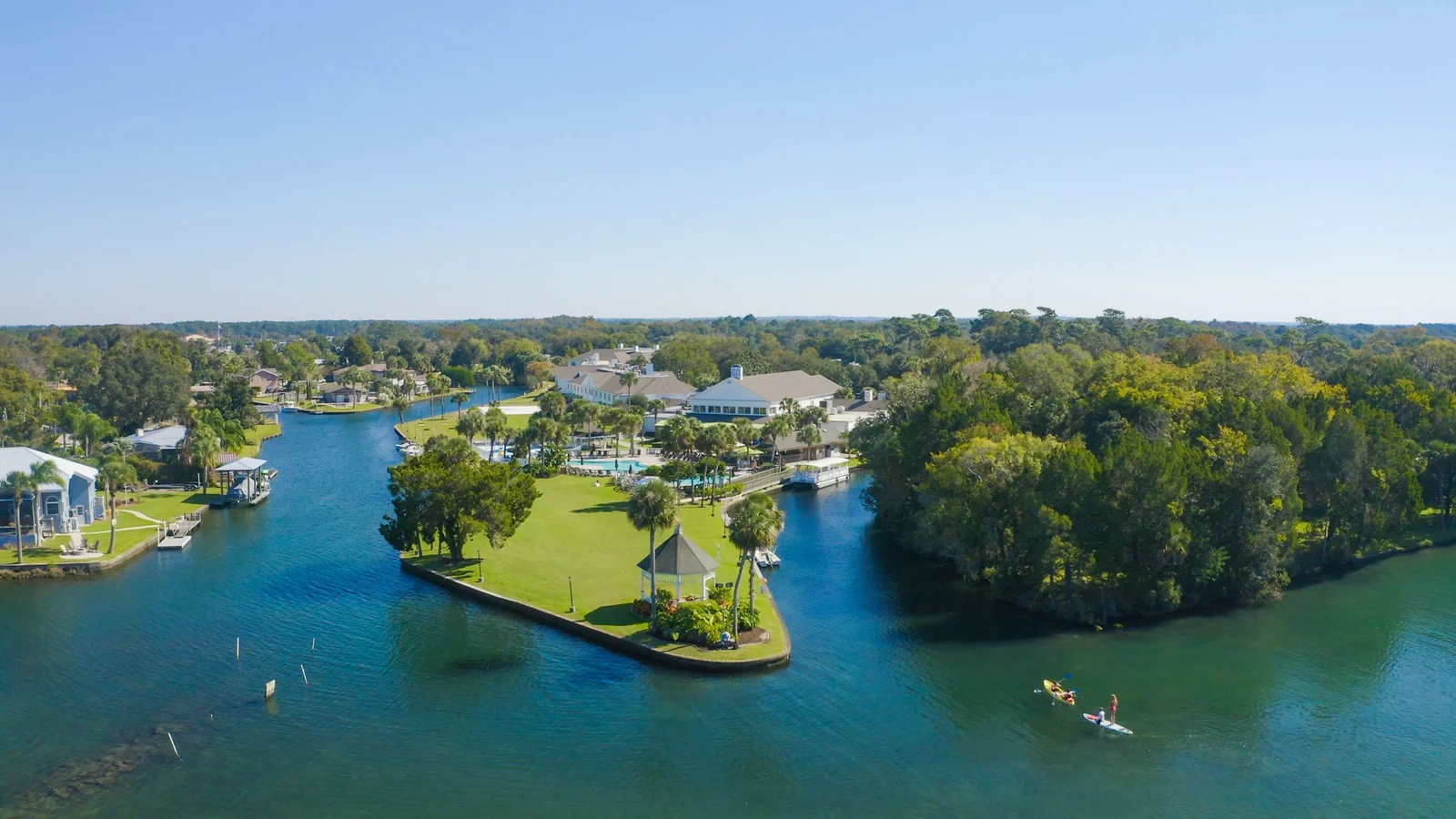
Citrus is a coastal county without a conventional beach. The Gulf edge here is salt marsh, islands and shallow water rather than sand, and the freshwater springs sit a short distance inland. That geography sets the property market as much as the tax rules do.
| Area | Character | What a guest is buying |
|---|---|---|
| Crystal River and Kings Bay | springs and manatee viewing | water access, boat or kayak launch, tour proximity |
| Homosassa and the river | summer boating and scalloping | dock, trailer parking, river frontage |
| Inverness and inland | lakes and the rail trail | quiet, space, lower entry price |
| Beverly Hills and Citrus Springs | residential | long lets rather than nightly stays |
Two things follow. Frontage and mooring are the differentiator, more than finish level, because both visitor economies arrive by water. And the inland residential areas are a long-let market, not a nightly one, so a purchase there should be modelled on a 12-month tenancy rather than on visitor demand.
Ask for the specific water position of any parcel: is there frontage, is there a dock, is the dock permitted, what draft can reach it, and is there space to park a boat and trailer. Those answers move rent here in a way that a renovated kitchen does not.
Licensing and what the county may still do
A DBPR vacation rental licence is required where the property meets the transient public lodging test: broadly, rented more than 3 times in a calendar year for periods under 30 days, or advertised as regularly available for such stays.
Under Florida Statute 509.032(7)(b), a local government may not prohibit vacation rentals or regulate the duration or frequency of stays by an ordinance adopted after 1 June 2011. Ordinances in place on or before that date survive, and may be amended only to become less restrictive.
Local government retains real powers regardless:
Registration and inspection programmes, which the statute contemplates.
Generally applicable rules on noise, parking, waste, occupancy limits and life safety, which apply to all dwellings rather than to vacation rentals specifically.
Private restrictions sit outside preemption entirely. A homeowners association or condominium declaration can restrict letting far more tightly than any county, and does so routinely. See the HOA and association restrictions checklist.
Where the 6-month line falls
Both the state transient sales tax and the county tourist tax attach to lodging of 6 months or less. A single written lease running longer sits outside the transient regime, and outside the vacation rental licensing test with it.
In a two-season market with a soft middle, that alternative deserves modelling rather than dismissal. A 7-month tenancy to a seasonal resident at a lower monthly figure competes seriously with a nightly operation once 5% county tax, 6% state tax, platform commission, cleaning, turnover vacancy and licensing are deducted from the nightly column.
The term of the letting governs, evidenced by a bona fide written lease, not the way the property is advertised. Two consecutive 5-month lettings are two transient lettings, not one long one.
Financing and the cost stack
Lenders price a letting purchase differently from a second home, so state the intended use at application. Conventional investment lending, a DSCR loan underwritten on the property’s own income, or cash are the usual routes, and overseas buyers work through foreign national mortgage programmes.
Build the cost stack from real figures before deciding the model works: taxes as above, platform commission, cleaning per turnover, management where used, insurance including flood where the property sits near water, property tax as actually assessed, maintenance, and a vacancy allowance covering the gap between the two seasons. Ask the seller for a full year of gross bookings alongside a full year of actual costs and reconcile them. A revenue figure with no cost column beside it proves nothing.
Before you buy in Citrus County
- Register with the Department of Revenue before the first booking.
- Confirm the filing frequency and whether zero returns are required.
- Establish which of your channels remit Florida tax and which do not.
- Track direct-booking rent separately from platform rent from day one.
- Confirm the current discretionary sales surtax rate at registration.
- Establish whether a DBPR vacation rental licence is required and obtain it.
- Get 12 months of actual occupancy and rate from comparable properties, both seasons.
- Confirm water access, dock rights and boat parking, which drive bookings here.
- Read any association documents, which can restrict letting more tightly than the county.
Where this leaves an investor
Citrus offers the least administrative friction of the counties in this series, because one authority receives everything and platform remittance genuinely reaches the county levy. That advantage is real and it is also the source of the county’s characteristic mistake: an owner who builds direct bookings without a registration, on the assumption that the tax has always been handled.
Track platform rent and direct rent as two separate numbers from the first booking, and the county’s simplicity works entirely in your favour. For neighbouring inland markets see Hernando County and Marion County.
Frequently Asked Questions
5% on lodging of 6 months or less. Citrus is one of the Florida counties whose local option transient rental tax is reported and remitted to the Florida Department of Revenue rather than to the county, which changes where the return goes and who can handle it.
For its own bookings, in effect yes. Citrus sits among the counties whose tourist development tax the state administers, and Airbnb remits Florida taxes to the Department of Revenue for those counties. That covers bookings made through that platform. It does not cover direct bookings or bookings through channels with no collection agreement.
Yes. Registration with the Department of Revenue for sales tax on transient rentals is the owner's obligation regardless of what any platform remits, and you file returns for the rent a platform did not handle. Confirm the filing frequency and whether a zero return is required in months with no direct bookings.
Two of them, and they are almost opposite. Manatee viewing at Kings Bay and the springs draws visitors through the cooler months, broadly November to March. Scalloping around Homosassa runs in the summer. A property that suits one may be idle during the other, and an annual model built on a single season will be wrong.
Yes, where the property meets the transient public lodging test: broadly a dwelling rented more than 3 times in a calendar year for periods under 30 days, or advertised as regularly available for such stays. The state licence is separate from tax registration.
Not by an ordinance adopted after 1 June 2011. Florida Statute 509.032(7)(b) preempts local prohibitions and local regulation of stay duration or frequency, except where a local law predates that date. Registration and inspection programmes remain available, as do generally applicable rules on noise, parking and occupancy.
Set up the registration and season model before you offer in Citrus County
Tell us the property you are considering. We will come back with the Department of Revenue registration steps and filing frequency, which of your channels remit and which do not, 12 months of comparable occupancy and rate across both seasons, and the water access and mooring position for the parcel.