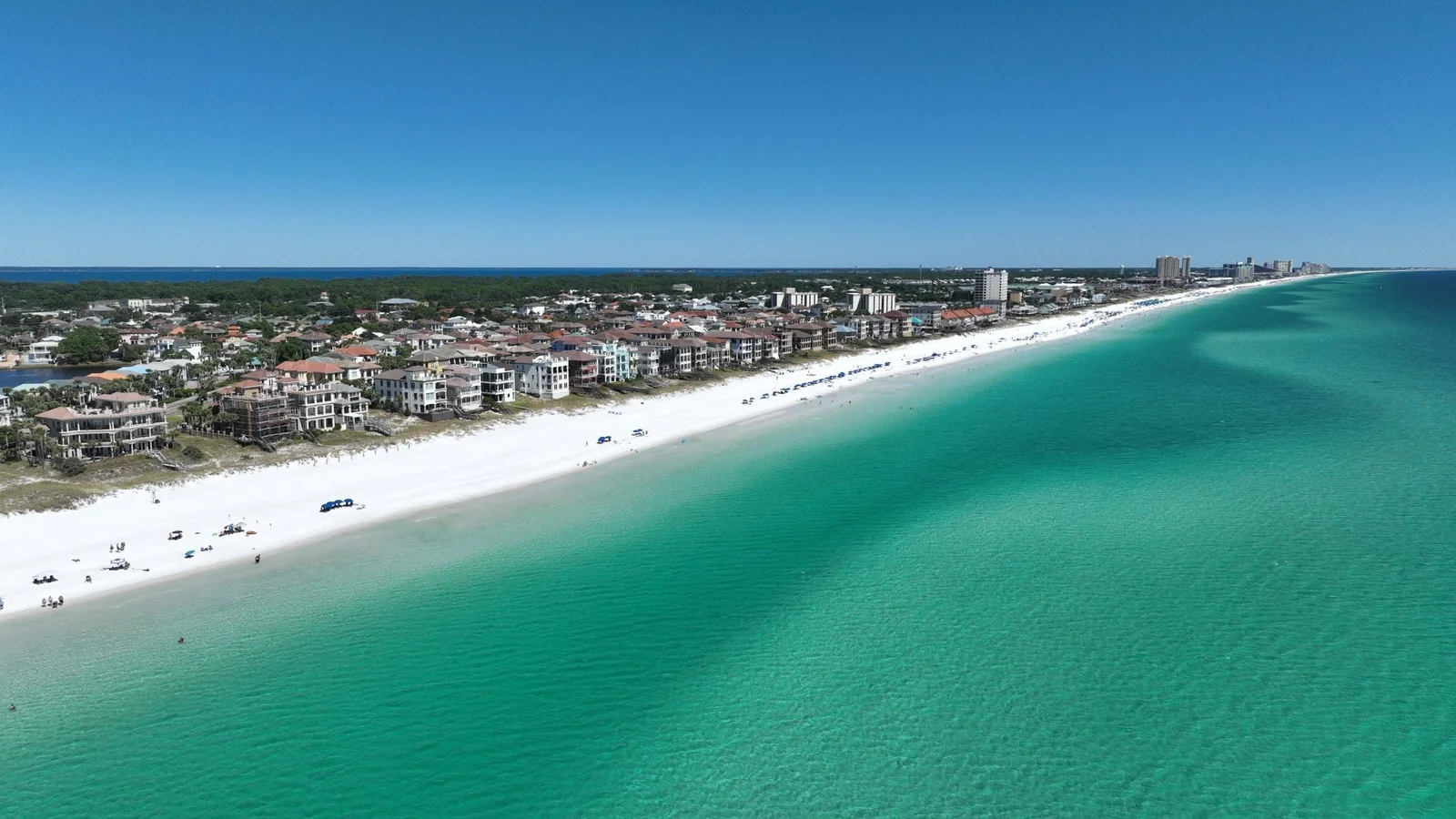
Quick answer: Destin’s binding constraint is not a tax rate or a permit fee. It is an occupancy formula: two guests per bedroom plus four. That sets a hard ceiling on what a property can sleep, which sets what it can charge, which sets what it is worth. A 3-bedroom house is capped at 10 people. Get that number before you get anything else, then register: a city permit, a county account for the 6% no platform remits, and a state licence.
The occupancy formula is the business model
Two guests per bedroom plus four. That is the whole revenue ceiling, and it is worth writing out because owners routinely buy on square footage and discover the rule afterwards.
| Bedrooms | Maximum occupancy |
|---|---|
| 2 | 8 |
| 3 | 10 |
| 4 | 12 |
| 5 | 14 |
| 6 | 16 |
In a beach market where the dominant booking is a family or two families sharing, occupancy is the single largest driver of nightly rate. A property that sleeps 12 competes for a different and better-paying booking than one that sleeps 8, and the gap is not proportional to the price difference between the two houses.
Three practical consequences:
Bedroom count matters more than floor area. A 2,400 square foot house with 4 bedrooms outperforms a 2,800 square foot house with 3, in this market, because the rule counts bedrooms.
Adding a lawful bedroom can be the highest-return improvement available, where the layout, permitting and life-safety requirements allow it. Establish what would be required before assuming it is possible.
Advertising above the cap is the easiest breach to prove. A listing stating a sleeping capacity above the permitted number is evidence in itself, before anyone visits the property.
Confirm the current formula and how it is applied to your specific property with the city, in writing, before offering.
The permit is a city requirement, not a state one
The City of Destin operates a short-term rental permit and registration programme under Article VI of its Code of Ordinances. It is a distinct requirement from both the county tax registration and the state licence, and all three are needed.
| Layer | What it is |
|---|---|
| City of Destin | short-term rental permit and registration |
| Okaloosa County | tourist development tax registration with the Clerk |
| State of Florida | DBPR vacation rental licence, on the transient test |
| State of Florida | sales tax registration for transient rentals |
Work through them in that order and confirm the current fees, renewal cycle and any inspection requirement directly with each authority, because municipal programmes change more often than state ones.
The 6% is yours to remit
Okaloosa’s tourist development tax rose to 6% effective 1 March 2025. Voters expanded the taxing district to the whole county in October 2021, and the state’s rate schedule records 6% for both the original district and the expansion district. The tax is administered locally by the Clerk of the Circuit Court.
| Component | Rate | Who remits it |
|---|---|---|
| Florida state sales tax on transient rentals | 6% | commonly handled by the platform |
| Okaloosa discretionary sales surtax | county surtax, where levied | with the state component |
| Okaloosa tourist development tax | 6% | the property owner, to the Clerk |
Okaloosa is not among the counties for which Airbnb collects the county tax, and it is not administered by the Department of Revenue. Both routes to automatic collection are therefore closed, and the county tax is the owner’s from the first booking.
The failure mode is the same everywhere it applies: the platform statement shows tax collected, and it is telling the truth about the state component only. Counties reconcile platform booking data against their own registration and filing records, so the discovery event is a letter covering the whole operating history with interest and penalties on gross rent.
Open the account with the Clerk before the first booking, and confirm the filing frequency and whether a zero return is required out of season. See Okaloosa County for the county-level detail.
Licensing
A DBPR vacation rental licence is required where the property meets the transient public lodging test: broadly, rented more than 3 times in a calendar year for periods under 30 days, or advertised as regularly available for such stays. In Destin’s market almost every short-stay property meets it.
What preemption leaves the city
Under Florida Statute 509.032(7)(b), a local government may not prohibit vacation rentals or regulate the duration or frequency of stays by an ordinance adopted after 1 June 2011, and pre-2011 rules survive and may be amended only to become less restrictive.
What preemption does not touch is substantial, and it is where Destin’s real controls sit:
Registration and inspection programmes, which the statute contemplates.
Generally applicable rules on occupancy, parking, noise and waste that apply to all dwellings rather than to vacation rentals specifically. The occupancy formula belongs in this category, which is why it stands.
Private restrictions. A condominium declaration or a homeowners association can restrict letting far more tightly than the city, and on the Emerald Coast many buildings do. See the HOA and association restrictions checklist.
Parking is the second constraint
Occupancy and parking travel together, because a house that sleeps 12 arrives in 3 or 4 vehicles.
Establish how many vehicles the property can lawfully accommodate on site, and what the city and any association require. Where the answer is fewer spaces than a full-capacity booking will bring, the property either cannot be let at capacity in practice or will generate complaints that reach code enforcement.
This is a diligence question with a documentary answer, and it should be asked at the same time as the occupancy question rather than after the first summer.
Insurance and the Gulf-front cost line
Wind and flood are normally written separately from the dwelling policy on this coast, and a letting operation needs liability cover written for that use.
Get real quotes for the specific address and elevation before offering, ask the seller for 3 years of actual premiums, and establish whether cover sits with a private carrier or the state-backed insurer of last resort. On a condominium, establish what the master policy covers and what an owner’s own policy has to bridge. See the Citizens insurance guide and the 1 million dollar liability requirement.
Financing
Lenders price a letting purchase differently from a second home, so state the intended use at application. Conventional investment lending, a DSCR loan underwritten on the property’s own income, or cash are the usual routes, and overseas buyers work through foreign national mortgage programmes.
Destin has one of Florida’s better-documented short-stay rental records, which helps a DSCR application: actual booking history from a comparable property in the same complex or street is stronger evidence than a projection.
Before you buy in Destin
- Confirm the occupancy figure for the specific property in writing from the city.
- Count bedrooms, not square feet, when comparing properties on revenue potential.
- Establish the lawful on-site parking capacity for a full-occupancy booking.
- Apply for the city short-term rental permit under Article VI before letting.
- Open the county tourist tax account with the Clerk before the first booking.
- Confirm the filing frequency and whether zero returns are required out of season.
- Register with the state for sales tax on transient rentals and obtain the DBPR licence.
- Read the condominium or association documents for their own minimum stay rules.
- Get real insurance quotes and, on a condominium, the master policy terms.
Where this leaves an investor
Destin is a mature, high-demand, well-documented short-stay market where the rules are clear and the constraints are physical rather than legal. Bedroom count and parking decide revenue; the permit, the licence and the county account decide whether you keep it.
The one number to carry into every viewing is the occupancy formula, because it converts a floor plan into a revenue ceiling before anything else does. For neighbouring markets see Walton County and Bay County.
Frequently Asked Questions
Yes. The City of Destin operates a short-term rental permit and registration programme under Article VI of its Code of Ordinances. That is a city requirement sitting on top of county tourist tax registration and, where the transient test is met, a state DBPR vacation rental licence.
The city caps occupancy at two guests per bedroom plus four additional people. A 3-bedroom property is therefore limited to 10, and a 4-bedroom to 12. That formula is a hard ceiling on what a property can be advertised and let for, and it determines revenue potential more directly than the nightly rate does.
6% on rentals of six months or less, effective 1 March 2025. Voters expanded the taxing district to the whole county in October 2021, and the Florida Department of Revenue schedule records 6% for both the original district and the expansion district. It is administered locally by the Clerk of the Circuit Court.
No. Okaloosa does not appear among the Florida counties for which Airbnb collects and remits county tourist development tax, and it is not administered by the Department of Revenue. Platforms commonly handle the state component only, so the 6% is the owner's obligation.
Through its code enforcement process, with penalties attaching to breaches of the permit conditions and of generally applicable rules on occupancy, parking, noise and waste. Complaints in a dense beach market travel quickly, and occupancy breaches are the easiest of all to evidence.
Not by an ordinance adopted after 1 June 2011. Florida Statute 509.032(7)(b) preempts local prohibitions and local regulation of stay duration or frequency, except where a local law predates that date. Registration and inspection programmes remain available, and so do generally applicable rules such as occupancy caps.
Get the occupancy and parking numbers before you offer in Destin
Tell us the property you are considering. We will come back with the permitted occupancy for that property in writing, its lawful on-site parking capacity, the city permit and county registration steps, the association's own minimum stay rule, and actual booking history from comparable properties.