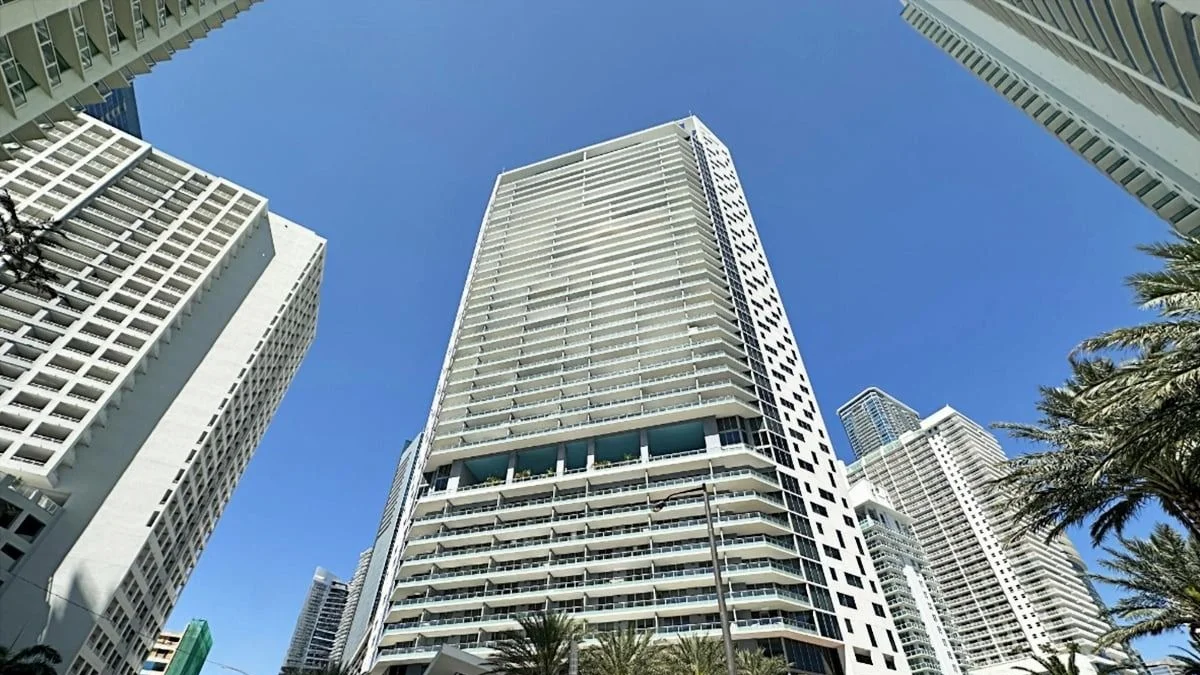
Quick answer: This building is known for a failure, and the failure is not the reason to avoid it. The robotic garage never worked, the manufacturer went bankrupt, and the association recovered roughly $72 million through litigation, enough to replace the system without assessing owners. A buyer reading only the headlines prices in a risk that the association already converted into cash. The work is to verify that the replacement is finished and operating, not to relitigate 2015.
The garage, in order
The sequence matters, because most summaries of this building stop halfway through it.
The tower opened with a fully automated 480-vehicle robotic garage, marketed as retrieving a car in around ten minutes. It did not work reliably. From November 2015 residents were without the parking they had bought, and many parked in a nearby garage instead. The system’s manufacturer, Boomerang Systems, filed for bankruptcy, which removed the obvious defendant and the obvious source of repair.
In 2016 the association filed against the development entity. The recoveries came in two parts: a $32 million settlement in March 2019 from the equipment insurer, Hartford Steam Boiler Inspection and Insurance Co, and a $40.6 million judgment in September 2019 against BrickellHouse Holdings. Together roughly $72 million, among the largest construction defect awards in Florida history.
The association then contracted ParkPlus High Density Parking Systems for the replacement, and did so without levying a special assessment on unit owners.
That last clause is the whole point. The normal Florida condominium story is a defect discovered, a reserve found short, and owners assessed five figures each. Here the opposite happened: a catastrophic defect was converted into a recovery large enough to fund the fix. Whether that leaves the building better or worse than a comparable tower depends entirely on the state of the replacement today, which is a question with an answer.
What that history means for a buyer now
Three things follow, and only the third is a risk.
The association has been tested. Most Brickell boards have never run a capital project of this size or litigated one to judgment. This one has, recently, and the record of how it did so is in the minutes. For a building whose SB 4-D milestone inspection arrives near 2039 to 2040, an association with demonstrated capital-project competence is an asset rather than a footnote.
The reputational discount may still be in the price. Asking prices average near $940 per square foot against roughly $949 at Dua Miami, the former SLS Brickell and near $985 at SLS LUX Brickell. A 2014 building trading within five per cent of towers finished in 2016 and 2018 is not obviously discounted, so if you are buying on the assumption that the garage story left money on the table, test that assumption against actual sold records rather than asking prices.
The replacement is the live question. A settlement funds a project; it does not guarantee the project finished on time, on budget or to specification. Confirm the current state directly.
Dues at $1.07, and what sits behind them
| Line | Brickell House | Branded Brickell towers | Brickell average |
|---|---|---|---|
| Dues per square foot, monthly | $1.07 | $1.25 to $1.63 | near $0.72 |
| Monthly dues, 1,000 sq ft | $1,070 | $1,250 to $1,630 | $720 |
| Annual dues, same unit | $12,840 | $15,000 to $19,560 | $8,640 |
The position is deliberate and it is defensible: more than the district average, less than the branded product. What deserves attention is not the level but the composition. A high-density mechanical parking system carries a maintenance and replacement schedule of its own, separate from anything structural, and that schedule now sits in this association’s reserve plan with equipment installed at the end of the 2010s rather than at completion.
Ask specifically how the ParkPlus system is reserved for. A building that recovered $72 million and then funded the new equipment’s future replacement is in genuinely strong shape. One that recovered $72 million, installed the equipment and reset the reserve to zero has moved the problem rather than solved it.
The financing and insurance lines
Nothing about this building suggests the hotel-style ineligibility problem that affects branded towers, but litigation history is its own financing question. Lenders ask about pending and recent construction defect litigation on project questionnaires, and an association with a nine-figure claim in its recent past will generate questions even after the matter closed.
Put the project eligibility question to a lender in writing before offering. If the answer is anything other than a clean warrantable determination, the routes are cash, portfolio lending, or a DSCR loan underwritten on the rent at a larger deposit, and overseas buyers work through foreign national mortgage programmes.
On insurance, the master policy sits inside the dues and coastal condominium premiums have repriced every year since 2022. That pressure is district-wide rather than specific to this address, and how it behaves across the state is set out in the Florida property insurance guide. For the wider market picture, see the Brickell area page.
What a defect verdict tells you, and what it does not
A judgment against a development entity is a fact about one project, not a verdict on a sponsor’s whole catalogue, and it is worth being precise about the difference because buyers routinely over-read it in both directions.
What it does tell you: this project shipped a headline amenity that did not work, the buyers who paid for it lost the use of it for years, and the association had to litigate rather than negotiate to be made whole. Those are facts about how the problem was handled as well as about the problem.
What it does not tell you: whether the concrete, the envelope, the plumbing or the mechanical systems have any issue at all. The claim concerned a parking system supplied by a third party that then went bankrupt. Nothing in the public record of the case suggests a structural defect, and the milestone inspection near 2039 to 2040 is the process that would surface one.
The practical use of the history is narrow and specific. When you request the reserve study, read it against a board that has already been through a large capital project and knows what one costs. When you read the minutes, you are reading an association with an unusually complete paper trail. Both of those are worth more at diligence than a clean history with thin documentation, which is what most buildings of this vintage actually offer.
Verification checklist before you wire
- Ask whether the ParkPlus replacement is complete and fully operational, and get the answer from the management office rather than a listing.
- Ask what average retrieval time the system delivers today and whether any valet support runs alongside it.
- Request the board minutes covering the replacement project from contract through commissioning.
- Establish how the new parking equipment is reserved for and at what funding percentage.
- Ask whether any part of the litigation recovery remains unspent, and whether it is restricted.
- Request three years of dues history and read the slope.
- Confirm the rental rules in the recorded declaration, including any amendment made since 2019.
- Ask the lender for a written project eligibility determination, mentioning the litigation history explicitly.
Which buyer this building suits
It suits a buyer willing to read documents rather than headlines. The garage failure is real, well documented and, unusually, already paid for by somebody else. An association that fought a nine-figure claim to judgment and rebuilt a 480-space system without assessing its owners has shown something most Brickell boards never have to.
It suits a buyer who wants a bargain on reputation less well. The pricing per foot sits close to towers built two and four years later, so the discount that the story implies is not clearly present in the asking prices. Buy it because the building works and the association is competent, not because you expect the market to have mispriced 2015. Verify the parking first: everything else here is ordinary Brickell diligence.
Frequently Asked Questions
The tower opened with a fully automated 480-space robotic garage that never worked reliably. Residents were without the promised parking from November 2015 and the system's manufacturer, Boomerang Systems, went bankrupt. The association sued, took a $32 million settlement from the equipment insurer in March 2019 and a $40.6 million judgment against the development entity in September 2019, roughly $72 million in total, among the largest construction defect awards in Florida history.
No. The awards covered the replacement, and the association contracted ParkPlus High Density Parking Systems for the new installation without a special assessment on unit owners. That is the counterintuitive part of this building's story and the reason its history reads worse than its balance sheet.
Sources give 2014 or 2015 for completion, with construction starting in spring 2012, making it one of the first Miami condominium projects to break ground after the 2007 downturn. It runs 46 storeys with 374 residences at 1300 Brickell Bay Drive, developed by Newgard Development Group with Sieger Suarez Architects.
Asking prices start near $498,000 and average about $940 per square foot, with residences from 644 to 2,365 square feet. Dues run around $1.07 per square foot per month, which sits below the branded towers nearby and above the wider Brickell average near $0.72.
A 2014 to 2015 completion places the 25-year coastal trigger near 2039 to 2040. That is beyond a standard ten-year hold. The structural question is not the near-term issue here, and the association has recent, well-documented experience of managing a large capital project.
Whether the ParkPlus replacement is complete and operating, what the current retrieval times are, whether parking is assigned or valet-operated, and whether any part of the settlement remains unspent or restricted. Ask for the board minutes covering the replacement, not a summary from a listing agent.
Get the parking replacement status and reserve position at Brickell House
Tell us the unit size you are considering. We will come back with the current state of the ParkPlus system, the board minutes covering the project, three years of dues, the reserve funding percentage, and a written lender view on project eligibility.