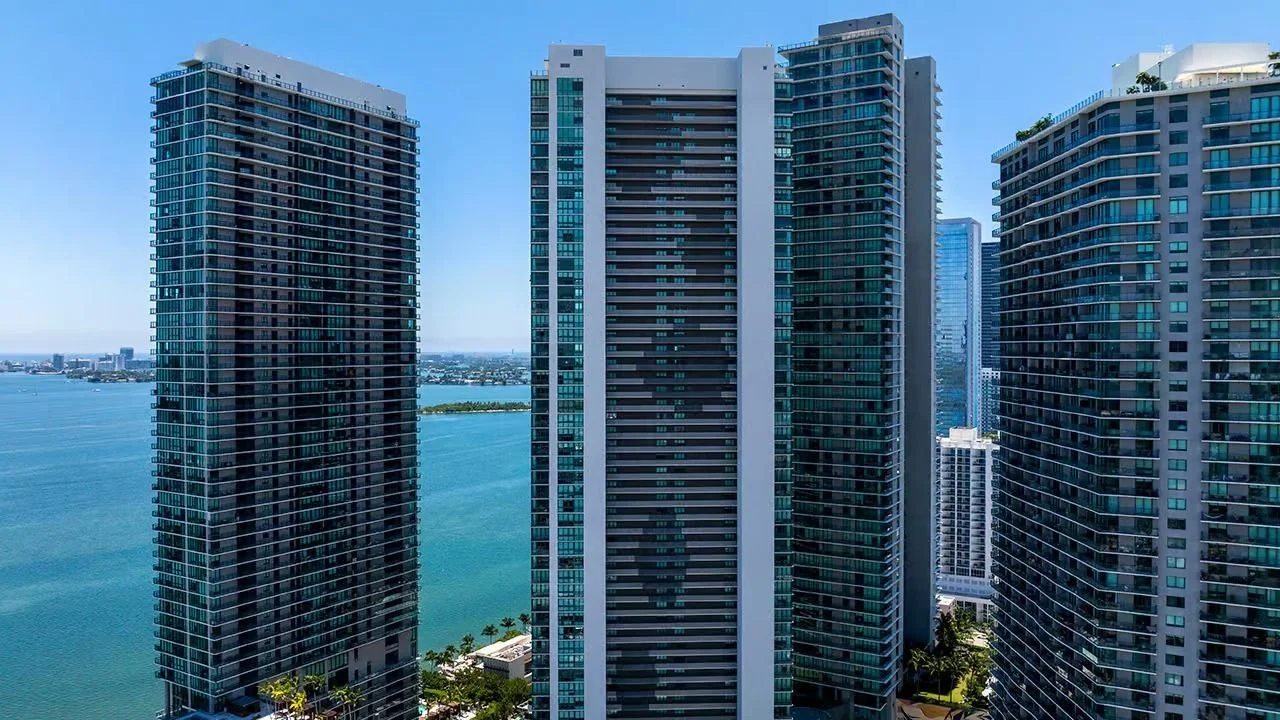
Quick answer: Four towers carry the Paraiso name on one Edgewater campus, and buyers routinely treat them as one product. They are not. They are separate condominiums with separate declarations and materially different rules. This one permits three lettings a year at a 30-day minimum. Its neighbour One Paraiso requires the association to approve every tenant and starts at a larger, more expensive residence. Same address, same master association, different investment.
Four towers, four sets of rules
The Paraiso campus is marketed as one destination and sold as four condominiums. For a buyer that distinction is the whole diligence exercise, because rental clauses, unit sizes and entry prices differ between the towers while the address, the sponsor and the master association do not.
| Paraiso Bay | One Paraiso | |
|---|---|---|
| Completed | 2018 | 2018 |
| Smallest standard residence | about 919 sq ft | about 1,124 sq ft |
| Largest quoted standard residence | about 2,246 sq ft | about 1,873 sq ft |
| Minimum lease | 30 days | 30 days |
| Tenant approval by association | not stated in published rules | required for every tenant |
| Lettings permitted | up to 3 per 12 months | not stated in published rules |
Two consequences follow.
The entry price differs. A 919 square foot residence is a materially cheaper ticket than a 1,124 square foot one at comparable pricing per foot. A buyer priced out of One Paraiso is not priced out of the campus.
The letting friction differs. A stated cap of three lettings per twelve months with a 30-day floor is a workable medium-stay position. A requirement that the board approve every tenant adds days or weeks to each turnover and introduces the possibility of refusal. Neither rule is better in the abstract, but they suit different owners, and a landlord should choose the tower on that basis rather than on the lobby.
Confirm both clauses from the recorded declarations, tower by tower, including amendments. Published summaries of campus rules frequently blur the towers together, which is exactly the error this section exists to prevent.
Why the published unit count varies
Sources give this tower between 346 and 364 residences and between 53 and 55 storeys. That spread is small but it is worth understanding, because the same ambiguity affects the numbers you will be quoted.
Unit counts usually differ because some sources include ground-floor or amenity-level units that are not conventional residences, and storey counts differ because towers frequently skip floor numbers or count mechanical levels inconsistently. Neither is evidence of anything wrong. It is evidence that no published figure should go into your model unverified.
The count matters practically in one place: per-owner arithmetic. Master budget apportionment, reserve funding per unit and voting weight all depend on the exact number of residences in the tower and across the campus. Take those figures from the recorded declaration rather than from a listing site, and take the campus totals from the master association’s own documents.
Two associations bill you
As with the rest of the campus, there are two levels: a Paraiso Bay Condo Association for this tower and a Paraiso Bay Master Homeowners Association covering shared campus elements.
| Document | Condominium association | Master association |
|---|---|---|
| Current adopted budget | request | request |
| Reserve study and funding percentage | request | request |
| Three years of fee history | request | request |
A listing that quotes a monthly association fee is almost always quoting the condominium level only. The master assessment funds shared landscaping, campus infrastructure and common amenity areas, it has its own budget and its own reserves, and it can rise independently of anything your tower’s board decides.
Ask specifically how the master budget is apportioned between the towers. Apportionment is usually by unit count or by floor area, and which basis applies changes what a tower of this size pays relative to its neighbours. In a campus where the towers differ in unit count and average residence size, that formula is not a technicality.
Thirty days, three times a year
The rental clause here permits letting up to three times in any twelve-month period with a 30-day minimum.
Placed against the district, that is the flexible end:
| Building | Lettings per year | Minimum lease |
|---|---|---|
| Paraiso Bay | 3 | 30 days |
| One Paraiso | not stated, board approves each tenant | 30 days |
| Quantum on the Bay | 2 | 6 months |
| Echo Brickell | 2 | 6 months |
Three tenancies with a 30-day floor supports a furnished medium-stay model: corporate lets, relocation tenants, seasonal occupancy at rates above an annual lease. It does not support nightly letting, and no Miami association rule can override the city and county rules that govern stays under 30 days in any case.
The practical caution is the same everywhere: rental clauses are amended, and associations tighten more often than they loosen. A 2018 building has had time for at least one amendment cycle. Ask for the amendment history rather than the current consolidated declaration alone, because the direction of travel matters to a ten-year hold.
A 2018 building on a young campus
A 2018 certificate of occupancy places the 25-year coastal trigger near 2043. The SB 4-D milestone framework applies eventually and not within a normal hold, so the structural question that dominates Edgewater’s 2008 stock is absent here.
What is present is the first replacement cycle, arriving now across finishes, mechanical plant, lift equipment and amenity fit-out, at both the tower and campus levels. Two reserve studies govern that, not one, and a tower that funds its own reserves properly can still be exposed to a master association that does not.
Insurance is the shared line. Master policies sit inside both fee levels and coastal condominium premiums have repriced every year since 2022. How that behaves statewide is in the Florida property insurance guide. For the district picture see the Edgewater area page and the Miami market overview.
Supply on one parcel
A campus of four towers by one sponsor produces a specific market condition: several hundred residences with similar layouts, similar finishes and an identical address competing for the same tenants and the same buyers.
That compresses both rent and price. A tenant comparing three near-identical two-bedrooms across the campus is comparing substitutes, and a buyer seeing several listings at once has negotiating room that would not exist in a standalone tower.
It also means new supply arrives on your doorstep rather than across town. Elsewhere in Edgewater, Aria Reserve is adding 782 residences across two towers with a third submitted for review in June 2025. The district is absorbing a great deal of new inventory at the same time, and a landlord here competes with all of it.
None of that argues against the building. It argues for underwriting rent conservatively and for asking how many campus units are typically listed for sale and for rent at once.
Financing at a two-tier campus
Obtain a written project eligibility determination before offering. Two features draw lender attention here: the two-tier association structure, which lenders assess for how obligations are documented between levels, and the investor concentration, which a permissive rental rule tends to raise.
Where a project is judged non-warrantable the conventional thirty-year loan is unavailable building-wide, leaving cash, portfolio lending or a DSCR loan underwritten on rent at a larger deposit. Overseas buyers work through foreign national mortgage programmes.
Verification checklist before you wire
- Get the recorded declaration for this tower specifically, not a campus summary, plus all amendments.
- Confirm the letting cap and minimum lease as recorded, and ask whether any amendment has tightened them since 2018.
- Request budgets, reserve studies and funding percentages for both associations.
- Ask how the master budget is apportioned between towers and on what basis.
- Add the master assessment to any quoted monthly figure and recompute.
- Ask how many campus residences are listed for sale and for rent today, and six months ago.
- Get the billed square footage as the association charges it.
- Obtain a written lender project eligibility determination covering the two-tier structure.
Which buyer this building suits
It suits a landlord who wants the flexible end of Edgewater’s rental rules at a lower entry than the campus neighbour, and who will underwrite rent against a large and growing local supply rather than against a headline yield.
It suits a buyer who wants scarcity less well. This is a large tower on a four-tower campus in a district absorbing hundreds of new residences, and scarcity is not what it offers. What it offers is a 2018 building with no structural event in sight, a workable letting rule, and a price of entry below its own neighbour. Read both declarations and both budgets, and the choice between the Paraiso towers becomes straightforward rather than confusing.
Frequently Asked Questions
Owners may lease up to three times in any twelve-month period with a minimum lease of 30 days. That is materially more flexible than One Paraiso on the same campus, where every tenant must additionally be approved by the association, and far more flexible than the six-month rules at Quantum on the Bay a few blocks away.
They are separate condominiums on the same master-planned campus, with separate declarations and separate rules. Paraiso Bay starts at about 919 square feet against 1,124 at One Paraiso, so the entry price is lower, and its rental clause is more permissive. Buyers who treat the Paraiso towers as one product are comparing the wrong things.
Completed in 2018 at 650 NE 32nd Street, Miami FL 33137, by The Related Group. Sources give roughly 53 to 55 storeys and between 346 and 364 residences, with about eight units per floor. Layouts run one to four bedrooms from 919 to 2,246 square feet.
Yes. There is a Paraiso Bay Condo Association for this tower and a Paraiso Bay Master Homeowners Association covering the wider campus. Any monthly figure quoted from a listing usually reflects only the first. Ask for both budgets and both reserve positions before modelling anything.
A 2018 completion places the 25-year coastal trigger near 2043, beyond a normal ten-year hold. The nearer financial questions are the two-tier association structure and the first replacement cycle on a young amenity base.
It is the conventional Miami density and it sits between the extremes. Fixed costs divide across a normal owner group rather than the small one at a boutique tower, and the standing supply of similar units is moderate rather than deep. For most buyers it is the unremarkable middle, which is usually the right place to be.
Compare the Paraiso towers before you choose one
Tell us the residence size and whether you plan to let. We will come back with the recorded rental clauses for each Paraiso tower side by side, both association budgets and reserve positions, the combined monthly cost, and how many campus units are listed today.