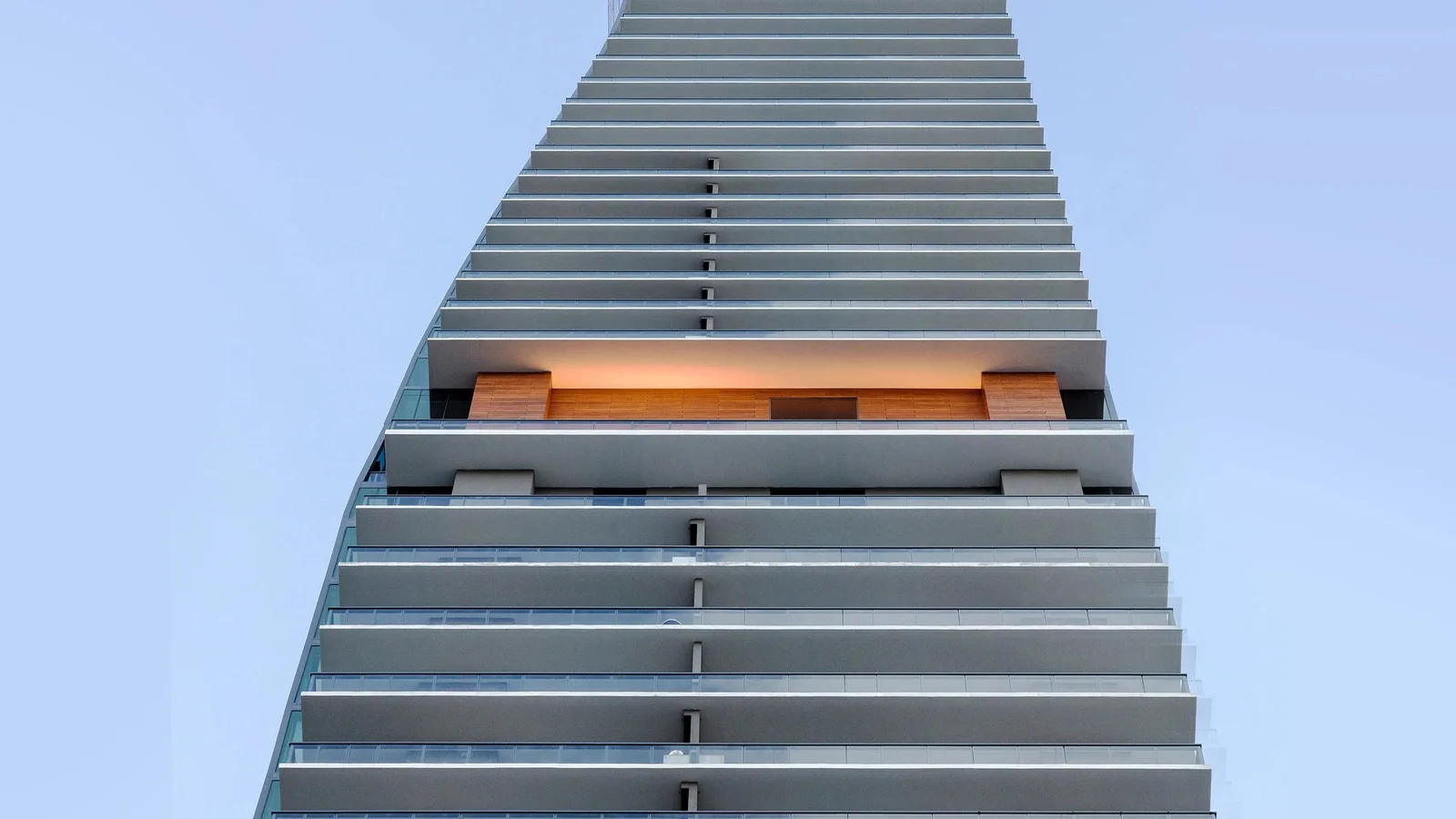
Quick answer: One number explains this building. Around 165 residences across 57 storeys is roughly three doors per floor, a third of the density of the towers either side of it on Brickell Avenue. That produces the privacy people buy it for, the higher cost per owner nobody mentions, and a resale market thin enough that a single comparable sale can move an appraisal. Everything else here follows from that ratio.
Three doors per floor, and what it costs
Low density is sold as exclusivity, and it genuinely delivers it: fewer neighbours, quieter lifts, no queue at the pool, a lobby that is not a thoroughfare. That part is real and it is most of why people choose this tower over a 500-unit competitor.
The part that is rarely mentioned is the arithmetic behind the monthly bill. Fixed costs do not scale with door count. A pool needs the same plant, a lobby the same staffing, a lift bank the same maintenance contract, and a master insurance policy covers roughly the same replacement value whether the building holds 165 owners or 500. Divide a similar operating base across a third as many owners and each owner’s share rises proportionally.
| Building | Approximate doors | Effect on dues per foot |
|---|---|---|
| Echo Brickell | around 165 | fixed costs across few owners, pressure upward |
| SLS LUX Brickell | 438 to 450 plus hotel suites | large amenity base, large owner group |
| Brickell House | 374 | mid-range on both counts |
| Quantum on the Bay | 698 | fixed costs across many owners, pressure downward |
This is not a criticism. It is the trade a buyer is making, and it should be made knowingly. Ask for the current dues per square foot and compare it against the district average near $0.72 and against the branded towers at $1.25 to $1.63. Wherever it lands, the low door count is a structural reason for it rather than a temporary one, and it will not improve with time.
Two rentals a year, six-month floor
Owners may let twice per year with no lease under six months.
That is the tightest tier available in Brickell. The branded towers nearby permit three tenancies with a 30 or 31-day floor; this building permits two with a six-month floor, matching the Edgewater rules at Quantum on the Bay. Practically it means one annual tenant, with a second letting available only if the first ends early.
For an owner-occupier that is a feature. It keeps transient traffic out of a building whose whole proposition is quiet, and it aligns the resident base.
For a landlord it removes every model except the annual lease. There is no seasonal pricing, no corporate medium-stay, and no ability to cover a summer gap with a short let. A vacancy that appears in a slow month stays a vacancy. Underwrite twelve months of rent at a single rate, and treat any model that requires more flexibility than that as inapplicable here.
Verify the clause in the recorded declaration including amendments rather than in a listing summary. Rental rules tighten more often than they loosen, and a building already at the strict end has less room to move but a board that clearly cares about the issue.
A thin market cuts both ways
In a 165-unit tower, the entire building might have a handful of listings at any moment. Two consequences follow and they point in opposite directions.
Scarcity supports price. There is no standing supply of near-identical inventory undercutting a seller, which is the condition that caps pricing in the 500 and 700-unit towers. A well-presented unit in a building with three listings is not competing with forty.
Thin data undermines appraisal. Lenders and appraisers need comparable sales, and in a building that trades rarely there may be very few recent ones. When comparables are scarce each individual sale carries disproportionate weight, and a single low transaction, a distressed sale or an unusual layout, can set the reference point for months. Marketing times run longer and the spread between asking and achieved prices runs wider than in a liquid tower.
For a long-hold owner this is fine and arguably favourable. For anyone who may need to exit on a timetable it is the risk to price in, and it is invisible in an asking-price comparison. Ask how many units in the building have sold in the last twelve and twenty-four months. If the answer is a small single digit, plan the exit accordingly.
2017 vintage, and where the reserve pressure sits
A 2017 completion places the 25-year coastal trigger near 2042, beyond a standard hold. The SB 4-D milestone and reserve framework will apply eventually, but not during most buyers’ ownership, and there is no deferred structural bill to inherit.
The pressure sits elsewhere. A building approaching its tenth year is entering the first replacement cycle for finishes, mechanical plant, lift equipment and amenity fit-out, and in a low-density tower that schedule is funded by a small owner group. The reserve study is therefore a more informative document here than the milestone date is.
Request it with the funding percentage, and request three years of dues history alongside. In a 165-unit building the difference between a board that funds reserves and one that does not is felt per owner at three times the rate it would be in a 500-unit tower. That is the same arithmetic as the dues, applied to a bigger number.
Insurance carries the same asymmetry. Master policies sit inside the dues and coastal premiums have repriced every year since 2022, and again the increase divides across few owners. How those lines behave statewide is set out in the Florida property insurance guide. For the district picture see the Brickell area page.
Financing a low-density luxury tower
Two ordinary lender questions apply with more force than usual here.
The first is comparable sales, discussed above: an appraisal needs them and this building generates few. A purchase that appraises short is a purchase that needs more cash at closing, and in a thin market that outcome is more likely than in a liquid one.
The second is investor concentration. Lenders examine what share of a project is rented rather than owner-occupied, and in a small building a handful of investor-owned units moves the percentage quickly. A ratio that would be unremarkable in a 700-unit tower can push a 165-unit project past a threshold.
Get a written project eligibility determination before offering. Where a project is non-warrantable the conventional thirty-year loan is unavailable building-wide, leaving cash, portfolio lending or a DSCR loan underwritten on rent at a larger deposit. Overseas buyers work through foreign national mortgage programmes.
Verification checklist before you wire
- Confirm the exact residence count from the declaration; published figures range from 165 to 180 and the number drives every per-owner calculation.
- Get the current dues per square foot and compare against the district average and the branded towers.
- Request the reserve study, the funding percentage and three years of dues history.
- Ask how many units sold in the last twelve and twenty-four months. That is your liquidity measure.
- Confirm the two-rentals-per-year and six-month minimum in the recorded declaration with amendments.
- Ask the current owner-occupancy ratio, because in a small building it moves fast and lenders watch it.
- Get a written lender project eligibility determination before the offer.
Which buyer this building suits
It suits an owner-occupier or a long-hold second-home buyer who values privacy and is willing to pay for it twice, once in the purchase price and again every month in a dues figure carried by few owners. For that buyer the low density delivers exactly what it promises and the strict rental rules protect it.
It suits a yield-first or short-hold investor poorly. The rental rules permit one annual tenant, the dues per foot carry a structural upward bias, and the thin trading history makes both appraisal and exit slower. None of that is a flaw in the building, which is a genuinely good one by Carlos Ott with a serious sponsor behind it. It is simply what three doors per floor means once you follow the number all the way through.
Frequently Asked Questions
Around 165, with some sources quoting between 165 and 180, across 57 storeys at 1451 Brickell Avenue. Roughly three residences per floor is very low density for a Brickell tower of that height, and it is the fact that explains most of the building's behaviour, from privacy to dues to how thinly it trades.
Completed in 2017 by Kevin P. Maloney's Property Markets Group. Carlos Ott designed the architecture and yoo Studio the interiors. The 25-year coastal milestone trigger therefore lands near 2042, beyond a standard ten-year hold.
Owners may rent a maximum of two times per year and no lease may run shorter than six months. That is the strictest tier in Brickell, matching Quantum on the Bay in Edgewater and tighter than the branded towers nearby, which permit three tenancies with a 30 or 31-day floor. In practice it means one annual tenant.
Because fixed costs do not shrink with the door count. A pool, a gym, a lobby, a security desk, lifts and a master insurance policy cost roughly the same to run whether 165 owners or 500 share them. Divide the same operating base across a third as many owners and each owner pays proportionally more.
Very. In a 165-unit building a handful of listings is a meaningful share of the whole tower, so comparable sales are scarce and each one carries disproportionate weight in an appraisal. Expect longer marketing times and a wider spread between asking and achieved prices than in a 500-unit tower nearby.
Near 2042 on a 2017 completion. The structural question is not the near-term issue. The near-term issue is the reserve funding on an amenity base carried by a small number of owners, which is where dues pressure in low-density buildings originates.
Get the dues, reserve position and trading history at Echo Brickell
Tell us the residence size you are considering. We will come back with current dues per square foot against the district, the reserve funding percentage, how many units have traded in the last twenty-four months, the recorded rental clause, and comparable low-density Brickell options.