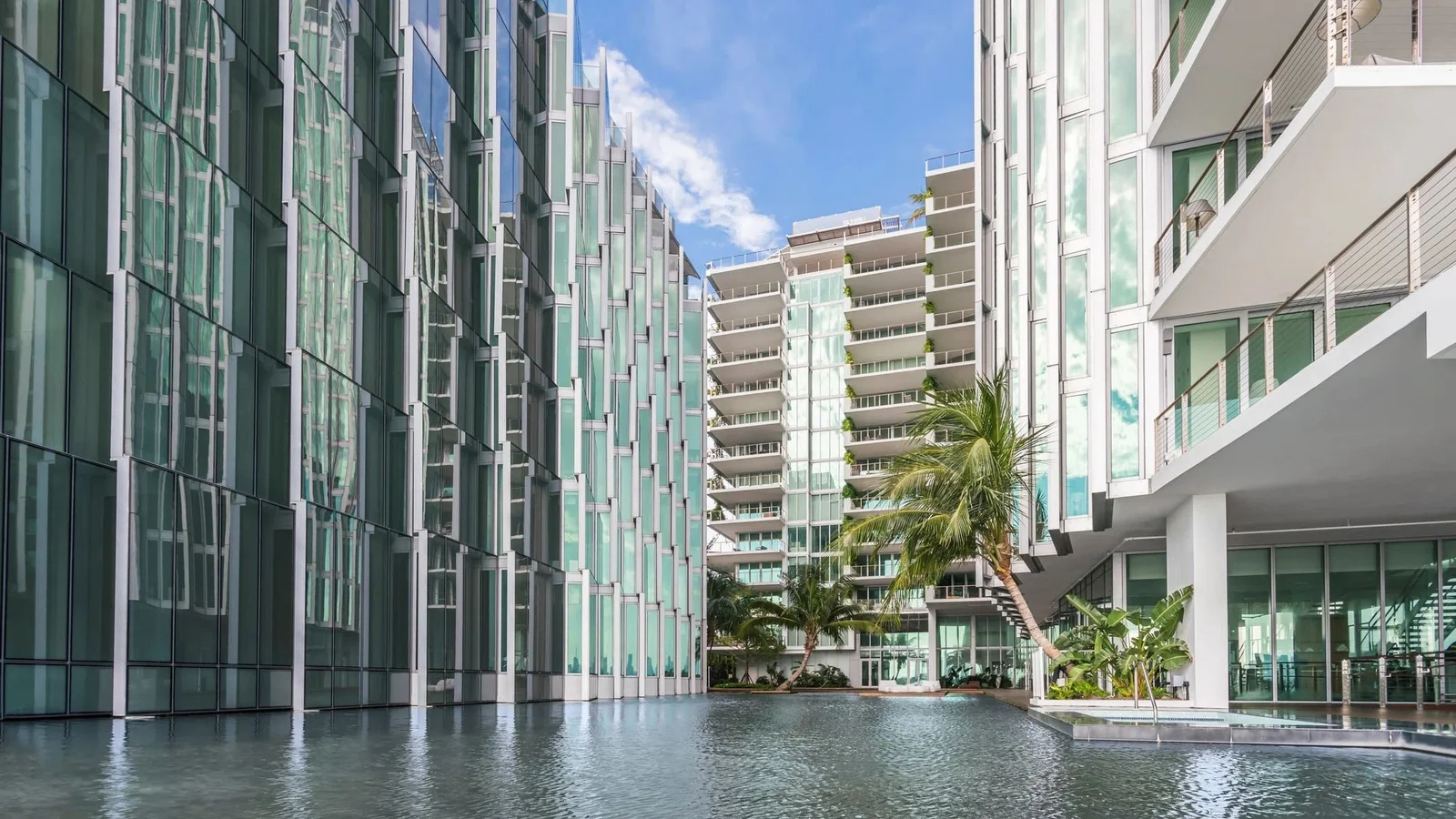
Quick answer: Fifty-nine residences makes this the smallest building in the series, and it is the number that governs everything else: the privacy, the per-owner cost, and a resale market thin enough that a single sale can move an appraisal. The second thing to know is that the public record does not state the rental rule. That is a gap to close from the declaration, not a permission to assume.
Fifty-nine owners, and what that means
| Building | Residences | Storeys | Residences per floor |
|---|---|---|---|
| Monad Terrace | 59 | 13 to 14 | about 4 |
| Muse | 68 | 47 | about 1.4 |
| Echo Brickell | about 165 | 57 | about 3 |
| Oceana Bal Harbour | 240 | 28 and 28 | about 4 |
| Quantum on the Bay | 698 | 51 and 44 | about 7 |
Fifty-nine is the lowest total in this series, and the arithmetic that follows is by now familiar. Fixed costs do not shrink with the door count: a pool, a lobby, a lift bank, grounds and a waterfront master insurance policy cost roughly what they cost, and fifty-nine owners divide them.
The consequence to plan for is not the monthly figure, which a buyer at this price level can absorb. It is any future capital project. Envelope work, plant replacement or an insurance-driven step change divides across fifty-nine owners rather than several hundred, and the per-owner share is correspondingly large.
Request the reserve study and funding percentage even though the milestone sits near 2046, and ask what the study assumes about a waterfront building’s envelope intervals. In small buildings the reserve position matters more, not less, because there is no large owner base to dilute a surprise.
The rental rule is not in the public record
Property databases record the letting rules here as not available. Across this series that has now happened twice, here and at Axis Brickell, and the correct response is identical in both cases.
A blank field is not a permission. Aggregators populate rental data inconsistently, and an absent entry usually means nobody filled it in rather than that no rule exists. In a 59-residence Miami Beach building at this price point, a permissive letting clause would be genuinely unusual.
Close the gap in three steps before offering:
- Obtain the recorded declaration of condominium and every recorded amendment.
- Ask the management office in writing and keep the reply.
- Verify City of Miami Beach rules for any stay you contemplate under six months, separately from the association’s clause. Much of Miami Beach prohibits short letting outright with substantial fines, and the stricter of the two layers always governs.
That third step is not optional here. Miami Beach enforcement is active and the penalties are levied against the owner, not the building.
Architecture as the product
Most buildings in this series are sold on amenities, views or brand. This one is sold on authorship, and that changes what a buyer is underwriting.
Jean Nouvel is a Pritzker Prize laureate and this is a rare residential project by him in the United States. JDS Development, the same sponsor behind Mercedes-Benz Places in Brickell, completed it in 2021. The building is low-rise by Miami Beach standards, 13 to 14 storeys, on the Westside of South Beach facing Biscayne Bay rather than the ocean.
Architecture-led value behaves differently from amenity-led value in two ways worth naming.
It does not depreciate the way a fit-out does. A resort-grade amenity deck is a maintenance liability that dates; a significant piece of architecture generally holds its interest. That is an argument in favour of the price per foot rather than against it.
It narrows the buyer pool. The purchaser who pays a premium for a Nouvel building is a specific person, and there are fewer of them than there are buyers for a well-located conventional tower. Combined with fifty-nine residences, the market here is thin by design.
Ask how many residences have traded in the last twelve and twenty-four months. In a building this size the answer will be a small single digit, and it is the honest measure of how long an exit takes.
Owning the street
JDS acquired the entire street to develop this site. That is unusual and it deserves a clear-eyed reading.
In a dense city the main uncontrolled risk to a low-rise waterfront building is what gets built next to it. A tower on the adjacent parcel can remove a view, a bay frontage or the light that a Nouvel facade was designed around. Assembling the street removed that risk at the time of development.
The question for a buyer today is what remains under that control. Development sites are assembled and then sold, and protection that existed in 2018 may not exist now. Ask specifically:
| Question | Why |
|---|---|
| What parcels adjoining the site are still held by the developer or affiliates? | determines whether the protection persists |
| What is the current zoning and permitted height on each adjacent parcel? | zoning outlives ownership |
| Are any development applications pending nearby? | public record, checkable today |
Zoning is the durable protection; ownership is temporary. Check both.
A 2021 building on the water
A 2021 completion places the SB 4-D milestone trigger near 2046, beyond any normal hold, so there is no structural question to price and no deferred concrete to inherit.
What a young building lacks is operating history. There is no completed reserve cycle and limited evidence of how the board behaves under pressure. Request every year of dues history since handover and compare the developer’s projected budget with the association’s adopted ones. The gap between projection and reality is the most useful early signal, and insurance is where it usually appears: coastal master policies have repriced every year since 2022 and developer pro formas routinely understate them. See the Florida property insurance guide and the Miami area page.
Financing a very small building
Two lender considerations apply with unusual force at this size.
Comparable sales. An appraisal needs recent transactions and a 59-residence building generates very few. A purchase that appraises short requires more cash at closing, and in a thin market that outcome is more likely than in a liquid one.
Investor concentration. In a building this small, a handful of investor-owned residences moves the owner-occupancy percentage quickly, and thresholds that a 700-unit tower would never approach can be crossed here by five or six units.
Obtain a written project eligibility determination before offering. Where a project is non-warrantable the conventional thirty-year loan is unavailable building-wide, leaving cash, portfolio lending or a DSCR loan underwritten on rent. Overseas buyers work through foreign national mortgage programmes.
Verification checklist before you wire
- Get the recorded declaration and amendments and read the letting clause in full. Do not rely on a blank database field.
- Verify City of Miami Beach rules for any stay under six months, separately.
- Request the reserve study, funding percentage and every year of dues history since handover.
- Ask what the reserve study assumes about waterfront envelope intervals.
- Ask how many residences have traded in the last twelve and twenty-four months.
- Check zoning and permitted height on adjacent parcels, and any pending applications.
- Ask what adjoining land the developer or affiliates still hold.
- Obtain a written lender project eligibility determination.
Which buyer this building suits
It suits a buyer who wants a specific piece of architecture on the water in South Beach, is paying largely in cash, and will hold long enough that thin liquidity is irrelevant. For that buyer the fifty-nine residences, the low rise and the Nouvel authorship are the entire point, and none of them can be replicated by a competitor next year.
It suits a buyer who wants flexibility or speed poorly. The letting rule is unknown until you read it, Miami Beach enforcement sits on top of whatever it says, the market is thin by construction, and every future capital cost divides across fifty-nine owners. Read the declaration, check the zoning next door, and then decide. This is a building to buy deliberately or not at all.
Frequently Asked Questions
Fifty-nine, across 13 or 14 storeys depending on the source, at 1300 Monad Terrace in the Westside part of South Beach. That is the smallest residence count of any building in this series and it governs the economics: every fixed cost and every future capital project divides across fifty-nine owners.
Jean Nouvel, the Pritzker Prize-winning architect, designed it, and JDS Development completed it in 2021. JDS acquired the entire street to develop the site, which is unusual and gives the project a degree of control over its immediate surroundings that most Miami Beach buildings do not have.
Property databases record them as not available, so the public record is silent. That is a gap in the data rather than evidence of permissiveness. Obtain the recorded declaration and all amendments, and get written confirmation from the management office, before assuming anything about letting here.
Current asking prices run about $2,700,000 to $8,000,000. With fifty-nine residences in the building, very few trade in any given year, so comparable sales are scarce and each transaction carries disproportionate weight in an appraisal.
A 2021 completion places the 25-year coastal trigger near 2046, beyond any normal hold. The nearer questions are the reserve funding on a young building carried by a small owner group, and how insurance is trending on a Miami Beach waterfront site.
Because in a dense city the main uncontrolled risk to a low-rise building is what gets built beside it. A developer that assembled the entire street had control over the immediate context at the time of development. Confirm what remains under that control and what has since been sold, because the protection lasts only as long as the ownership does.
Get the declaration and the neighbouring zoning at Monad Terrace
Tell us the residence size you are considering. We will come back with the recorded letting clause and amendments, City of Miami Beach requirements, the reserve position and dues history since handover, how many residences have traded in twenty-four months, and the zoning and pending applications on adjacent parcels.