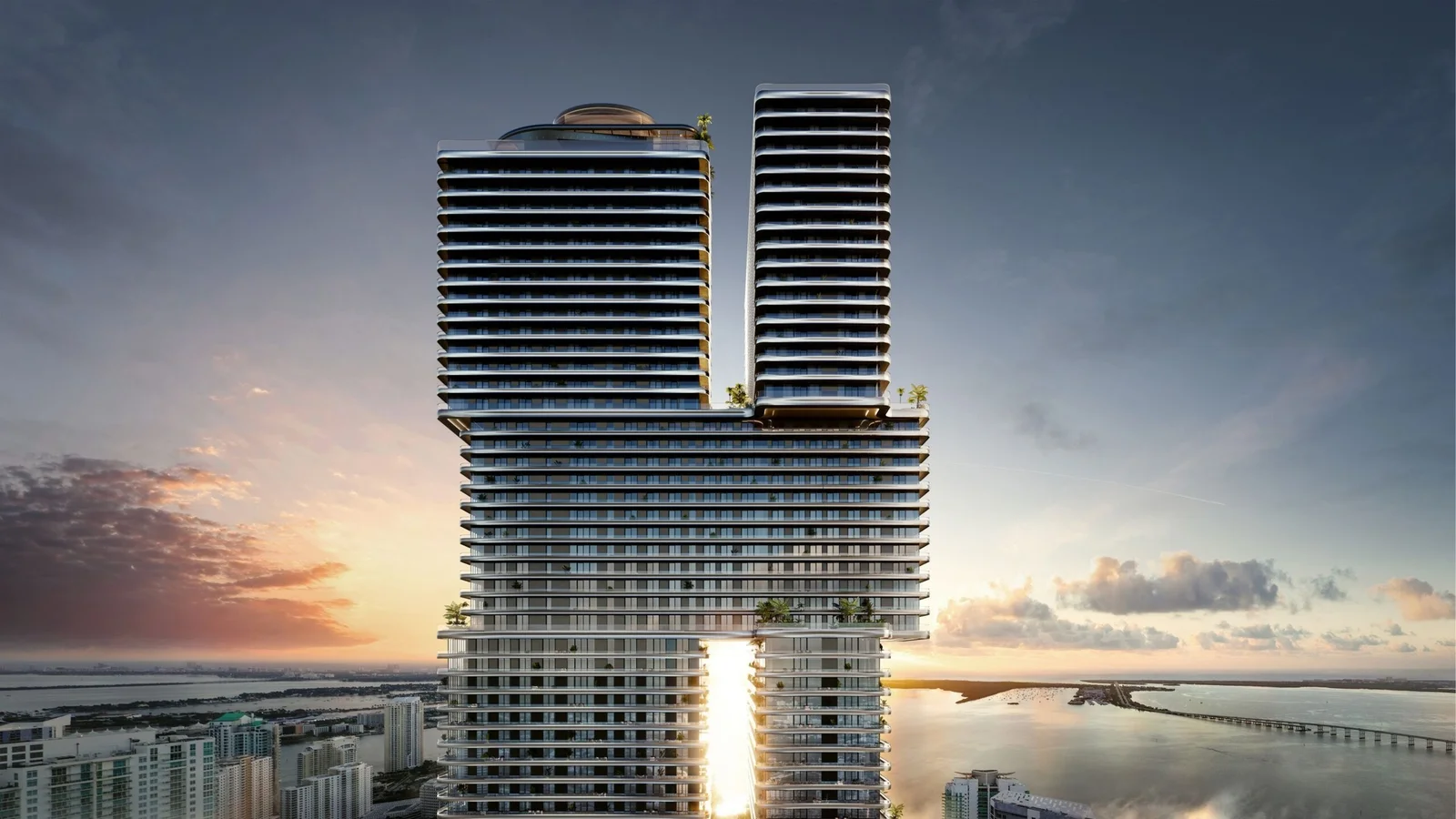
Quick answer: At roughly $1,600 per square foot for delivery in 2028, this project asks a buyer to pay about double what finished Brickell towers trade at today, and to wait two years to take possession. Both halves of that proposition can be reasonable. Neither is obvious. The work is to identify what you are being paid to accept, and in a mixed-use scheme of this scale the answer starts with the financing question, not the finishes.
The price gap, stated plainly
| Building | Status | Approximate price per square foot |
|---|---|---|
| Mercedes-Benz Places | delivering 2028 | about $1,600 |
| One Paraiso | finished 2018 | about $1,330 |
| SLS LUX Brickell | finished 2018 | about $985 |
| Dua Miami, ex SLS Brickell | finished 2016 | about $949 |
| Brickell House | finished 2015 | about $940 |
A buyer here is paying roughly 60 to 70 per cent more per foot than the finished branded stock a few blocks away, for a residence that does not exist yet.
There are legitimate reasons a number can look like that. New construction commands a premium over resale everywhere. The design team is at the top of the market. The scheme includes office and hospitality components that a plain residential tower does not. And 2028 pricing is not 2026 pricing, so part of the gap is a forward view rather than a present valuation.
There is also one illegitimate reason, and it is worth naming: a pre-construction price is set by the developer rather than discovered by the market. It reflects what the sponsor believes buyers will pay, and it is not tested against comparable sales until the building delivers and the first resales trade. That test is the moment pre-construction buyers find out whether the premium was justified.
Neither position is a prediction. The instruction is to know which part of the gap is product and which part is forecast, and to be comfortable holding through the answer.
Mixed use is a financing question first
The scheme runs to approximately 2,500,000 gross square feet and contains office, wellness and hospitality space alongside the 791 residences. That composition is the most consequential fact for a leveraged buyer.
Fannie Mae limits the share of a project’s total space that may be non-residential, and separately treats projects operated as a hotel, offering hotel-type services, or requiring owners to join a rental pool, as ineligible. A scheme of this size with a hospitality component sits directly in the territory those rules address.
| Question to settle | Why it matters |
|---|---|
| Is the residential condominium a legally separate regime from the commercial? | determines whether the non-residential share is even counted against it |
| What percentage of the residential project’s space is non-residential? | drives eligibility under agency limits |
| Are hotel-type services offered to residences? | can make the project ineligible regardless of percentages |
| Is any rental pooling contemplated? | ineligible if required |
If the project is judged non-warrantable at closing, the conventional thirty-year loan is unavailable on every residence. The alternatives are cash, portfolio lending, or a DSCR loan underwritten on rent at 25 to 30 per cent down and above conforming pricing. Overseas buyers work through foreign national mortgage programmes.
Discovering that in 2028, after committing a deposit in 2026, is the worst possible moment. Ask a lender for an indicative view now and ask the sales office for the intended condominium structure in writing.
791 residences arriving at once
Scale is a virtue in fixed-cost terms and a liability at handover, and the second effect is visible in delivered Miami towers already.
When a large project sells out in presale and then completes, a share of those buyers reach closing and choose to sell rather than complete or occupy. At Aston Martin Residences, a 391-residence tower delivered in 2024, roughly 51 units have been listed at once, about one door in eight. That is the resale queue, and it caps pricing until it clears.
A 791-residence project is twice the size. The same proportion would put around a hundred residences on the market simultaneously, all with the same address, the same finishes and the same amenities. For a buyer intending to occupy and hold, that is an irrelevance and possibly an opportunity, since the queue is the best negotiating position the building will offer. For a buyer intending to resell within a few years of delivery, it is the central risk.
Ask two questions before contracting: what share of the project is currently under contract, and what proportion of those contracts are held by buyers outside the United States, since overseas presale buyers historically show a higher rate of reselling at closing rather than completing.
The deposit is the product
In pre-construction the payment schedule matters more than the floor plan, because it defines what you are exposed to and for how long.
Published deposit structures on comparable Miami projects commit 40 per cent or more before closing. At Aria Reserve the North Tower schedule runs 20 per cent at contract, then 5, 10 and 5 per cent at construction milestones, with 60 per cent at closing. Get this project’s schedule in the contract rather than assuming it matches.
Three questions follow:
- Which instalments sit in escrow and which may the developer draw for construction? Florida law distinguishes between them and the contract states which is which.
- What is the outside completion date and what are the buyer’s remedies if it passes? Anticipated 2028 is a target, not an obligation, until the contract says otherwise.
- What happens to your capital in the meantime? It earns nothing, cannot be borrowed against and cannot be let. On a $750,000 studio a 40 per cent commitment is $300,000 idle for two years.
A 2028 completion puts the SB 4-D milestone trigger near 2053, so there is no structural risk to price. The risks here are financial, and unlike structural risk they are front-loaded rather than deferred.
What the project is, on its merits
None of the above is an argument against the scheme. SHoP Architects with ODP, Woods Bagot interiors and Field Operations landscape is a genuinely first-rank team, and JDS Development Group has delivered at scale in New York and Miami. A 67-storey mixed-use tower with office, wellness and hospitality alongside residences is a more ambitious proposition than the single-use towers around it, and Brickell has absorbed ambitious projects well.
The residence range is unusually wide for the price point: studios near $750,000 alongside three-bedroom homes near $3,300,000 means the building will house very different households, which affects both the resident mix and the eventual resale pool.
Insurance and dues cannot be assessed yet because the building does not exist. The developer’s projected budget will exist, and it should be compared line by line with adopted budgets at comparable recent Brickell deliveries, with particular attention to insurance, which has repriced every year since 2022 and is the line most often understated in a pro forma. See the Florida property insurance guide and the Brickell area page for context.
Verification checklist before you sign
- Get the full deposit schedule in the contract and confirm which instalments are escrowed.
- Read the outside completion date and the buyer’s remedies if it passes.
- Ask for the intended condominium structure in writing: how the residential regime is separated from office and hospitality.
- Get an indicative lender view on project eligibility now, including the non-residential share.
- Ask what percentage of residences is under contract and what share of those buyers are overseas.
- Compare the developer’s projected budget with adopted budgets at recent comparable deliveries, especially insurance.
- Confirm the intended rental rules. In pre-construction these are set by the developer and can change before turnover.
Which buyer this project suits
It suits a cash buyer who wants a landmark address by a top-tier design team, can leave 40 per cent or more idle until 2028, and intends to occupy or hold well past delivery. For that buyer the premium per foot is a purchase decision rather than an investment thesis, and it can be entirely rational.
It suits a leveraged or short-horizon buyer poorly. The price per foot is the highest in this series, the balance is financed at unknown future rates, project eligibility is an open question that a mixed-use scheme makes genuinely uncertain, and 791 residences delivering together will produce a resale queue at exactly the moment such a buyer would want to exit. Settle the financing question first. If the answer is that only cash and portfolio buyers can transact here, that fact should inform the price you are willing to pay, not just the loan you apply for.
Frequently Asked Questions
Delivery is anticipated in 2028 at 1133 SW 2nd Avenue, Miami FL 33130. A buyer contracting now is committing to a purchase that completes roughly two years out, with the balance financed at rates that will exist then rather than now.
67 storeys with 791 residences inside a mixed-use scheme of approximately 2,500,000 gross square feet that also contains office, wellness and hospitality space. JDS Development Group is the developer, with architecture by SHoP Architects with ODP, interiors by Woods Bagot and landscape by Field Operations.
Studios start near $750,000 and three-bedroom residences run to about $3,300,000, at an average near $1,600 per square foot. For context, finished Brickell towers such as Dua Miami and SLS LUX trade near $949 and $985 per square foot respectively.
It is the first question to settle. Fannie Mae limits the share of a project's total space that may be non-residential and treats projects operated as a hotel or offering hotel-type services as ineligible. In a 2.5 million square foot mixed-use scheme, how the residential condominium is legally separated from the commercial components determines whether conventional financing is available at all.
Three: the deposit committed before closing earns nothing and is exposed to completion, the balance is financed at unknown future rates, and 791 residences delivering at once creates a resale queue at handover as presale buyers reach closing and choose to sell.
A 2028 completion places the 25-year coastal trigger near 2053. Structural risk is irrelevant here. The risks are financial and they are front-loaded rather than deferred.
Settle the financing question at Mercedes-Benz Places before you contract
Tell us the residence type you are considering. We will come back with the deposit schedule and escrow treatment, the intended condominium structure separating residential from commercial, an indicative lender view on project eligibility, and how the price per foot compares with finished Brickell stock.