Quick answer: The number that decides this purchase is not the asking price. It is 70,000 square feet of amenity divided by 154 residences, which is about 455 square feet of staffed, cooled and insured amenity attached to every home in the building. That ratio is the highest in this series and it arrives every month as association dues near 1.10 dollars per square foot, which on the smallest residence is about 3,400 dollars and on the largest about 11,800. Everything else here is straightforward.
Not Turnberry Ocean Colony
Two buildings on Collins Avenue share most of a name and neither is the other. Turnberry Ocean Club is the 2020 tower at 18501 Collins Avenue. Turnberry Ocean Colony is a separate, earlier, two-tower development.
They have different associations, different dues, different letting rules, different reserve positions and different milestone dates. A comparable set that mixes them is not a comparable set. Search by address and folio, and check which of the two a listing, an appraisal or a sold record actually refers to before you use it.
The amenity ratio is the whole story
| Building | Residences | Amenity space | Amenity per residence |
|---|---|---|---|
| Turnberry Ocean Club | 154 | over 70,000 sq ft across six floors | about 455 sq ft |
| Estates at Acqualina | two towers, low density | extensive | high |
| Jade Signature | 192 | substantial | high |
| Vizcayne | about 846 | conventional | low |
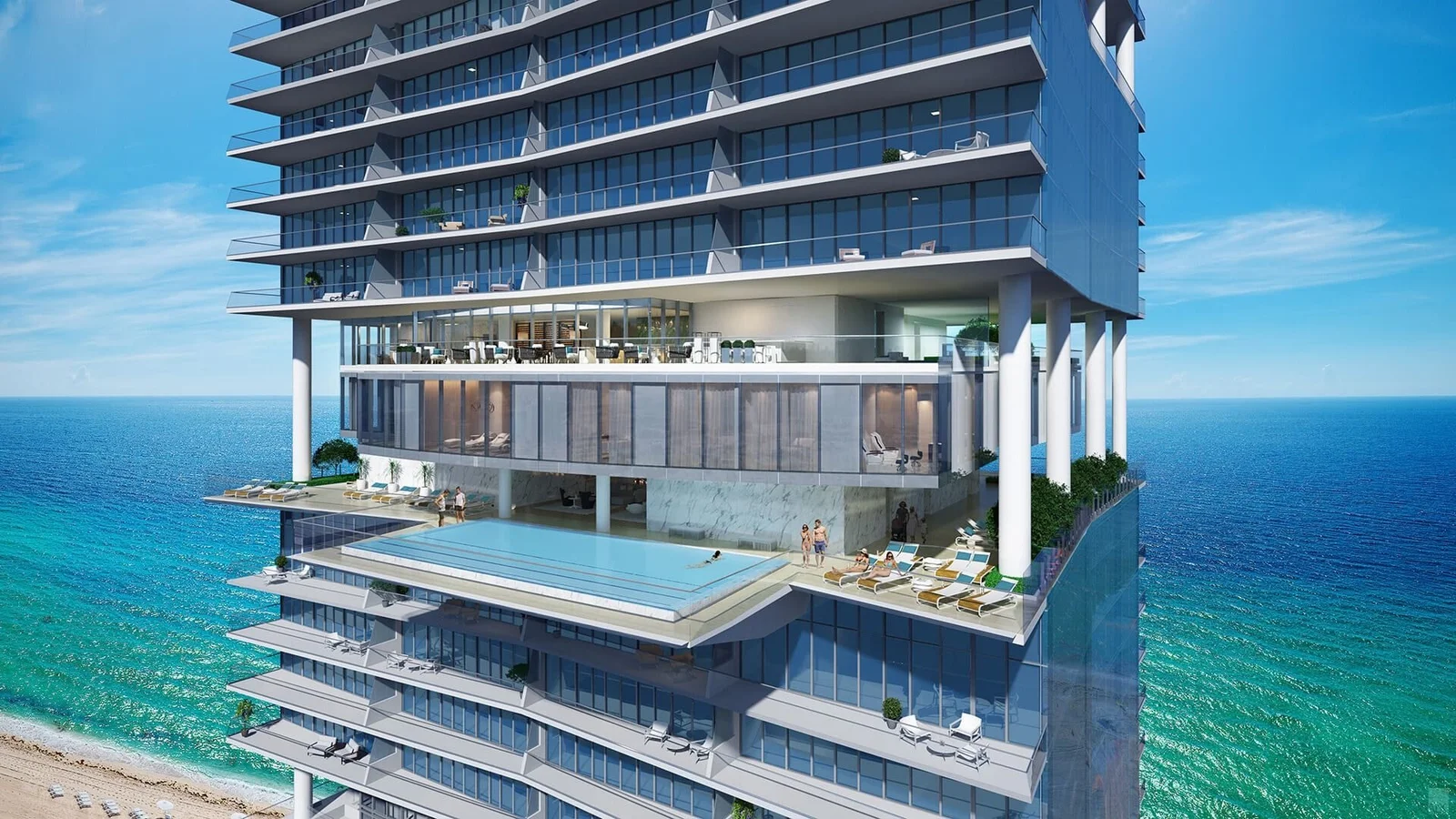
Six floors of the tower are given over to amenity, including the Sky Club at the top of the building. That space does not maintain itself. It is staffed through the day, air conditioned through the year, insured as part of the master policy, cleaned, repaired and eventually refurbished, and every dollar of that reaches owners through the dues.
With 154 residences sharing it, the per-owner share is large by construction. This is the exact inverse of the position at a large tower, where a modest amenity deck divides across several hundred owners and the dues per foot come out low. Neither is better; they are different products with different cost structures, and the ratio above tells you which one you are buying.
What the dues actually cost per year
At approximately 1.10 dollars per square foot per month:
| Residence size | Monthly dues | Annual dues |
|---|---|---|
| 3,110 sq ft | about 3,420 USD | about 41,000 USD |
| 4,500 sq ft | about 4,950 USD | about 59,400 USD |
| 7,000 sq ft | about 7,700 USD | about 92,400 USD |
| 10,750 sq ft | about 11,830 USD | about 142,000 USD |
Dues are one of four annual lines. The others are Miami-Dade property tax, which on a high-value residence is a substantial figure in its own right, an owner’s HO-6 policy covering the interior and personal liability inside the unit, and management if the residence is let or left unoccupied.
Build all four before deciding what this building costs you to hold. The dues alone will understate it by a wide margin, and the dues alone are the only figure a listing shows.
Two lettings a year, six-month floor
Owners may let twice per year with no lease shorter than six months. That places Turnberry Ocean Club in the strict tier alongside most of the Sunny Isles and Bal Harbour oceanfront stock.
The consequence is specific here because of the carrying cost above. A six-month floor removes seasonal letting, which is the one model that could plausibly cover a five- or six-figure annual dues bill in a high-season market. What remains is an annual tenant at whatever the small pool of tenants for a 4,000 square foot oceanfront residence will pay, which is a thin and unpredictable market at this size.
Treat this as a residence with an option to let, not as an asset that produces income. Buyers who want the second thing should look at the buildings in this series with 30-day or 60-day floors and much lower entry costs, where the arithmetic points the other way. Confirm the clause in the recorded declaration with all amendments.
A 2020 building, and what that changes
A 2020 completion places the first milestone inspection near 2045, far outside any normal hold. That removes the question that dominates every older building in this series.
It does not remove the reserve question. The structural integrity reserve study requirement applies regardless of building age, and on a tower with six floors of amenity the components it must cover are numerous and expensive: lifts, pool structures, the amenity fit-out, roof, waterproofing, exterior finishes. Ask for:
| Document | Why it matters here |
|---|---|
| Structural integrity reserve study | scope is unusually large on an amenity-heavy tower |
| Current reserve funding percentage | tells you whether tomorrow’s refurbishment is prepaid |
| Three years of dues history split into reserves and insurance | separates prudence from premium inflation |
| Any developer turnover or construction-defect claim history | a 2020 building may still be inside that window |
That last line matters at this vintage specifically. Buildings completed around 2020 are at the stage where the association has taken control from the developer and where any construction-defect claim would be live. Ask directly whether one exists.
Insurance sits inside the dues
The master policy on an oceanfront tower in Sunny Isles is the single largest variable in the budget, and it has repriced every year since 2022. On a building with 154 owners, a premium increase divides across a small group, so a given dollar rise moves each owner’s dues more than it would at a large tower.
Ask the manager for the master policy premium for each of the last three years as a separate figure, not as part of a total. The trend line tells you more about the next five years of dues than the current number does.
Financing at this price level
Two lender questions apply. Reserve funding, which appears on every project questionnaire since 2021. And investor concentration, which at a building of 154 residences is measured across a small denominator, so a handful of let residences moves the percentage sharply.
Get a written project eligibility determination before offering. Where a project is non-warrantable the conventional thirty-year loan is unavailable building-wide, leaving cash, portfolio lending or a DSCR loan underwritten on rent at a larger deposit. Overseas buyers work through foreign national mortgage programmes. For the wider market see the Sunny Isles area page.
Verification checklist before you wire
- Confirm the listing refers to Turnberry Ocean Club at 18501 Collins Avenue and not Turnberry Ocean Colony.
- Get the current dues per square foot and multiply by your residence size, then add tax, HO-6 and management.
- Request three years of dues history split into reserve contribution and master insurance premium.
- Get the structural integrity reserve study and the current funding percentage.
- Ask whether any construction-defect claim or developer turnover dispute is live.
- Confirm the two-lettings and six-month minimum in the recorded declaration.
- Obtain a written lender project eligibility determination.
Which buyer this building suits
It suits an owner-occupier or second-home buyer who wants low density, flow-through ocean and intracoastal exposure, a very large amenity programme, and who has underwritten a five- or six-figure annual dues bill as the price of that programme rather than as a surprise. On those terms the building delivers exactly what it advertises.
It suits an income buyer poorly. Two lettings a year at a six-month floor, against dues that scale with residence size, is a combination that does not produce yield at any plausible rent. The amenity ratio that makes this building what it is also makes it expensive to hold, and that trade is the decision.
Frequently Asked Questions
No, and confusing the two is the most common error on this address. Turnberry Ocean Club is at 18501 Collins Avenue, a 54-floor tower of 154 residences completed in 2020. Turnberry Ocean Colony is a separate two-tower development further south on Collins Avenue, completed in the 2000s. Different buildings, different associations, different dues, different comparables.
Association dues run near 1.10 dollars per square foot per month. On the smallest residence at about 3,110 square feet that is roughly 3,400 dollars a month, and on the largest at about 10,750 square feet it is roughly 11,800 dollars a month. Confirm the current figure and the three-year history from the association before offering.
The building carries over 70,000 square feet of amenity across six floors, including the Sky Club, and only 154 residences share the cost. That is roughly 455 square feet of serviced amenity for every residence, the highest ratio of any building in this series. Amenity space is not free to run; it is staffed, cooled, insured and maintained out of the dues.
Owners may let a maximum of two times per year with no lease shorter than six months. That is the strict tier and it rules out any seasonal or short-stay model, which matters here because the annual carrying cost is among the highest in Florida.
A 2020 completion places the first milestone inspection near 2045 under the 25-year coastal trigger, well outside a normal hold. The live question at this building is not the inspection date but the structural integrity reserve study, which is required regardless of age and which sets the reserve line inside your dues.
Two to four, and the residences are flow-through, meaning they run from the ocean side through to the intracoastal side. Floor plans run from about 3,110 to about 10,750 interior square feet in three, four, five and six bedroom layouts.
Get the dues history and reserve study at Turnberry Ocean Club
Tell us the residence size you are considering. We will come back with the current dues per square foot applied to that size, three years of history split into reserves and insurance, the reserve funding percentage, any live defect or turnover claim, and the recorded letting clause.